Farmer's Market Find of the Week
Fresh!
Mozzarella. It was real interesting several weeks ago at the Green City Market. A genuine market swept the market. And by interesting I'm not sure if it was that there was market rumors or that it actual reached me, a mere shopper. The rumor, Traders Creamery had fresh mozzarella. Of course by the time it was a rumor, the mozzarella was gone. Since then, or perhaps because of that, I've been a bit obsessed with getting fresh mozzarella at the market. After all it's the peak of tomato season, and this thread has been motivating me anyways. But really, it seems more like finding and buying fresh mozzarella seems like being tipped off by your broker to a real cool IPO. No?
I've mentioned Brunkow cheese before (and coincidentally, Time Out Chicago highlighted them this week as well). They have told me in the past that fresh mozza was just too much week. Until now or shall I say then. The other day. Oak Park Farmer's Market. Saturday Morning. Not cheap ($8/lb), yet this was, well this was the fresh mozz we dream about. I bought two balls. Brunkow uses a bit of vinegar and seals the balls in plastic, so the stuff is not fresh-fresh (he knows), but it still tastes of well contented local cows.
I think there will be some next week.
PS
This book has some great ideas for other things to do with fresh mozzarella. (It's one of my favorites.)
Friday, September 01, 2006
What's Local This Week at Caputo's
What's Local Everywhere
Well before the farmer's market season started, my wife and I would find local food in the oddest of places--like Michigan apples and Minnesota potatoes at the dollar store. I also noted that on any given week, if one looked a bit, one could find something local at your neighborhood market; for instance Caputo's.
Am I just paying attention or is there more focus on local produce?
Whole Foods has realized that there is a 32 degree of food coolness out there, that organic hardly cuts it with the cutting edge foodies. They now offer pamphlets on how they stock local. Recent visits to their store in River Forest, Illinois found much local produce including many vegetables from Wisconsin (local AND organic); peaches from Southern Illinois and some so-so (and expensive) heirloom tomatoes from Michigan. The Seedlings people from Green City (and other markets) have told me that their melons will soon be for sale at Whole Foods (if they are not there now).
Or Sunset Foods on the North Shore. Scroll down their weekly flier to see the ads for local (really local) vegetables.
And my neighborhood Caputo's, plenty of Michigan apples and peaches and plums intertwined with their other produce.
My wife speculates that the stuff was always there; it's just that stores are labeling things more because local food is "in". I'm not sure that's the case. I think because local food is more in, the market has opened up more to local food. Regardless, it's a good thing.
What's Local Everywhere
Well before the farmer's market season started, my wife and I would find local food in the oddest of places--like Michigan apples and Minnesota potatoes at the dollar store. I also noted that on any given week, if one looked a bit, one could find something local at your neighborhood market; for instance Caputo's.
Am I just paying attention or is there more focus on local produce?
Whole Foods has realized that there is a 32 degree of food coolness out there, that organic hardly cuts it with the cutting edge foodies. They now offer pamphlets on how they stock local. Recent visits to their store in River Forest, Illinois found much local produce including many vegetables from Wisconsin (local AND organic); peaches from Southern Illinois and some so-so (and expensive) heirloom tomatoes from Michigan. The Seedlings people from Green City (and other markets) have told me that their melons will soon be for sale at Whole Foods (if they are not there now).
Or Sunset Foods on the North Shore. Scroll down their weekly flier to see the ads for local (really local) vegetables.
And my neighborhood Caputo's, plenty of Michigan apples and peaches and plums intertwined with their other produce.
My wife speculates that the stuff was always there; it's just that stores are labeling things more because local food is "in". I'm not sure that's the case. I think because local food is more in, the market has opened up more to local food. Regardless, it's a good thing.


Thursday, August 31, 2006
Eat Local Challenge
The Spice Conundrum
I make no bones about not being pure to the Local Challenge. When asked/challenged, I pretty quickly throw out coffee and then olive oil. Because the first is crucial to my sanity and the second is necessary to most of my [or especially] my wife's cooking, they are things that always come to mind. If I think about it, however, I would come up with all sorts a other exceptions. A major challenge to the Eat Local Challenge is spices. After all, most spices come from exotic locations like the Malabar Coast or shall I say, "Malabar Coast"--you know what I mean. Surely, one needs spices to cook...or do they?
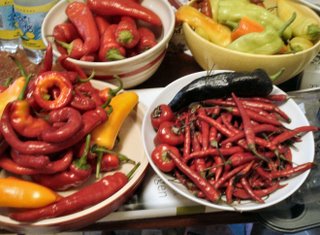 Right now we have peppers coming out of the wazoo. Went to Milwaukee and could not resist the bags of small peppers for a dollar, went to Minnesota and could not resist the bags of small peppers for a dollar--and I bought out the entire supply of micro bell peppers at a quarter each. At Madison I bought a godly amount of Hungarian hot wax because I want to duplicate the vinegar peppers at Old Town Serbian, and Farmer Vicki just keeps on piling them on me. There must have been 25 (at least) various peppers in our box this week.
Many of the peppers we are already drying; from there we can make our own spice powders or chile flakes. Other peppers are going into the freezer or into vinegar. Our intention is to create a slightly new palate to cook from. Of course, we have fresh herbs now and many dried herbs (some we have done ourselves, some from Farmer Vicki). I'm not saying we will never stir up a pot of curry again or dabble in international, spice dependent cuisines, nor would we skip nutmeg in a squash puree or cinnamon in an apple pie, or hell, I'm not skipping fresh cracked pepper on my salads, but over time, it will be a lot less of their spices and a lot more of ours.
The Spice Conundrum
I make no bones about not being pure to the Local Challenge. When asked/challenged, I pretty quickly throw out coffee and then olive oil. Because the first is crucial to my sanity and the second is necessary to most of my [or especially] my wife's cooking, they are things that always come to mind. If I think about it, however, I would come up with all sorts a other exceptions. A major challenge to the Eat Local Challenge is spices. After all, most spices come from exotic locations like the Malabar Coast or shall I say, "Malabar Coast"--you know what I mean. Surely, one needs spices to cook...or do they?
 Right now we have peppers coming out of the wazoo. Went to Milwaukee and could not resist the bags of small peppers for a dollar, went to Minnesota and could not resist the bags of small peppers for a dollar--and I bought out the entire supply of micro bell peppers at a quarter each. At Madison I bought a godly amount of Hungarian hot wax because I want to duplicate the vinegar peppers at Old Town Serbian, and Farmer Vicki just keeps on piling them on me. There must have been 25 (at least) various peppers in our box this week.
Many of the peppers we are already drying; from there we can make our own spice powders or chile flakes. Other peppers are going into the freezer or into vinegar. Our intention is to create a slightly new palate to cook from. Of course, we have fresh herbs now and many dried herbs (some we have done ourselves, some from Farmer Vicki). I'm not saying we will never stir up a pot of curry again or dabble in international, spice dependent cuisines, nor would we skip nutmeg in a squash puree or cinnamon in an apple pie, or hell, I'm not skipping fresh cracked pepper on my salads, but over time, it will be a lot less of their spices and a lot more of ours.
Wednesday, August 30, 2006
Green City Market
August 30, 2006
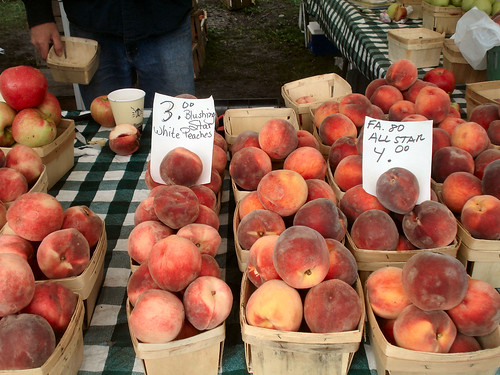
It's always fun to go to a farmer's market, and Green City is generally funner than most because of things found only there. Still, today's market was missing something. It's just that the market the other day in Oak Park seemed so over-flowing. Today's Green City seemed like, well just another week.

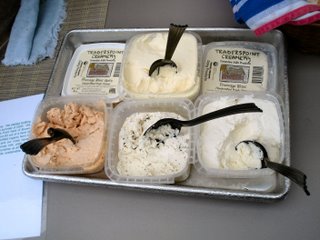
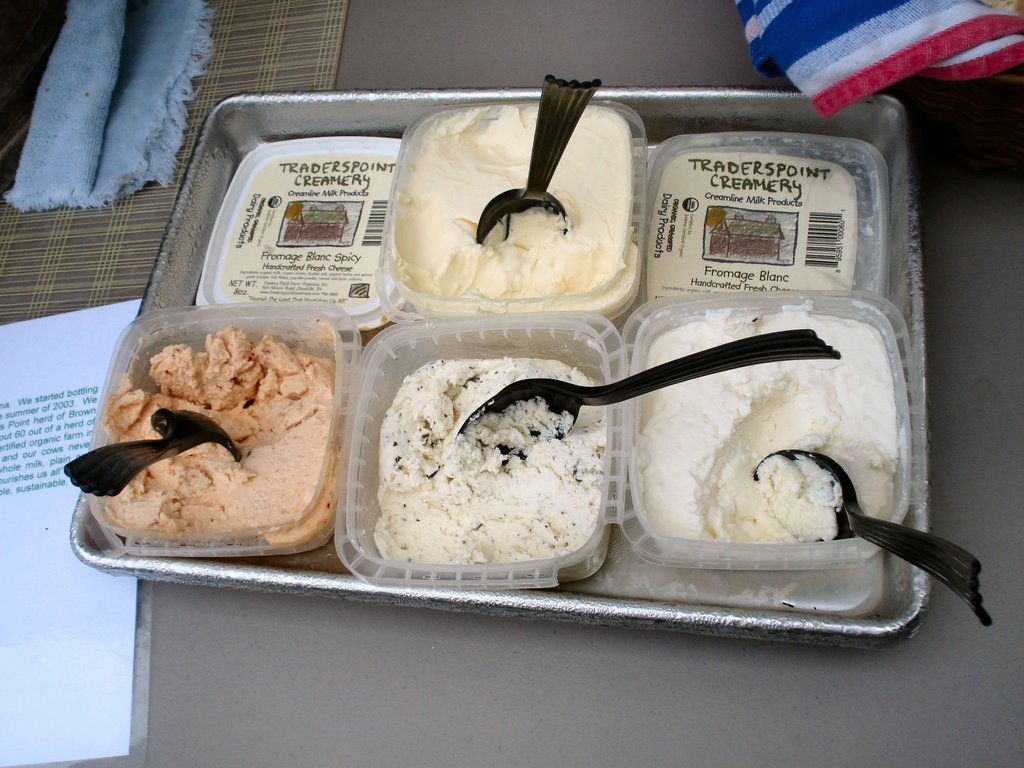
There were a few new spots for the week including the first grapes (no Concords yet) and new stuff from Trader's Creamery--fromage blanc and creme fraiche.
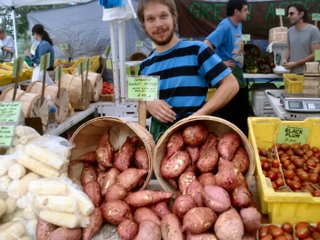
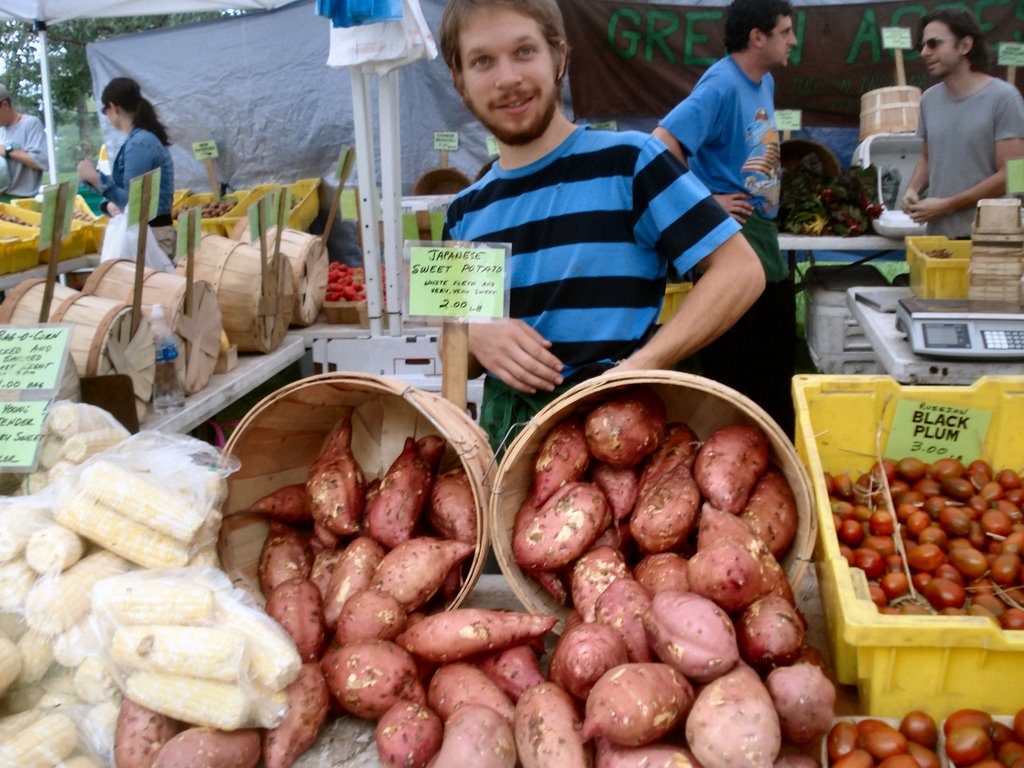
Japanese sweet potatoes are not something you run into too often.
It also seemed like melon week.
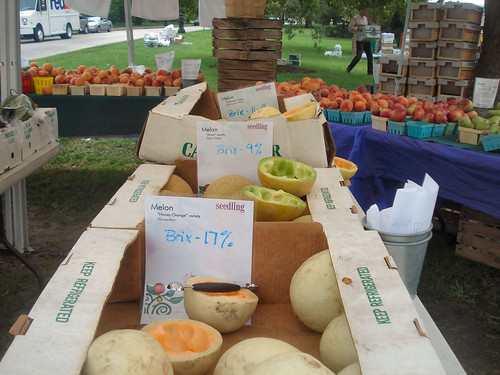
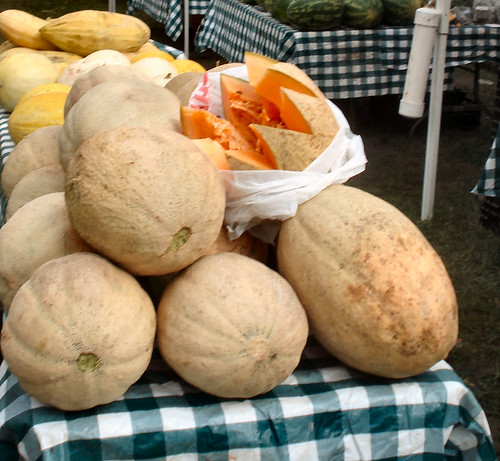
There's always a market for weeds!
Here's a few more shots form this week's market.

August 30, 2006
It's always fun to go to a farmer's market, and Green City is generally funner than most because of things found only there. Still, today's market was missing something. It's just that the market the other day in Oak Park seemed so over-flowing. Today's Green City seemed like, well just another week.

There were a few new spots for the week including the first grapes (no Concords yet) and new stuff from Trader's Creamery--fromage blanc and creme fraiche.
Japanese sweet potatoes are not something you run into too often.
It also seemed like melon week.
There's always a market for weeds!
Here's a few more shots form this week's market.
Monday, August 28, 2006
Oak Park Farmer's Market
The Peak!
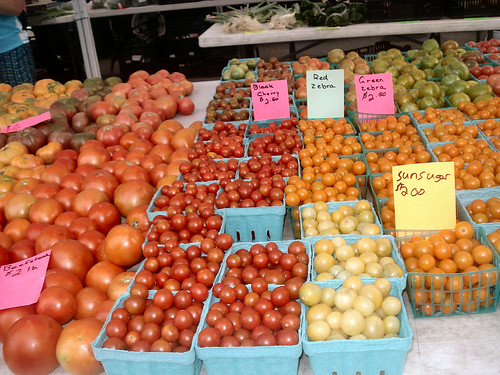
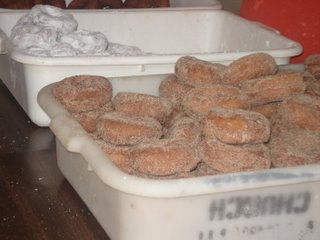
If you ever wanted to see what the fuss was about farmer's markets, now is the time. Summer is still flowing with sweet corn, tomatoes (and more tomatoes) and other fruit/vegetables like eggplants and bell peppers. And oh the fruit, berries, melons, peaches, but also the start of fall: apples and pears.
Enjoy!
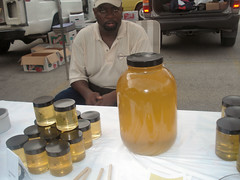
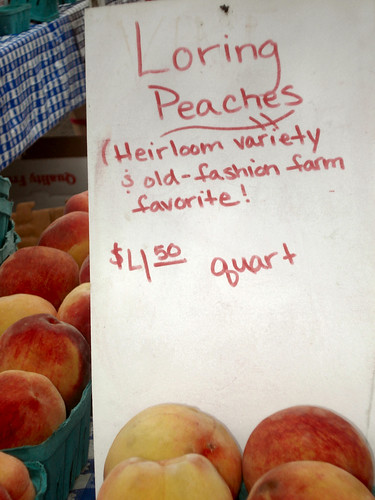
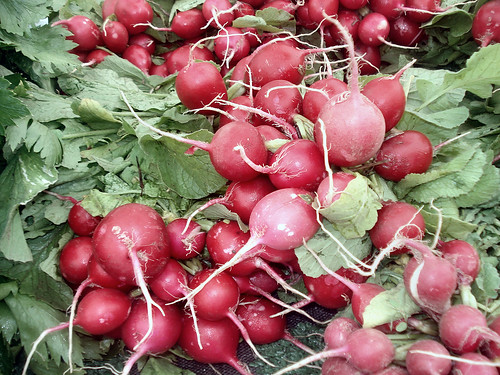
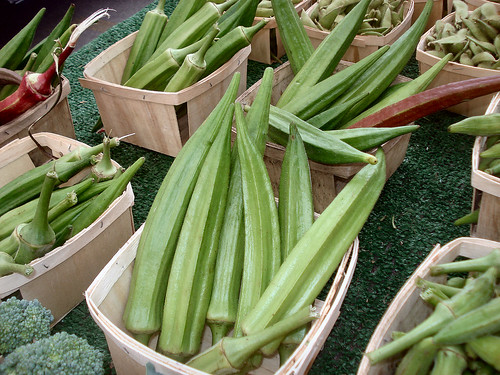
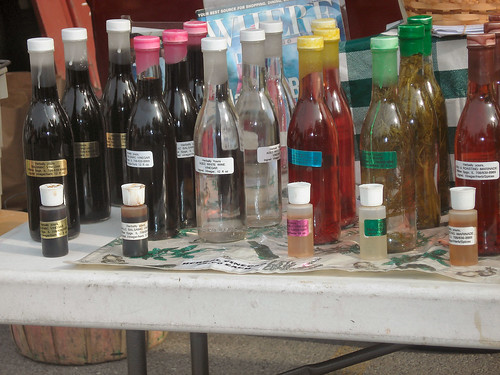
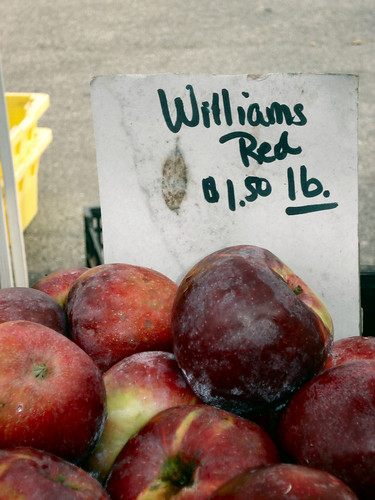
The tomatoes, mostly mini, in the first picture are from Farmer Vicki/Genesis Growers. Below, the okra and radishes come from Nicholl's Farm, the peaches from Hardin Farms and the apples, which are softball sized, come from the stand next to Hardin. The herbed oils are from my friend Jim at Herbally Yours.
Credit to my daughter Sophia for some of these pics (I'm not saying).
The Peak!
If you ever wanted to see what the fuss was about farmer's markets, now is the time. Summer is still flowing with sweet corn, tomatoes (and more tomatoes) and other fruit/vegetables like eggplants and bell peppers. And oh the fruit, berries, melons, peaches, but also the start of fall: apples and pears.
Enjoy!
The tomatoes, mostly mini, in the first picture are from Farmer Vicki/Genesis Growers. Below, the okra and radishes come from Nicholl's Farm, the peaches from Hardin Farms and the apples, which are softball sized, come from the stand next to Hardin. The herbed oils are from my friend Jim at Herbally Yours.
Credit to my daughter Sophia for some of these pics (I'm not saying).
Sunday, August 27, 2006
Monday, August 14, 2006
Eat Local
Friday Fish Fry
The VI family spends a lot of time in Wisconsin. Not the least because it's close, but mostly for the food (or a lot for the food). And one of the main reasons about the food is that Wisconsin is all about eat local. I mean a restaurant recently opened in Madison focusing on Wisconsin cuisine. A great example of eating local is the Friday Fish Fry.
Saveur magazine nicely features Wisconsin fish fries this month. They note the origins of the fish fry came from the mixture of Catholic eating habits and ample stocks of fresh fish. Today, people care less about missing meat on Friday, and in Milwaukee, there aint very much in the way of fresh fish outta Lake Michigan. Most fish fries these days serve Icelandic cod or Alaskan trash fish, I mean pollack. Still, the best fish fries, while not being truly local, are very much local in spirit. That's one of the reason a good fish fry makes such a satisfying meal.
Take Turner Hall. The lake perch comes from Eire, and it is not even on the menu, but it's there and as delicious as lake perch is, breaded in the Wisconsin way instead of dusted as they do in Indiana. With potato pancakes, a sweet cabbage slaw, apple sauce, marble rye and your own pat of Wisconsin butter, everything could have come from Wisconsin if it may or may not have.
The vast double storied, paneled Turner Hall is worth the visit even if the food sucked (which it does not!)
Historic Turner Restaurant/Turner Hall
1034 N 4th St
Milwaukee, WI 53203
(414) 276-4844
(414) 276-0442
Friday Fish Fry
The VI family spends a lot of time in Wisconsin. Not the least because it's close, but mostly for the food (or a lot for the food). And one of the main reasons about the food is that Wisconsin is all about eat local. I mean a restaurant recently opened in Madison focusing on Wisconsin cuisine. A great example of eating local is the Friday Fish Fry.
Saveur magazine nicely features Wisconsin fish fries this month. They note the origins of the fish fry came from the mixture of Catholic eating habits and ample stocks of fresh fish. Today, people care less about missing meat on Friday, and in Milwaukee, there aint very much in the way of fresh fish outta Lake Michigan. Most fish fries these days serve Icelandic cod or Alaskan trash fish, I mean pollack. Still, the best fish fries, while not being truly local, are very much local in spirit. That's one of the reason a good fish fry makes such a satisfying meal.
Take Turner Hall. The lake perch comes from Eire, and it is not even on the menu, but it's there and as delicious as lake perch is, breaded in the Wisconsin way instead of dusted as they do in Indiana. With potato pancakes, a sweet cabbage slaw, apple sauce, marble rye and your own pat of Wisconsin butter, everything could have come from Wisconsin if it may or may not have.
The vast double storied, paneled Turner Hall is worth the visit even if the food sucked (which it does not!)
Historic Turner Restaurant/Turner Hall
1034 N 4th St
Milwaukee, WI 53203
(414) 276-4844
(414) 276-0442
Thursday, August 10, 2006
Towards Better Eating
Two Recent Meals
As I expound and expand on my better eating plan, I thought I would detail two of the meals eaten this week at the VI Bungalow (I'm skipping a third meal as it was practically a repeat of one of the meals.)
A certain repitition of ingredients? Darn right, but these tomatoes are so fleeting and it is best to get our complete fill now. Of course, not only do we eat old fashioned, we live old fashioned, and with limited air conditioning in the Bungalow, these kinda meals are truly seasonal.
Two Recent Meals
As I expound and expand on my better eating plan, I thought I would detail two of the meals eaten this week at the VI Bungalow (I'm skipping a third meal as it was practically a repeat of one of the meals.)
Meal #1
First
Farmer Vicki's hierloom muskmelon with prosciutto (not local I know); also Nicholl's Farm celery stuffed with a mint marscopone blend--this was supposed to be blue cheese, but yes, after several months en fridge, blue cheese does spoil
Second
Caputo's brand linguini with arugula, tomatoes, and hot peppers from Vicki; capers and black olives. Ever hear the expression tasting summer, well this was it.
Third
Fresh Fruit
To Drink
Inspired by Bridgestone's post on LTHForum, we had home made plum "snaps" and then a bottle of Lambrusco, chilled, truly an ideal summer wine.
Meal #2
First
Seedlings peaches, Seedlings who are at Green City and other Markets sell some of the best fruit to be found under Parma ham (again). Still, the experience of peach and ham and muskmelon and ham are so different. The melon is subtle, and you focus on the intensity of the ham. The peaches nearly drown out the ham, and it is a minor key harmony of flavors instead.
Second
Classic summer Caprese salad, what I've been waiting for, for ages. Vicki's heirloom tomatoes, sorry I do not know the variety, they are small and oblong-round with green streaks over a bright red background. With the tomatoes, Freddy's fresh mozza, which LTHForum Italian maven, Antonious, believes it about the tastiest around.
Third
Pasta again, this time with Vicki's patty pan squash and Vicki's heirloom black cherry tomatoes.
Fourth, fresh fruit again. Nicholl's Farm's plums have been especially delicious this year.
To Drink
What else, Prosecco, very cold
A certain repitition of ingredients? Darn right, but these tomatoes are so fleeting and it is best to get our complete fill now. Of course, not only do we eat old fashioned, we live old fashioned, and with limited air conditioning in the Bungalow, these kinda meals are truly seasonal.
Tuesday, August 08, 2006
The Latest in Great Neighborhood Restaurants
The participants of the LTHForum.com site have identified a new group of places considered GNR's or Great Neighborhood Restaurants. Do I love all of the restaurants nominated? Well, maybe there's one or two I do not love, but I love the list, like previous rounds it repersents of range of places that inspire passions in eaters. These are the kinda places I would seek out if I was a visitor to Chicago (or a recent arrival).
The participants of the LTHForum.com site have identified a new group of places considered GNR's or Great Neighborhood Restaurants. Do I love all of the restaurants nominated? Well, maybe there's one or two I do not love, but I love the list, like previous rounds it repersents of range of places that inspire passions in eaters. These are the kinda places I would seek out if I was a visitor to Chicago (or a recent arrival).
For more information, contact:
David Dickson (630) 399-9172, ddickson@rmcis.com
Gary Wiviott, (773) 282-3277
FOR IMMEDIATE RELEASE
Chicago, August 7, 2006 – LTHForum, the Chicago-based culinary society, has announced its latest choices in its semi-annual Great Neighborhood Restaurants program.
A sampling of winners, with comments from LTH members, are:
Scooter's Frozen Custard,1658 W. Belmont Ave.,Chicago
“I am convinced each time I try it that Scooter’s is making the best ‘ice cream’ in Chicago these days... Scooter’s went about it the right way, tasting famous custards from Milwaukee, St. Louis and elsewhere before concocting their own, which tastes like something you grew up on. The creamy richness of Scooter’s makes so many ice creams seem (what else?) plain-vanilla...It is truly a great neighborhood restaurant because the owners are so friendly to everyone.”
Burt's Place [Chicago Style Pan Pizza] 8541 N. Ferris, Morton Grove
“Burt’s cooks a mean pizza in a very unique style, with roots far back into the annals of Chicago Pizza History... Burt has spent over 40 years developing and perfecting his style of pizza. It has a wonderful caramelized crust and the sauce is obviously made from fresh ground tomatoes. The flavor and texture of the crunchy sweet peppers contrasts wonderfully with the warm tangy sauce and melted cheese... Burt and his wife seemed genuinely pleased to serve us pizza, sit and chat, and give a tour of their historic memorabilia.”
Hai Woon Dae [Korean Barbeque] 6240 N California, Chicago
“Live coals have never had it so good as being able to excite Hai Woon Dae’s meat... The perfect Korean barbecue in a nondescript north side strip mall. Real charcoal grills, big tables, tender marinated meats in many varieties, a glorious array of panchan to choose from and a free flow of good, inexpensive soju—I always leave Hai Woon Dae well-fed, a bit rowdy, and happy with my lot in life... One item that may not stand out on the menu is simply called Steamed Eggs. Light, flavorful egg custard, perfect as a starter.”
Sunshine Cafe, (Japanese/non-sushi) 5449 N.. Clark St., Chicago
“This is a very simple restaurant, and yet so warm, quaint and welcoming... Japanese food is more than sushi and sashimi. Home-style cooking (ofukuro-aji, meaning mom’s taste) like this is so under-represented in the city... If grilled mackerel is served in Heaven, I believe this is how it would taste... And if you’re looking for the perfect tempura (crispy, non-greasy), or the perfect bowl of Udon noodle soup, or excellent miso, fantastic sukiyaki, teriyaki, salmon, it’s all here... What a wonderful homey place.”
BomBon Bakery [Mexican bakery] 1508 W. 18th St., Chicago
“The most fabulous bakery I know of in Chicago is BomBon, in Pilsen. I had a slice of a tres leches cake from them last night which could not have been better... They succeed in making every pastry taste equally as wonderful as it looks. Every tart I have sampled is fresh and full of distinct flavors. Their flan is the absolute best I have ever tasted... A Mexican bakery that is artisanal and artful, as well as a true neighborhood place in one of Chicago’s most vibrant neighborhoods.”
Over the history of the awards, winners have represented an eclectic mix, including everything from the most minimalist hot dog stand in town to the most exotic one, from a Japanese restaurant dishing up spiritual experiences in a Korean neighborhood to one serving up Japanese comfort food in Lincolnwood.
Only 21 out of Chicagoland’s nearly 15,000 restaurants received the award in this round of nominations. Previously, 43 other restaurants have been so honored. Awards are based on multiple visits by some of LTHForum’s more than 2,400 registered users.
Said program administrator David Dickson, “We have two primary objectives in doing this. We want be a tool for consumers to find good and adventurous places to eat, and we want to help support deserving restaurants that many might not otherwise have discovered.” He pointed out that LTHForum is an all-volunteer organization, with no financial interest in any of the awardees.
Other recognized restaurants in this round are:
The Hopleaf [Belgian Bar Food] 5148 N. Clark St., Chicago
La Unica [Cuban/Latin] 1515 W. Devon Ave.., Chicago
Spacca Napoli [Neopolitan Pizza] 1769 W. Sunnyside, Chicago
Volo Restaurant & Wine Bar 2008 W. Roscoe St., Chicago
Nuevo Leon Restaurant [Norteño Mexican] 1515 W. 18th St., Chicago
La Casa de Samuel [Mexican/Guerrerense] 2834 W. Cermak, Chicago
Steve's Shish-Kabab [Middle Eastern] 3816 W. 63rd St.,. Chicago
Taqueria Puebla [Mexican/Pueblan] 3619 W. North Ave., Chicago
Calumet Fisheries [seafood, primarily fried or smoked] 95th Street at the Bridge, 3259 E. 9th St., Chicago
San Soo Gap San [Korean Barbeque] 5247 N. Western Ave., Chicago
Sticky Rice [Northern Thai] 4018 N.. Western Ave., Chicago
Priscilla's Ultimate Soul Food Buffet 4330 W. Roosevelt Rd., Hillside
Salam Restaurant {Middle Eastern] 4636 N.. Kedzie Ave. Chicago
Fonda del Mar [Mexican] 3749 W Fullerton Ave. Chicago
El Nuevo Kappy's [Mexican antojitos] 2759 Cermak Rd., Chicago
Shan [Pakistani] 5060-A N. Sheridan Rd., Chicago
Katy's Dumpling House [Hand-pulled Noodles] 665 N. Cass Ave., Westmont
Mandarin Kitchen [Shanghainese] 2143 S. Archer, Chicago
Full details on these restaurants can be found at LTHForum.com, in the “Great Neighborhood Restaurants” section.
Each restaurant was nominated by one of the over 2,400 registered members of LTHForum.com, the Chicago-based culinary chat site, and ratified by the moderators of the board based on the degree of discussion and community-wide enthusiasm from the food-obsessed participants on the site.
LTHforum is a Chicago-based internet chat site and impromptu dining society which has quickly grown to become an influential fixture on the Chicago dining scene, widely read by journalists and chefs eager to know what’s new and what regular diners are saying about the city’s restaurants. Participants, while not ignoring the city’s high-profile restaurants, are particularly adept at finding small, out-of-the-way eateries that many Chicagoans may not be familiar with.
Registered members discuss everything from restaurants to recipes, focusing on Chicago but taking in destinations as far afield as Montreal, Paris, and Xi’an China. Discussions also cover cooking techniques, local sources for unique foodstuffs, and, occasional silliness, such as a recent discussion about the atmosphere on Planet Mongo when visited by Flash Gordon. The site's web address is www.lthforum.com.
#30#
For more information, contact:
David Dickson (630) 399-9172
Gary Wiviott, (773) 282-3277
Monday, August 07, 2006
Eat Local
In the Long Run
When I dived into the eat local fray over a year ago, I did it, I admit, mostly for the challenge. Since my attempts to lose weight had been failing, it would give me a new challenge. Something to do, so to speak. And the thing is, I never really succeeded much as a challenge. I had too many exceptions right from the start. I mean there's that whole eat out exception--that pokes a big hole through the framework; then there's my wine, my coffee, my olive oil, and when the Condiment Queen wanted to pack baby carrots in the kidz lunches, who was I to complain. The less I have cared, however, about the challenge, the more I have succeeded in eating local.
To some extent, I do better at eating locally because I am more committed than ever to the idea, to the benefits. I do best, though, because I have time and experience behind me (and ahead of me). It takes time to know how to eat local, or should I say that it takes experience to eat local. The biggest thing we learned, a big duh moment perhaps, but the biggest thing we learned that was even with two refrigerators, we did not have enough freezer space to effectively stock up. Related to that, we learned that extra freezers hardly cost. Costco had chest models for under $300. We ended up splurging on a huge stand up freezer for less than $500 from Sears. We have been freezing away.
Berries go flat on a tray for a day then into ziplocks; cherries get pitted and then put into various containers; we blanch the vegetables, green beans and asparagus and peas and most of the many ears of corn that arrive each week in the CSA; we will do the first wet pack peaches this week and soon it will be some tomatoes. The volume of the freezer is a luxury we adore. This will be our produce when the harvests end.
We still need time. We know that last year by mid-winter, we had barely any local produce left. Then, we were not even eating in as much, being local enough. Now, we use more but expect to need more. Will we have enough until next spring's first harvests? It will take at least a few years to know how much to store. Eating local is not just a challenge. It is a destination.
In the Long Run
When I dived into the eat local fray over a year ago, I did it, I admit, mostly for the challenge. Since my attempts to lose weight had been failing, it would give me a new challenge. Something to do, so to speak. And the thing is, I never really succeeded much as a challenge. I had too many exceptions right from the start. I mean there's that whole eat out exception--that pokes a big hole through the framework; then there's my wine, my coffee, my olive oil, and when the Condiment Queen wanted to pack baby carrots in the kidz lunches, who was I to complain. The less I have cared, however, about the challenge, the more I have succeeded in eating local.
To some extent, I do better at eating locally because I am more committed than ever to the idea, to the benefits. I do best, though, because I have time and experience behind me (and ahead of me). It takes time to know how to eat local, or should I say that it takes experience to eat local. The biggest thing we learned, a big duh moment perhaps, but the biggest thing we learned that was even with two refrigerators, we did not have enough freezer space to effectively stock up. Related to that, we learned that extra freezers hardly cost. Costco had chest models for under $300. We ended up splurging on a huge stand up freezer for less than $500 from Sears. We have been freezing away.
Berries go flat on a tray for a day then into ziplocks; cherries get pitted and then put into various containers; we blanch the vegetables, green beans and asparagus and peas and most of the many ears of corn that arrive each week in the CSA; we will do the first wet pack peaches this week and soon it will be some tomatoes. The volume of the freezer is a luxury we adore. This will be our produce when the harvests end.
We still need time. We know that last year by mid-winter, we had barely any local produce left. Then, we were not even eating in as much, being local enough. Now, we use more but expect to need more. Will we have enough until next spring's first harvests? It will take at least a few years to know how much to store. Eating local is not just a challenge. It is a destination.
Friday, August 04, 2006
Towards Eating Better
Quality Ingredients
There are a lot of cooking shows on TV. And books, plenty of cook books. I think people think they can eat better if they learn to cook better. I am also pretty sure that cooking can be improved. Often to cook better, takes just a bit of improvement, a little knife technique, pans just a bit hotter, leaving things alone long enough for crust; seasoning... Still, the improved cooking only goes so far. Eating better means more than better cooking.
Restaurants cook well. Even at Jimmy Johns, they know how to cook. Restaurants cook in ways you cannot. They have mis en place, which is another way of saying they have a lot of time to prepare, to slice evenly, fix stocks, and make things easier to cook. Restaurants also have technology, not the least the paco jets and odd contraptions of the avante garde. I mean true convection ovens and 1800 degree broilers and big ass pots (which really aint so hi-tech but makes a difference). The home cook who reads all the books and watches all the shows can only get so far. Or ask yourself, does it really matter that the people at Cheesecake Factory know how to cook. The home cook, however, has a secret weapon, the tomato.
If you eat out today or tomorrow or any day next week, look at the tomato. Does it seem like a tomato. Like a tomato you could get. Like a tomato you would eat? Long story short, quality ingredients are available to the home cook, especially in ways not very available at restaurant eating. If you seek out and obtain quality ingredients, you will eat well. This is our weapon; our source for great eating.
Some quality ingredients are easily accessible and add little cost. Trader Joe's sells outstanding estate olive oil for no more than average EVOO costs. Or take butter, is there any product that can be so good, add so much, with so little added cost? Some times it takes a bit more money and some times it takes a lot more money to obtain quality ingredients. Farmer's market stuff, from eggs to fruits to vegetables cost more, but it's not that much more. On the other hand, prime-aged steaks cost a lot more money than Jewel Angus. Some quality ingredients are too expensive or barely available to the home cook, think caviar of foie gras. Seafood, especially here in Chicago, I would argue, it is nearly impossible to get true quality seafood at home. All this means, cater your diet, your menus towards what you can get and what you want to pay.
Quality ingredients are not difficult to find or afford. Taste the difference. Eat better by making the effort to get quality ingredients.
Quality Ingredients
There are a lot of cooking shows on TV. And books, plenty of cook books. I think people think they can eat better if they learn to cook better. I am also pretty sure that cooking can be improved. Often to cook better, takes just a bit of improvement, a little knife technique, pans just a bit hotter, leaving things alone long enough for crust; seasoning... Still, the improved cooking only goes so far. Eating better means more than better cooking.
Restaurants cook well. Even at Jimmy Johns, they know how to cook. Restaurants cook in ways you cannot. They have mis en place, which is another way of saying they have a lot of time to prepare, to slice evenly, fix stocks, and make things easier to cook. Restaurants also have technology, not the least the paco jets and odd contraptions of the avante garde. I mean true convection ovens and 1800 degree broilers and big ass pots (which really aint so hi-tech but makes a difference). The home cook who reads all the books and watches all the shows can only get so far. Or ask yourself, does it really matter that the people at Cheesecake Factory know how to cook. The home cook, however, has a secret weapon, the tomato.
If you eat out today or tomorrow or any day next week, look at the tomato. Does it seem like a tomato. Like a tomato you could get. Like a tomato you would eat? Long story short, quality ingredients are available to the home cook, especially in ways not very available at restaurant eating. If you seek out and obtain quality ingredients, you will eat well. This is our weapon; our source for great eating.
Some quality ingredients are easily accessible and add little cost. Trader Joe's sells outstanding estate olive oil for no more than average EVOO costs. Or take butter, is there any product that can be so good, add so much, with so little added cost? Some times it takes a bit more money and some times it takes a lot more money to obtain quality ingredients. Farmer's market stuff, from eggs to fruits to vegetables cost more, but it's not that much more. On the other hand, prime-aged steaks cost a lot more money than Jewel Angus. Some quality ingredients are too expensive or barely available to the home cook, think caviar of foie gras. Seafood, especially here in Chicago, I would argue, it is nearly impossible to get true quality seafood at home. All this means, cater your diet, your menus towards what you can get and what you want to pay.
Quality ingredients are not difficult to find or afford. Taste the difference. Eat better by making the effort to get quality ingredients.
Tuesday, August 01, 2006
Towards Eating Better
About sometime in 2001 I began posting reports on restaurants on the Internets. One reason I had a lot to say about restaurants is that I ate out a lot. I still eat out a lot, but not nearly as much. One of the reasons I eat more at home, is that I have really grown to enjoy how we are eating (at home). So, I thought I would share some reasons why our home eating has become so enjoyable.
Now, the forthcoming posts will surely reveal no secrets, and some of the ideas may have been worked a bit already at this site--do you know about eating local? Moreover, I fear I will sound banal and rather dorky, but I'll give it a try. Many, nay most of the things to be presented may be done or known, like you need VI to tell ya, but maybe, maybe I'll provoke an idea or two. Maybe, maybe there will be a few aha moments that will add pleasure to your meals. For these are not about big changes or cooking tips: hey cut the vegetables uniformly so they cook evenly. They are about marginal changes, changes at the fringes. Details, things that can be done at home a lot easier that can change a meal.
I risk the fool for another reason. I believe that one of the problems Americans have with food, and with the resulting food related illnesses, is the fact that we do not eat organically and naturally and for pleasure and enjoyment. And while I think organic/natural in a Euell Gibbons meets Whole Foods is good (very good), I'm not talking about that. I mean eating in a way that is natural to the flow of life and family, that fits into schedules yet is not a slave to schedules. Think of the patterns of traditional Spanish eating, to take something seemingly extreme, yet this way of eating developed to fit with the Spanish climate. Natural, I mean cooking and eating with the foodstuffs around, in season, again as you find in other cuisine's. I believe the way these other peoples approach food and eating is the primary reason they are healthier than us and surely look a lot better.
About sometime in 2001 I began posting reports on restaurants on the Internets. One reason I had a lot to say about restaurants is that I ate out a lot. I still eat out a lot, but not nearly as much. One of the reasons I eat more at home, is that I have really grown to enjoy how we are eating (at home). So, I thought I would share some reasons why our home eating has become so enjoyable.
Now, the forthcoming posts will surely reveal no secrets, and some of the ideas may have been worked a bit already at this site--do you know about eating local? Moreover, I fear I will sound banal and rather dorky, but I'll give it a try. Many, nay most of the things to be presented may be done or known, like you need VI to tell ya, but maybe, maybe I'll provoke an idea or two. Maybe, maybe there will be a few aha moments that will add pleasure to your meals. For these are not about big changes or cooking tips: hey cut the vegetables uniformly so they cook evenly. They are about marginal changes, changes at the fringes. Details, things that can be done at home a lot easier that can change a meal.
I risk the fool for another reason. I believe that one of the problems Americans have with food, and with the resulting food related illnesses, is the fact that we do not eat organically and naturally and for pleasure and enjoyment. And while I think organic/natural in a Euell Gibbons meets Whole Foods is good (very good), I'm not talking about that. I mean eating in a way that is natural to the flow of life and family, that fits into schedules yet is not a slave to schedules. Think of the patterns of traditional Spanish eating, to take something seemingly extreme, yet this way of eating developed to fit with the Spanish climate. Natural, I mean cooking and eating with the foodstuffs around, in season, again as you find in other cuisine's. I believe the way these other peoples approach food and eating is the primary reason they are healthier than us and surely look a lot better.
Monday, July 31, 2006
Eat Local
Local Pride
There are many, many great reasons to eat local. I fully believe in the environmental, political, biological and economical reasons to eat local, but even if you don't, you should eat local if you enjoy eating. Now, at times, I feel I am trusting my instinct, or even worse, blind faith, when it comes to endorsing local products. Through various circumstances, I've had non-local cherries and nectarines and corn this summer, and I know, well for the most part, the stuff sucked when compared to farmer's market stuff, but for the most part I have no real sample population to fully know that my local food is, in fact, better. Which is why I appreciate a bit of national love.
First, there's our hot dogs. A few weeks ago, I was watching the new American Eats show on the History channel, and I was surprised to learn that 95% of hot dogs eaten nationwide were skinless. My daughter, in one of those proud papa moments that makes it worthwhile to be a papa, immediately recognized that she was firmly in that 5%, eating pretty much only skinned or real hot dogs. And now comes Michael Rulhman in this month's Gourmet to confirm. He declares Vienna the best commercial hot dog in the country. Take that!
Then, there's our cheese and dairy. Via Eating L.A., I got the results of the latest American Cheese Society competition (pdf). Sure, Cabot of Vermont took the top prize, but the list of winners is loitered with local purveyors: Upland, Rothkase, Carr Valley, of course, but also Leelanau of Michigan and Trader's Creamery (yeah, that yoghurt is the best); there are many more Wisconsin cheese guys. My friends at Brunkow got an award for they cheese spread and I expect next year, they will get a few more awards with their new cheeses. Crave Brothers Farmstead, Burnett Dairy Cooperative, Hook's Cheese, Mount Sterling, and Blue Mont Dairy were other winners from Wisconsin.
When you eat local, you have the chance to eat some of the best food. Fer sure.
Local Pride
There are many, many great reasons to eat local. I fully believe in the environmental, political, biological and economical reasons to eat local, but even if you don't, you should eat local if you enjoy eating. Now, at times, I feel I am trusting my instinct, or even worse, blind faith, when it comes to endorsing local products. Through various circumstances, I've had non-local cherries and nectarines and corn this summer, and I know, well for the most part, the stuff sucked when compared to farmer's market stuff, but for the most part I have no real sample population to fully know that my local food is, in fact, better. Which is why I appreciate a bit of national love.
First, there's our hot dogs. A few weeks ago, I was watching the new American Eats show on the History channel, and I was surprised to learn that 95% of hot dogs eaten nationwide were skinless. My daughter, in one of those proud papa moments that makes it worthwhile to be a papa, immediately recognized that she was firmly in that 5%, eating pretty much only skinned or real hot dogs. And now comes Michael Rulhman in this month's Gourmet to confirm. He declares Vienna the best commercial hot dog in the country. Take that!
Then, there's our cheese and dairy. Via Eating L.A., I got the results of the latest American Cheese Society competition (pdf). Sure, Cabot of Vermont took the top prize, but the list of winners is loitered with local purveyors: Upland, Rothkase, Carr Valley, of course, but also Leelanau of Michigan and Trader's Creamery (yeah, that yoghurt is the best); there are many more Wisconsin cheese guys. My friends at Brunkow got an award for they cheese spread and I expect next year, they will get a few more awards with their new cheeses. Crave Brothers Farmstead, Burnett Dairy Cooperative, Hook's Cheese, Mount Sterling, and Blue Mont Dairy were other winners from Wisconsin.
When you eat local, you have the chance to eat some of the best food. Fer sure.
Friday, July 28, 2006
Farmer's Market Buy of the Week
My weekly Oak Park Farmer's Market is nigh perfect: organic produce, some really cool cheese guys, Wisconsin wheat, visits from the Wettsteins, fresh donuts; but it is not totally perfect. A source for Wisconsin maple syrup and more grain options would make it that much easier to eat local. And I cannot partake further in this week's But of the Week.
Green Acres Farm, from North Judson Indiana is at the Wednesday Green City Market and the Saturday Evanston Market. I am not sure if they are at the Saturday Green City Market. I really wish they'd stop by Oak Park. They have some of the most interesting inventory at the market, including many varieties of radishes, peppers and edible weeds. They surely have the biggest collection of ethnic type produce. And prices, did I mention prices? This week's Buy of the Week is organic garlic for 50 cent a head.
Anyone know if garlic is freezable?
My weekly Oak Park Farmer's Market is nigh perfect: organic produce, some really cool cheese guys, Wisconsin wheat, visits from the Wettsteins, fresh donuts; but it is not totally perfect. A source for Wisconsin maple syrup and more grain options would make it that much easier to eat local. And I cannot partake further in this week's But of the Week.
Green Acres Farm, from North Judson Indiana is at the Wednesday Green City Market and the Saturday Evanston Market. I am not sure if they are at the Saturday Green City Market. I really wish they'd stop by Oak Park. They have some of the most interesting inventory at the market, including many varieties of radishes, peppers and edible weeds. They surely have the biggest collection of ethnic type produce. And prices, did I mention prices? This week's Buy of the Week is organic garlic for 50 cent a head.
Anyone know if garlic is freezable?
Tuesday, July 25, 2006
Good Potatoes Bring Out Good Poets
or
The Simple Truth
I'm not much of a poetry person. I never "got" Hammond's tamal poem (scroll down). Still, I was pretty impressed when, after I mentioned on LTHForum.com that the best thing I ate recently was some of Farmer Vicki's red potatoes, I got a poem in the mail.
Finish here and thank Jason.
or
The Simple Truth
I'm not much of a poetry person. I never "got" Hammond's tamal poem (scroll down). Still, I was pretty impressed when, after I mentioned on LTHForum.com that the best thing I ate recently was some of Farmer Vicki's red potatoes, I got a poem in the mail.
I bought a dollar and a half's worth of small red potatoes,
took them home, boiled them in their jackets
and ate them for dinner with a little butter and salt.
Then I walked through the dried fields
on the edge of town. In middle June the light
hung on in the dark furrows at my feet,
and in the mountain oaks overhead the birds
were gathering for the night, the jays and mockers
squawking back and forth, the finches still darting
into the dusty light. The woman who sold me
the potatoes was from Poland; she was someone
out of my childhood in a pink spangled sweater and sunglasses
praising the perfection of all her fruits and vegetables
at the road-side stand and urging me to taste
even the pale, raw sweet corn trucked all the way,
she swore, from New Jersey. "Eat, eat" she said,
"Even if you don't I'll say you did."
Some things
Finish here and thank Jason.
Thursday, July 20, 2006
Critically Critical of Critic's Critic
I was a bit surprised that the grand old daddy of Chicago food bloggers, Paul of Foodblog, was not included in today's Chicago Tribune report of bloggers and their pics. Paul surely shoots with the best of 'em. So, I go there this morning to see what the Trib's been missing, and I find this link to a critical analysis of Chicago food critics.
Now, surely the world of Chicago food critics could use some criticism no? Granted, the Phil Vettel Game's been mostly retired as he seems to be working harder with the new At Play section, but could a review of food critics not notice the weeks that pass without Vettel action? What about the failure of the biggies to cover ethnic and neighborhood eating--consigning these to the hyper-segmented Cheap Eats reviews for instance.
What's worse, is this piece seems oddly, weirdly, out of date. It's been a while since Laura Levy Shatkin's pieces were the leads in the Reader's restaurant reviews. Worse, how could a critic's critic not love last week's Reader take-down of Mulan in Chinatown. In fact, the fact that the Reader gives you the good the bad and the ugly in dining options a reason to cheer it on? Or Time Out Chicago, again, you have range and variety that's not noted. Is not James Ward gone. Did he ever matter given his obviousness? Who reads or cares about Sherman Kaplan or "biweekly student newspaper Chicago Business."
The food media in Chicago can use a critic.
I was a bit surprised that the grand old daddy of Chicago food bloggers, Paul of Foodblog, was not included in today's Chicago Tribune report of bloggers and their pics. Paul surely shoots with the best of 'em. So, I go there this morning to see what the Trib's been missing, and I find this link to a critical analysis of Chicago food critics.
Now, surely the world of Chicago food critics could use some criticism no? Granted, the Phil Vettel Game's been mostly retired as he seems to be working harder with the new At Play section, but could a review of food critics not notice the weeks that pass without Vettel action? What about the failure of the biggies to cover ethnic and neighborhood eating--consigning these to the hyper-segmented Cheap Eats reviews for instance.
What's worse, is this piece seems oddly, weirdly, out of date. It's been a while since Laura Levy Shatkin's pieces were the leads in the Reader's restaurant reviews. Worse, how could a critic's critic not love last week's Reader take-down of Mulan in Chinatown. In fact, the fact that the Reader gives you the good the bad and the ugly in dining options a reason to cheer it on? Or Time Out Chicago, again, you have range and variety that's not noted. Is not James Ward gone. Did he ever matter given his obviousness? Who reads or cares about Sherman Kaplan or "biweekly student newspaper Chicago Business."
The food media in Chicago can use a critic.
Monday, July 17, 2006
Organic Farming is Hard and Other Reasons to be Blogging
Blogging is quite Newtonian. A blog that stays in motion stays in motion and a blog stuck in inertia, well no one goes there any more. It’s not like I have been away from the Internets. I wrote long takes on Las Vegas high and low, and I made by contribution to the LTHForum GNR program here. Still, it has been almost two months between blog posts. But Farmer Vicki and her farm, to the blog!
It’s been two years since I last visited a working farm. As I noted then, if you are a chowhound, if you love to eat and live to eat, you owe it to yourself to visit a farm. Your tasty dinner has to start somewhere. Genesis Growers enjoys none of the scenery of Henry’s Farm. This IS what Illinois looks like. Flat. Parcels of land divvied up long ago. Conventional farms, soy and corn surround Vicki, and if she is concerned enough to irrigate with tape, across the street they use a very big sprinkler—my lawn obsessed neighbor would really be jealous. Ok, this was not about the view. It was about learning how to farm, organically.
What you learn: it’s hard. There are weeds. Weeds battle the crops. Always. A dragging tractor gets about all the weeds. That is a percentage, however, that farmer’s cannot handle. Vanquish weeds. Work. Vicki and her crew take daily to the fields with special European hoes, square rings on the end of long poles, and hoe, hoe, hoe. Try it. We visitors did. Twenty minutes and I had my workout of the day. Do that all day? Beyond the weeds, what about what’s left. Wander a field of, say cucumbers, and you see there is no easy way to get those things beyond stooping. On top of that, there are prickles. With so much effort involved, organic vegetables are a real bargain.
I did learn a bit more about organic farming (beyond that: it’s hard). I learned that there are bands of yearly shifting weeds. The whole field cannot be turned over to crops. Keeping some weeds is necessary for various botanical purposes, but they also serve as resting spots, spas, for the other pests. In other words, they are temptations for the bugs so they do not eat the real crops. Of course, with organic farming you can eat the weeds too. Already a couple of times our weekly box included a big bag of lamb’s quarters, seen at Green City Market as “wild spinach.” We were promised purslane soon, which we munched on after we got tired of trying to hoe. An organic farm is very alive. There was catnip growing near the stream and wild raspberries and elderberry for this guy. I picked up one weed that looked edible, mint-like, and I learned that I was right; Vicki’s Mexican farmers knew it and used it. They gave me the name in Spanish but I forgot already.
What else.
Do not take the lack of blogging to mean that I have given up on eating local. Perhaps, when something becomes so natural, so innate, the there is less thrill in writing about it. Our Spring CSA took through June. It was not a great Spring for crops. Vicki had bad maggot problems that ate into a lot of crops. We actually had to rely a bit more than expected on freezer stuff and local potatoes found at odd spots.
June began a very abundant new CSA from Genesis. As promised, we are getting more each week than we can possibly eat. The only problem, a few things are not right for the freezer. Can you say too much lettuce. On the other hand, I mistakenly made a salad of escarole this week. We supplement the box with Oak Park Farmer’s Market, better than ever and trips to other farmer’s markets. Take a recent dinner. First, bruschetta, the ciabatta bought at Wednesday’s Green City Market; tomatoes from Genesis Growers hoop house, meaning ground grown; snips of arugula from Growing Power Farm, only the condiments not local. Second, sautéed chicken livers from the market, mushrooms from the market, over pasta not from the market. Last, market raspberries and teeny-tiny strawberries. If you enjoy eating well, you need to eat local.
The best thing: we recently purchased a freezer. We purchased some canning supplies too, but the freezer, that we can do. We are starting now, now. Plenty of asparagus has gone in the freezer, blanched first as has some rhubarb (also blanched) and berries, many berries. My other method of saving, infused vodkas. Strawberries work especially well for this as it only takes a few days to produce a gorgeous liquor.
Another best thing: Thank you Ann Fisher in the comments. If you ask Tony at the Scotch Hills farm stand (Oak Park Farmer’s Market), he might have some five pound bags of Wisconsin grown soft wheat. Makes a great clafoutis. His eggs are pretty good too.
More soon.
Blogging is quite Newtonian. A blog that stays in motion stays in motion and a blog stuck in inertia, well no one goes there any more. It’s not like I have been away from the Internets. I wrote long takes on Las Vegas high and low, and I made by contribution to the LTHForum GNR program here. Still, it has been almost two months between blog posts. But Farmer Vicki and her farm, to the blog!
It’s been two years since I last visited a working farm. As I noted then, if you are a chowhound, if you love to eat and live to eat, you owe it to yourself to visit a farm. Your tasty dinner has to start somewhere. Genesis Growers enjoys none of the scenery of Henry’s Farm. This IS what Illinois looks like. Flat. Parcels of land divvied up long ago. Conventional farms, soy and corn surround Vicki, and if she is concerned enough to irrigate with tape, across the street they use a very big sprinkler—my lawn obsessed neighbor would really be jealous. Ok, this was not about the view. It was about learning how to farm, organically.
What you learn: it’s hard. There are weeds. Weeds battle the crops. Always. A dragging tractor gets about all the weeds. That is a percentage, however, that farmer’s cannot handle. Vanquish weeds. Work. Vicki and her crew take daily to the fields with special European hoes, square rings on the end of long poles, and hoe, hoe, hoe. Try it. We visitors did. Twenty minutes and I had my workout of the day. Do that all day? Beyond the weeds, what about what’s left. Wander a field of, say cucumbers, and you see there is no easy way to get those things beyond stooping. On top of that, there are prickles. With so much effort involved, organic vegetables are a real bargain.
I did learn a bit more about organic farming (beyond that: it’s hard). I learned that there are bands of yearly shifting weeds. The whole field cannot be turned over to crops. Keeping some weeds is necessary for various botanical purposes, but they also serve as resting spots, spas, for the other pests. In other words, they are temptations for the bugs so they do not eat the real crops. Of course, with organic farming you can eat the weeds too. Already a couple of times our weekly box included a big bag of lamb’s quarters, seen at Green City Market as “wild spinach.” We were promised purslane soon, which we munched on after we got tired of trying to hoe. An organic farm is very alive. There was catnip growing near the stream and wild raspberries and elderberry for this guy. I picked up one weed that looked edible, mint-like, and I learned that I was right; Vicki’s Mexican farmers knew it and used it. They gave me the name in Spanish but I forgot already.
What else.
Do not take the lack of blogging to mean that I have given up on eating local. Perhaps, when something becomes so natural, so innate, the there is less thrill in writing about it. Our Spring CSA took through June. It was not a great Spring for crops. Vicki had bad maggot problems that ate into a lot of crops. We actually had to rely a bit more than expected on freezer stuff and local potatoes found at odd spots.
June began a very abundant new CSA from Genesis. As promised, we are getting more each week than we can possibly eat. The only problem, a few things are not right for the freezer. Can you say too much lettuce. On the other hand, I mistakenly made a salad of escarole this week. We supplement the box with Oak Park Farmer’s Market, better than ever and trips to other farmer’s markets. Take a recent dinner. First, bruschetta, the ciabatta bought at Wednesday’s Green City Market; tomatoes from Genesis Growers hoop house, meaning ground grown; snips of arugula from Growing Power Farm, only the condiments not local. Second, sautéed chicken livers from the market, mushrooms from the market, over pasta not from the market. Last, market raspberries and teeny-tiny strawberries. If you enjoy eating well, you need to eat local.
The best thing: we recently purchased a freezer. We purchased some canning supplies too, but the freezer, that we can do. We are starting now, now. Plenty of asparagus has gone in the freezer, blanched first as has some rhubarb (also blanched) and berries, many berries. My other method of saving, infused vodkas. Strawberries work especially well for this as it only takes a few days to produce a gorgeous liquor.
Another best thing: Thank you Ann Fisher in the comments. If you ask Tony at the Scotch Hills farm stand (Oak Park Farmer’s Market), he might have some five pound bags of Wisconsin grown soft wheat. Makes a great clafoutis. His eggs are pretty good too.
More soon.
Thursday, May 18, 2006
A Swing and a Miss
Or the Perils of Straying
What a price I pay for being non-local. And I am not talking about the $15 for a chunk of fresh mozzarella. We went to Caputo’s Cheese Market in Melrose Park intending to eat local. Asparagus purchased that day at Chicago’s Green City Market, steamed; topped with a farm egg, fried in local butter. All we needed to accent, the smallest portion of imported Parmesan Regianno. We could have used local, heck Kraft is based in the Chicago area, but we are snobs. We had to have the real thing.
There are days when you do not feel like shopping, and there are days when the money’s burning a hole in your pocket. We went to Green City in a shopping mood. We expected to get all the foods to enhance our Eat Local efforts that have been hard to get of late. Local meat, local eggs, and especially, local grains. Surely, because it took me an hour to go from Damen and North to actually shopping at the market, having to fork over $4 to boot for a parking space, I was not predisposed towards liking the market. We found our grain guy, Wilmont Milling, who stone grinds in Indiana, missing. (He would be there on Saturdays.) Some of our favorite meat guys, like Land Connection/Wettstein and Milwaukee’s Growing Power (for their chickens) were not there. All of a sudden, the prices seemed high, the selections not what we wanted. We got the barest of necessities: winterized parsnips, chives with flower, and the harbinger, asparagus; also some delicious apple butter from Seedlings, equally delicious goat cheese from Prairie Fruits Farm and equally equally delicious cheeses (butterkase and cheddar) from Prairie Pure Cheese. Plus, the littlest of meat purchases, chicken livers and ham hocks from Twin Oaks Meat.
Our quench to buy exploded at Caputo’s. It started local, a giant (and I mean giant) torpedo of Wisconsin Provolone beckoned. We grabbed a chunk. Then a chunk of this, a chunk of that. So many cheeses at these prices, mostly $5/lb (or less), shrink wrapped for time, we got local and not local. Then, we got to the fresh mozza. Caputo’s makes their own, and they have won the blue ribbon several times at the Illinois State Fair. What were we thinking when we saw giant balls of imported mozzarella di buffalo. Well, I was thinking, how fresh could it be? They told me it had come in just today. Could that be true? I took them on their word. Go for it. Splurge.
We re-wrote the menu. Out the Lombard style asparagus (scroll down for the recipe). In, a deli style dinner focused on our imported mozzarella. We assumed that this one outstanding ingredient would dominate the meal. To accent, we got a few slices of Parma ham, some eggplant salad and some weird spinach pancakes that would be our hot course. We had good crusty bread, pickled vegetables and olives at home. It seemed like a good meal, and only later did I realize I was subconsciously imitating Johnny Apple from earlier in the day (reg. required).
It started with the mozzarella. It just did not blow me away. There was a complexity to it. It tasted a bit more like goat cheese. Still, the flavors were muted. There was no epiphany. It drove the whole meal down. It did not help that the spinach pancakes were awful, the eggplant salad dry. I liked the ham a lot but it was a losing battle. Some times you have an idea and it does not work. Every time I drag my family to some new restaurant that sucks, I say, you have to kiss some frogs to find your prince. Not a restaurant per se but a frog nonetheless. And what happens, I suppose when we go non-local.
Or the Perils of Straying
What a price I pay for being non-local. And I am not talking about the $15 for a chunk of fresh mozzarella. We went to Caputo’s Cheese Market in Melrose Park intending to eat local. Asparagus purchased that day at Chicago’s Green City Market, steamed; topped with a farm egg, fried in local butter. All we needed to accent, the smallest portion of imported Parmesan Regianno. We could have used local, heck Kraft is based in the Chicago area, but we are snobs. We had to have the real thing.
There are days when you do not feel like shopping, and there are days when the money’s burning a hole in your pocket. We went to Green City in a shopping mood. We expected to get all the foods to enhance our Eat Local efforts that have been hard to get of late. Local meat, local eggs, and especially, local grains. Surely, because it took me an hour to go from Damen and North to actually shopping at the market, having to fork over $4 to boot for a parking space, I was not predisposed towards liking the market. We found our grain guy, Wilmont Milling, who stone grinds in Indiana, missing. (He would be there on Saturdays.) Some of our favorite meat guys, like Land Connection/Wettstein and Milwaukee’s Growing Power (for their chickens) were not there. All of a sudden, the prices seemed high, the selections not what we wanted. We got the barest of necessities: winterized parsnips, chives with flower, and the harbinger, asparagus; also some delicious apple butter from Seedlings, equally delicious goat cheese from Prairie Fruits Farm and equally equally delicious cheeses (butterkase and cheddar) from Prairie Pure Cheese. Plus, the littlest of meat purchases, chicken livers and ham hocks from Twin Oaks Meat.
Our quench to buy exploded at Caputo’s. It started local, a giant (and I mean giant) torpedo of Wisconsin Provolone beckoned. We grabbed a chunk. Then a chunk of this, a chunk of that. So many cheeses at these prices, mostly $5/lb (or less), shrink wrapped for time, we got local and not local. Then, we got to the fresh mozza. Caputo’s makes their own, and they have won the blue ribbon several times at the Illinois State Fair. What were we thinking when we saw giant balls of imported mozzarella di buffalo. Well, I was thinking, how fresh could it be? They told me it had come in just today. Could that be true? I took them on their word. Go for it. Splurge.
We re-wrote the menu. Out the Lombard style asparagus (scroll down for the recipe). In, a deli style dinner focused on our imported mozzarella. We assumed that this one outstanding ingredient would dominate the meal. To accent, we got a few slices of Parma ham, some eggplant salad and some weird spinach pancakes that would be our hot course. We had good crusty bread, pickled vegetables and olives at home. It seemed like a good meal, and only later did I realize I was subconsciously imitating Johnny Apple from earlier in the day (reg. required).
It started with the mozzarella. It just did not blow me away. There was a complexity to it. It tasted a bit more like goat cheese. Still, the flavors were muted. There was no epiphany. It drove the whole meal down. It did not help that the spinach pancakes were awful, the eggplant salad dry. I liked the ham a lot but it was a losing battle. Some times you have an idea and it does not work. Every time I drag my family to some new restaurant that sucks, I say, you have to kiss some frogs to find your prince. Not a restaurant per se but a frog nonetheless. And what happens, I suppose when we go non-local.
Tuesday, May 16, 2006
A Tale of Two Non-Local Dinners
In the Same Night
With a Non-Local Treat
If you know anything about the Omega, the mega-Greek Coffee Shop in Des Plaines, you would find it hard to believe that I was still hungry after dinner. Yet there I was, driving down Cumberland looking for something interesting because, yea, I was still hungry. Many (many) years ago, Mike G asked how. Not how I could still be hungry after eating dinner, but how one finds interesting eats. He focused on Mexican restaurants, but it was a good question for any restaurant. What do people look for when they are out chowhounding. Me, I’m a sucker for signs I cannot read. In languages I cannot recognize.
So, I U-Turned and pulled into this strip mall in Norridge, intrigued by what exactly was Tasty World. There were two especially pale cones of gyro. I did not want that. I quizzed the fetching girl with green eye shadow. She showed me a tri-part menu with value meals across the range of Chicago fast food. I tried to figure out a way to ask nicely. The sign, what the hell does it say. What the hell language is that. Which is what I finally blurted out (or something to that extent). Bulgarian. Bulgarian she admitted. She told me that the sign roughly translated as tasty cheap treats, or Bulgarian fast food. But where was the Bulgarian on the menu. “Oh, this menu,” she showed me—in Bulgarian Cyrillic. She kindly read me the list.
Mousaka, tripe soup, sausage, Bulgarian burgers shaped either long or in patties, a few other things. I got the burgers, one in each shape. It came with, as my daughter noted, Bulgarian ketchup, think red, but thicker and spicier; an onion heavy salad with bottled dressing and crinkle-cut fries (something Ms. Green Eye shadow was especially keen on). It was supposed to be the same meat, but I liked the round patty better. The onion flavor seemed more pronounced and integrated in the meat, a more complex product. It was, as advertised, cheap but tasty food.
Like I say, I should not be hungry after Omega. I mentioned to Pigmon yesterday how I (oddly) loved this place. He zeroed in right away on what made it appeal to me but not him. Vegas. Eating at Omega is like eating at one of the Vegas buffets before they went gourmet. If you know Las Vegas, think Station Casino. Of course, there is no buffet, they just bring the food. Completes start with big bread baskets, croissants, muffins, soft rolls, then soup, salad, big portions of your main, starch, vegetable and finally a dessert that neither looks nor tastes too special but fits properly in this meal. Few people, even me, eat a complete. Rather, we split.
While I love Omega, I really limit myself to a few offerings. My favorite is what I split with my daughter the other night, Greek style skirt steak. I like the meat and its lemony-oregano bath, but I also like (nay love), the Greek salad offered with this dinner. Again, this is like the buffet comes to the table, a big mass of feta fingers, peppers, anchovies, thick vegetables and a creamy, hearty dressing. I just wish they’d dry the lettuce better. It’s not just the gluttony that makes Omega Vegas. It is the crowd. It is my people. Alter-kocker heaven. The loud kibitz, the duds, the packing away the rolls to go, well you just will not find this kinda place very much longer. Appreciate it while you can.
Finally, a purchase far from the Eat Local Challenge; in the same strip mall as Tasty World is a small Middle-Eastern market called City Food. They were selling tiny-tart green plums from California. I figured how much degradation of product could something supposed to be picked too young, to green be? If anything was meant to be shipped, was this not it?
Tasty World
4834 N. Cumberland
Norridge, IL
708-453-2725
Omega Restaurant
9100 N Golf
Des Plaines
847-296-7777
City Food & Grocery
4832 N Cumberland Ave
Norridge, IL 60706
(708) 453-1899
In the Same Night
With a Non-Local Treat
If you know anything about the Omega, the mega-Greek Coffee Shop in Des Plaines, you would find it hard to believe that I was still hungry after dinner. Yet there I was, driving down Cumberland looking for something interesting because, yea, I was still hungry. Many (many) years ago, Mike G asked how. Not how I could still be hungry after eating dinner, but how one finds interesting eats. He focused on Mexican restaurants, but it was a good question for any restaurant. What do people look for when they are out chowhounding. Me, I’m a sucker for signs I cannot read. In languages I cannot recognize.
So, I U-Turned and pulled into this strip mall in Norridge, intrigued by what exactly was Tasty World. There were two especially pale cones of gyro. I did not want that. I quizzed the fetching girl with green eye shadow. She showed me a tri-part menu with value meals across the range of Chicago fast food. I tried to figure out a way to ask nicely. The sign, what the hell does it say. What the hell language is that. Which is what I finally blurted out (or something to that extent). Bulgarian. Bulgarian she admitted. She told me that the sign roughly translated as tasty cheap treats, or Bulgarian fast food. But where was the Bulgarian on the menu. “Oh, this menu,” she showed me—in Bulgarian Cyrillic. She kindly read me the list.
Mousaka, tripe soup, sausage, Bulgarian burgers shaped either long or in patties, a few other things. I got the burgers, one in each shape. It came with, as my daughter noted, Bulgarian ketchup, think red, but thicker and spicier; an onion heavy salad with bottled dressing and crinkle-cut fries (something Ms. Green Eye shadow was especially keen on). It was supposed to be the same meat, but I liked the round patty better. The onion flavor seemed more pronounced and integrated in the meat, a more complex product. It was, as advertised, cheap but tasty food.
Like I say, I should not be hungry after Omega. I mentioned to Pigmon yesterday how I (oddly) loved this place. He zeroed in right away on what made it appeal to me but not him. Vegas. Eating at Omega is like eating at one of the Vegas buffets before they went gourmet. If you know Las Vegas, think Station Casino. Of course, there is no buffet, they just bring the food. Completes start with big bread baskets, croissants, muffins, soft rolls, then soup, salad, big portions of your main, starch, vegetable and finally a dessert that neither looks nor tastes too special but fits properly in this meal. Few people, even me, eat a complete. Rather, we split.
While I love Omega, I really limit myself to a few offerings. My favorite is what I split with my daughter the other night, Greek style skirt steak. I like the meat and its lemony-oregano bath, but I also like (nay love), the Greek salad offered with this dinner. Again, this is like the buffet comes to the table, a big mass of feta fingers, peppers, anchovies, thick vegetables and a creamy, hearty dressing. I just wish they’d dry the lettuce better. It’s not just the gluttony that makes Omega Vegas. It is the crowd. It is my people. Alter-kocker heaven. The loud kibitz, the duds, the packing away the rolls to go, well you just will not find this kinda place very much longer. Appreciate it while you can.
Finally, a purchase far from the Eat Local Challenge; in the same strip mall as Tasty World is a small Middle-Eastern market called City Food. They were selling tiny-tart green plums from California. I figured how much degradation of product could something supposed to be picked too young, to green be? If anything was meant to be shipped, was this not it?
Tasty World
4834 N. Cumberland
Norridge, IL
708-453-2725
Omega Restaurant
9100 N Golf
Des Plaines
847-296-7777
City Food & Grocery
4832 N Cumberland Ave
Norridge, IL 60706
(708) 453-1899
Thursday, May 11, 2006
Seek This Out
(or $3.69 Very Well Spent)
Also know as pudding with cherries or cherry cake. Actually a babka, or yeast cake, in a aluminum round mold. I'm no baker, so maybe I should not say this, but I always feel that yeast cakes are cheating a bit. Those little microbes do all the hard work to make the cake fluffy, light and moist. And $3.69. Get two!
Avenue Food Mart is near the top of my favorite Polish supermarkets. It is one of many new school supermarkets that have opened in Chicago in recent years, combining the best of ethnic markets with the scale and presentation of a supermarket. Like any Polish market worth its salt, it has a great selection of deli meats. I swoon over the six or so kinda headchease, including ones dedicated just to tongue or just to ears even if I would never order. I do frequently get the turkey, the various hams, the Hungarian salami, and different cheeses. They offer two versions of pickled herring, in winegar [sic] and oil. With value, they weigh and price the herring, then add a good amount of onion garnish. There is Amish organic chicken and really fantastic sour pickles--maybe the best I have had in Chicago. It is a place worth seeking.
Avenue Food Mart
6850 W. Belmont
Chicago, IL
773-286-0606
(or $3.69 Very Well Spent)
Pudding z owocami-wisnie at Avenue Food Mart
Also know as pudding with cherries or cherry cake. Actually a babka, or yeast cake, in a aluminum round mold. I'm no baker, so maybe I should not say this, but I always feel that yeast cakes are cheating a bit. Those little microbes do all the hard work to make the cake fluffy, light and moist. And $3.69. Get two!
Avenue Food Mart is near the top of my favorite Polish supermarkets. It is one of many new school supermarkets that have opened in Chicago in recent years, combining the best of ethnic markets with the scale and presentation of a supermarket. Like any Polish market worth its salt, it has a great selection of deli meats. I swoon over the six or so kinda headchease, including ones dedicated just to tongue or just to ears even if I would never order. I do frequently get the turkey, the various hams, the Hungarian salami, and different cheeses. They offer two versions of pickled herring, in winegar [sic] and oil. With value, they weigh and price the herring, then add a good amount of onion garnish. There is Amish organic chicken and really fantastic sour pickles--maybe the best I have had in Chicago. It is a place worth seeking.
Avenue Food Mart
6850 W. Belmont
Chicago, IL
773-286-0606
Wednesday, May 10, 2006
It Takes a Community to Eat Well
On Chowhound.com's site board, Jim Leff argues against community:
True? Compare the trove on Chicago's Chowhound Board to LTHForum.com I have longed believe that a great community leads exactly to better eating, and the rich content of LTHForum surely shows that.
I know, to most Chicago foodies, this seems like a battle long over. That does not mean I cannot still point out how right we were, no?
On Chowhound.com's site board, Jim Leff argues against community:
The more we maintain a super tight focus on compiling a data trove rather than being a conventional social network, the better we'll all eat. And that's the goal.
True? Compare the trove on Chicago's Chowhound Board to LTHForum.com I have longed believe that a great community leads exactly to better eating, and the rich content of LTHForum surely shows that.
I know, to most Chicago foodies, this seems like a battle long over. That does not mean I cannot still point out how right we were, no?
Tuesday, May 09, 2006
Tyranny of the Fresh
I knew one person who liked canned peas, my grandfather. He is, though, no culinary hero of mine. He went years on the same three meals: poached egg on toast for breakfast; (American) cheese sandwich on toast for lunch; and plain hamburger, baked potato and canned peas for dinner. His condiment, his sole condiment for all this food, salt. Pale mushy peas and their evil cousin pale mushy green beans are the foods that leap to most people’s mind when you say canned. Begin an Eat Local Challenge in any month, and a segment of foodies will declare, “well only if my farmer’s market was open” or “we are down to a few things in our market.” Even in California there are fallow periods (there are, aren’t there?). That’s because we are trained to expect fresh. How can they eat local if there is no fresh? The inventories of our stores convince us that we should have a fresh product. We have fallen victim to the tyranny of the fresh.
People are scarred of canned. Andy Warhol may have famously painted soup cans, but where in the museum do you see a still life with canned peaches? Consumers want their supermarkets to sell fresh, a year round supply of fresh tomatoes, fresh berries, fresh heads of lettuce, and fresh bell peppers in assorted colors. This is supposed to be real food. Never mind the environmental impact of a grape hauled into town from Chile, a tomato that has to be gassed to look red, let’s just talk about flavor.
What do we get as fresh. Whole Foods labels told me the other day that their pretty bell peppers, their vivid red tomatoes with tight green "vines", came from Canada. What does that mean. It means hydroponic. It means all of the flavor, all of what a vegetable should taste like is gone. On the other hand, take something out of the freezer. Food scientist Harold McGee notes that food picked at its peaked, properly frozen, is of higher quality than food picked off-ripe to survive long shipping. Besides, the places that can supply you with off-season products are not the optimum places for the products. Is Florida really the area where blueberries prosper? Yet, the market demands blueberries in March, and farmer’s can coax something round and blue out of the ground in March down there. Because most of the supermarket inventory comes from California, we get the impression that the best vegetables grow in California. Yes, great vegetables grow in California. Not what find in your supermarket. It is just that vegetables grow in California. Period. How many people realize that Green Giant is based in Minnesota, Birdseye started in Massachusetts. This is not to say that our food conglomerates do not harvest around the world, it’s just, I think, it points out that the stuff worth preserving, often does not come from California. Extrapolate that back to fresh vs. frozen. Does this convince you that fresh is not always the best product?
Here’s three ways I battled the tyranny of the fresh last week: 1) canned strawberries preserved in syrup; 2) frozen red peppers cooked into a frittata and 3) candied preserved pear as part of an ice cream flavor. Three different ways of putting things away, by can, by freeze, by drying/candying. The strawberries, well they had that real, that true strawberry flavor so unfamiliar to most eaters. The peppers taste of sun of summer. The pears made every cliché of “explodes with flavor” and “burst in your mouth” go through my head. Sure, there were textural issues. The strawberries are soft, seeds more noticeable; the peppers flaccid, the pear gummy, but why do we need all of our foods to have the dry, static texture of fresh. You could not dip canned strawberries in brown sugar or make a salad of the red peppers. So. Find dishes that match the food, for instance over ice cream as Vie served the strawberries. The Elmwood Park shop, Massa, expertly mixed the candied pears with Nutella into a mascarpone gelato base. My wife, the Condiment Queen, knew how to use the peppers.
If we remove ourselves from the tyranny of the fresh, we can eat local without the farmer’s market being open. We do not need to rely on someone else, on weather, on seasons. Obviously, one cannot march into this battle wily-nily. But this is not a “how-to” post. There’s plenty of time for that. Before taking the time, the effort, the capital to start preserving your food, you have to enlist. You have to become a conscript against the tyranny. Wallow in conserved foods. Realize you can eat a peach in February, just not a fresh peach. Maybe you will even develop a taste for canned peas.
I knew one person who liked canned peas, my grandfather. He is, though, no culinary hero of mine. He went years on the same three meals: poached egg on toast for breakfast; (American) cheese sandwich on toast for lunch; and plain hamburger, baked potato and canned peas for dinner. His condiment, his sole condiment for all this food, salt. Pale mushy peas and their evil cousin pale mushy green beans are the foods that leap to most people’s mind when you say canned. Begin an Eat Local Challenge in any month, and a segment of foodies will declare, “well only if my farmer’s market was open” or “we are down to a few things in our market.” Even in California there are fallow periods (there are, aren’t there?). That’s because we are trained to expect fresh. How can they eat local if there is no fresh? The inventories of our stores convince us that we should have a fresh product. We have fallen victim to the tyranny of the fresh.
People are scarred of canned. Andy Warhol may have famously painted soup cans, but where in the museum do you see a still life with canned peaches? Consumers want their supermarkets to sell fresh, a year round supply of fresh tomatoes, fresh berries, fresh heads of lettuce, and fresh bell peppers in assorted colors. This is supposed to be real food. Never mind the environmental impact of a grape hauled into town from Chile, a tomato that has to be gassed to look red, let’s just talk about flavor.
What do we get as fresh. Whole Foods labels told me the other day that their pretty bell peppers, their vivid red tomatoes with tight green "vines", came from Canada. What does that mean. It means hydroponic. It means all of the flavor, all of what a vegetable should taste like is gone. On the other hand, take something out of the freezer. Food scientist Harold McGee notes that food picked at its peaked, properly frozen, is of higher quality than food picked off-ripe to survive long shipping. Besides, the places that can supply you with off-season products are not the optimum places for the products. Is Florida really the area where blueberries prosper? Yet, the market demands blueberries in March, and farmer’s can coax something round and blue out of the ground in March down there. Because most of the supermarket inventory comes from California, we get the impression that the best vegetables grow in California. Yes, great vegetables grow in California. Not what find in your supermarket. It is just that vegetables grow in California. Period. How many people realize that Green Giant is based in Minnesota, Birdseye started in Massachusetts. This is not to say that our food conglomerates do not harvest around the world, it’s just, I think, it points out that the stuff worth preserving, often does not come from California. Extrapolate that back to fresh vs. frozen. Does this convince you that fresh is not always the best product?
Here’s three ways I battled the tyranny of the fresh last week: 1) canned strawberries preserved in syrup; 2) frozen red peppers cooked into a frittata and 3) candied preserved pear as part of an ice cream flavor. Three different ways of putting things away, by can, by freeze, by drying/candying. The strawberries, well they had that real, that true strawberry flavor so unfamiliar to most eaters. The peppers taste of sun of summer. The pears made every cliché of “explodes with flavor” and “burst in your mouth” go through my head. Sure, there were textural issues. The strawberries are soft, seeds more noticeable; the peppers flaccid, the pear gummy, but why do we need all of our foods to have the dry, static texture of fresh. You could not dip canned strawberries in brown sugar or make a salad of the red peppers. So. Find dishes that match the food, for instance over ice cream as Vie served the strawberries. The Elmwood Park shop, Massa, expertly mixed the candied pears with Nutella into a mascarpone gelato base. My wife, the Condiment Queen, knew how to use the peppers.
If we remove ourselves from the tyranny of the fresh, we can eat local without the farmer’s market being open. We do not need to rely on someone else, on weather, on seasons. Obviously, one cannot march into this battle wily-nily. But this is not a “how-to” post. There’s plenty of time for that. Before taking the time, the effort, the capital to start preserving your food, you have to enlist. You have to become a conscript against the tyranny. Wallow in conserved foods. Realize you can eat a peach in February, just not a fresh peach. Maybe you will even develop a taste for canned peas.
Saturday, May 06, 2006
Eat Local Challenge
On the Radio Today
For those interested in the eat local movement, Jen M, the instigator and workaholic of the Eat Local Blog, will be on the radio today--the Tom Douglas show in Seatle. There will be no archive, but if anyone is bored this afternoon, with a good connection, here's the url:
http://www.710kiro.com/
Here's the url for the Douglas show:
http://www.tomdouglas.com/
On the Radio Today
For those interested in the eat local movement, Jen M, the instigator and workaholic of the Eat Local Blog, will be on the radio today--the Tom Douglas show in Seatle. There will be no archive, but if anyone is bored this afternoon, with a good connection, here's the url:
http://www.710kiro.com/
Here's the url for the Douglas show:
http://www.tomdouglas.com/
Thursday, May 04, 2006
The Box
Spring CSA Week 5
We did not subscribe to the spring CSA from Farmer Vicki in anticipation of the May Eat Local Challenge, but having the CSA surely makes the challenge that much easier. In the Chicago area, it will still be a few weeks before the first farmer's markets open. Vicki, however, using greenhouse technology provides me and her subscribers with a big box of produce each week. And because of the greenhouse, our box includes, of all things in early May (for this part of the world), zucchini.
Last week's box seemed like a bit of more of the same. This week, the box took a nice detour. New for the week, for the season, well beyond the freaky zucchini, was sorrel and a cabbage. Repeats were more breakfast radishes and white icicle radishes and the ever present carrots and green onions. The bag of mixed greens this week was labeled spicy mesculun instead of just plain mesculun. There was no head lettuce this week.
We intend to use the greens (radish tops, last week's turnip tops) in soup, with locally ground corn. The cabbage, I've been reading a bunch of traditional French cookbooks, and that has me hankering for potee, a spring one pot meal of pork products and cabbage. The chinni, I think we will slice, blanch and freeze since it is hard to do much with two fruits. Finally, the sorrel. Anyone have some good ideas? I tasted a bit. The stuff is incredible. It's green but it feels almost exactly like biting into a lemon. Almost like something served at Moto (beware flash!).
Spring CSA Week 5
We did not subscribe to the spring CSA from Farmer Vicki in anticipation of the May Eat Local Challenge, but having the CSA surely makes the challenge that much easier. In the Chicago area, it will still be a few weeks before the first farmer's markets open. Vicki, however, using greenhouse technology provides me and her subscribers with a big box of produce each week. And because of the greenhouse, our box includes, of all things in early May (for this part of the world), zucchini.
Last week's box seemed like a bit of more of the same. This week, the box took a nice detour. New for the week, for the season, well beyond the freaky zucchini, was sorrel and a cabbage. Repeats were more breakfast radishes and white icicle radishes and the ever present carrots and green onions. The bag of mixed greens this week was labeled spicy mesculun instead of just plain mesculun. There was no head lettuce this week.
We intend to use the greens (radish tops, last week's turnip tops) in soup, with locally ground corn. The cabbage, I've been reading a bunch of traditional French cookbooks, and that has me hankering for potee, a spring one pot meal of pork products and cabbage. The chinni, I think we will slice, blanch and freeze since it is hard to do much with two fruits. Finally, the sorrel. Anyone have some good ideas? I tasted a bit. The stuff is incredible. It's green but it feels almost exactly like biting into a lemon. Almost like something served at Moto (beware flash!).
Wednesday, May 03, 2006
Eat Local Challenge
Lunch
I came home from the gym as hungry as a guy could be at 1:30 who has already skipped breakfast. My wife practically dared me to eat local. I countered with the fact that we had nary much in the bungalow to eat, local or not.
Day 3 of the challenge. My first lunch of cheese omelet and green salad was local all the way up to its olive oil and lemon dressing. Yesterday, I strayed a lot further with canned Italian tuna and canned Italian white beans (over local greens). Today, I returned to the fold.
Here's a nice simple local lunch, when hungry:
*Manufactured locally from ingredients who knows where.
Lunch
I came home from the gym as hungry as a guy could be at 1:30 who has already skipped breakfast. My wife practically dared me to eat local. I countered with the fact that we had nary much in the bungalow to eat, local or not.
Day 3 of the challenge. My first lunch of cheese omelet and green salad was local all the way up to its olive oil and lemon dressing. Yesterday, I strayed a lot further with canned Italian tuna and canned Italian white beans (over local greens). Today, I returned to the fold.
Here's a nice simple local lunch, when hungry:
A few Farmer Vicky radishes
Some Belgioioso aged Provolone cheese
House made dried sausage from D'Ancona market in Berwyn*
Freddy's bread and butter*
OK, and a few olives for contrast
*Manufactured locally from ingredients who knows where.
Eat Local in the Future
The Chicago Tribune does a good feature today on Milwaukee's public market and the lame attempts to get a market in Chicago. Here's the link, but I'd pay the 50 cents for the nice pictures.
My (overly) cynical take on a Chicago public market, is that it will be like Millennium Park. It will sound great on paper. Take seven extra years to build, and then arrive with a lot of pizzaz and little substance. As the Condiment Queen pointed out this morning, what makes the Milwaukee Public Market such a treat is its complete lack of Great Steak and Fries shops. It aint no Faneuil Hall. We have no trust that if a public market opened in the Chicago that would be true. Hope we're wrong!
For those not seeking to wait, the Tribune also provides a directory of farmer's markets in the Chicago area.
"The city is considering a year-round public market," said Kathleen Dickhut, acting deputy commissioner of planning and development. "We've been looking at the idea of farmers markets in general and at a year-round public market."
The Chicago Tribune does a good feature today on Milwaukee's public market and the lame attempts to get a market in Chicago. Here's the link, but I'd pay the 50 cents for the nice pictures.
My (overly) cynical take on a Chicago public market, is that it will be like Millennium Park. It will sound great on paper. Take seven extra years to build, and then arrive with a lot of pizzaz and little substance. As the Condiment Queen pointed out this morning, what makes the Milwaukee Public Market such a treat is its complete lack of Great Steak and Fries shops. It aint no Faneuil Hall. We have no trust that if a public market opened in the Chicago that would be true. Hope we're wrong!
For those not seeking to wait, the Tribune also provides a directory of farmer's markets in the Chicago area.
Tuesday, May 02, 2006
What's Local This Week at Caputo's
As Jamie S writes on the ELC Blog, one of the keys to eating local is to poke around. Find local where you shop. Yea, it's not like a balanced meal here, but again as Jamie says, "Sourcing anything locally is a success."
I post this first, to get people to Caputo's in Elmwood Park; then, to get people to see what else might lurk out there, at Cub Foods, your local bodega, Jewel, Fox & Obel, A&G, and god forbid, Whole Foods!
Pasta (tip to the Chicago Tribune)
Michigan Apples
Igl Farm organic red potatoes
As Jamie S writes on the ELC Blog, one of the keys to eating local is to poke around. Find local where you shop. Yea, it's not like a balanced meal here, but again as Jamie says, "Sourcing anything locally is a success."
I post this first, to get people to Caputo's in Elmwood Park; then, to get people to see what else might lurk out there, at Cub Foods, your local bodega, Jewel, Fox & Obel, A&G, and god forbid, Whole Foods!
Monday, May 01, 2006
Eat Local Web Site Up!
I really feel honored to have been asked to contribute to this site. It already has an amazing collection of data on eating local, and how people attempt to eat local. The authors come from all across the country, and have various insights into eating local in their neck of the woods. Still, I should add, that we are not of one mind on HOW to eat local, and we subscribe to no one set of rules. See how each person approaches the problems, the exceptions, and the solutions.
Stop by often to see what's happening there.
Eat Local Challenge
I really feel honored to have been asked to contribute to this site. It already has an amazing collection of data on eating local, and how people attempt to eat local. The authors come from all across the country, and have various insights into eating local in their neck of the woods. Still, I should add, that we are not of one mind on HOW to eat local, and we subscribe to no one set of rules. See how each person approaches the problems, the exceptions, and the solutions.
Stop by often to see what's happening there.
Thursday, April 27, 2006
The Box
Spring CSA Week 4
Farmer Vicki noted in her weekly e-mail that her spring greenhouse crops were not coming in so well. She sez:
It's not the box came empty, but it brings up some of the weaknesses with CSAs. Essentially, it is a lot of the same: radishes (standard red and long, white icicle), lettuces, a bunch of turnips, larger than last week, and a couple of carrots. Yea, and some green onions. Farmer Vicki recommends using the greens from the radishes and the turnips to extend the stuff. Still, it is not enough to make a week's worth of eating. Another thing that makes it hard, the head of curly green lettuce provided this week wilts very quickly. There is some mescalin that will last longer.
OK, enough with the complaining. Last week we made pasta with our kale and chard, with goat cheese and ricotta salata, our kidz loved it. We also made good use of carrots, tiny turnips, and radishes with home-made aioli. I will say that the green onions are piling up. I have a recipe for braised green onions to try, but green onions are not a favorite of mine. Even if the boxes cannot support a whole week's worth of eating, each meal they support is highly delicious. (And oh so local!)
Spring CSA Week 4
Farmer Vicki noted in her weekly e-mail that her spring greenhouse crops were not coming in so well. She sez:
"We have been having problems with one greenhouse in that the crops are not all getting ready at the same time. It is frustrating, but so far I have not figured out why. The only clue I have is that we did a poor job spreading the composted manure. In some places it is thick and others, thin. In this case, though I have been a poor diagnostician."
It's not the box came empty, but it brings up some of the weaknesses with CSAs. Essentially, it is a lot of the same: radishes (standard red and long, white icicle), lettuces, a bunch of turnips, larger than last week, and a couple of carrots. Yea, and some green onions. Farmer Vicki recommends using the greens from the radishes and the turnips to extend the stuff. Still, it is not enough to make a week's worth of eating. Another thing that makes it hard, the head of curly green lettuce provided this week wilts very quickly. There is some mescalin that will last longer.
OK, enough with the complaining. Last week we made pasta with our kale and chard, with goat cheese and ricotta salata, our kidz loved it. We also made good use of carrots, tiny turnips, and radishes with home-made aioli. I will say that the green onions are piling up. I have a recipe for braised green onions to try, but green onions are not a favorite of mine. Even if the boxes cannot support a whole week's worth of eating, each meal they support is highly delicious. (And oh so local!)
Tuesday, April 25, 2006
Eat Local Challenge
May 2006
I'm in!
As I mentioned the other day, an Eat Local Challenge has been issued for May. Since I'm trying to eat local in January, February, March, April...June, July (well you get the idea), I had no problem with jumping aboard the May challenge. Of course, a May challenge is a lot harder generally than an August (or summer) challenge.
Jen, who is helping organize the challenge, has asked all participants to address the following questions. I have indented my responses.
1. What's your definition of local for this challenge?
The Locavores are using a 100-mile radius around their home to define local foods. [Jen] will be doing the same. You could define local as anything from within your county to within the state or the United States.
2. What exemptions will you claim?
There are some things that are a part of your everyday life that will be impossible to source locally. Will you be drinking coffee during this month? What will you do about spices? In many areas, local grains are hard to find. What will you do if you can't find them?
3. What is your personal goal for the month?
You don't have to set your goal at eating every meal locally -- while that is the ideal, we want to be realistic here. You could set a goal of having each dinner with local products, having one family meal a week, or even hosting one weekend picnic with local foods during the month.
May 2006
I'm in!
As I mentioned the other day, an Eat Local Challenge has been issued for May. Since I'm trying to eat local in January, February, March, April...June, July (well you get the idea), I had no problem with jumping aboard the May challenge. Of course, a May challenge is a lot harder generally than an August (or summer) challenge.
Jen, who is helping organize the challenge, has asked all participants to address the following questions. I have indented my responses.
1. What's your definition of local for this challenge?
The Locavores are using a 100-mile radius around their home to define local foods. [Jen] will be doing the same. You could define local as anything from within your county to within the state or the United States.
In an urban area like Chicago, 100 miles is too limiting. I've said before, that my eat local circle roughly covers the Big 10 conference. Essentially, I eat stuff from Northern Illinois, Wisconsin and Michigan. I think of downstate Illinois and Indiana as slightly less local because the climate is a bit different than up here. Still, I consider local, various providers of milk, eggs, cheese and meats from all around the Big 10 states.
2. What exemptions will you claim?
There are some things that are a part of your everyday life that will be impossible to source locally. Will you be drinking coffee during this month? What will you do about spices? In many areas, local grains are hard to find. What will you do if you can't find them?
That's a great question. There are many things off the bat that I know cannot be local, the way I want to eat, both from a economic perspective and a culinary perspective. Skip coffee. What about olive oil, wine, salt and freakin' pepper. But I have ideas here, see below. The other problem, as I have mentioned before, it costs a lot more to eat locally grown meat, chicken, etc. So, while I have a preference for such products, my budget does not allow full commitment.
3. What is your personal goal for the month?
You don't have to set your goal at eating every meal locally -- while that is the ideal, we want to be realistic here. You could set a goal of having each dinner with local products, having one family meal a week, or even hosting one weekend picnic with local foods during the month.
So, here's the important stuff. What does the May Challenge mean (to me). I have two main goals. First, it is to see how much I can "localize" things. How many exceptions can I reduce or eliminate. For instance, my wife and I talked about using honey and local syrup more instead of sugar. What else. Then, I want to carry the spirit and the effect of eating local to all my food buying. Like, I want to see how much packaging I can eliminate when shopping, say think about the way a local butcher wraps meat as compared to the supermarket.
During the month, I will post, as always, on my local buys, including the Farmer Vicki Spring CSA. I will also post resources for others seeking to eat local. The main thing, though, is focusing on the idea of localizing. Stay tuned to see how I do.
Monday, April 24, 2006
The Big Picture
I get annoyed easily; really, too easily. My wife tells me I should look at the big picture.
Jerusalem Cafe opened in Oak Park this year, in a space formerly of Panda Express. Surely an improvemment, especially as I have finally run out of patience with the mediocre Grape Leaves. I'm not sure now. At this place, there is a sign, and I paraphrase
Immediately in eye view of this sign are 15 or so falafal sitting under a heat lamp. Also, within eyesight, a man working chicken chunks on the grill that will sit around under the guise of "shwarma".
Alas, I must look at the big picture.
Jerusalem Cafe
1030 Lake St.
Oak Park 60301
708-848-7734
I get annoyed easily; really, too easily. My wife tells me I should look at the big picture.
Jerusalem Cafe opened in Oak Park this year, in a space formerly of Panda Express. Surely an improvemment, especially as I have finally run out of patience with the mediocre Grape Leaves. I'm not sure now. At this place, there is a sign, and I paraphrase
Forgive the extended time it takes to get you your lunch. We cook everything fresh and from scratch
Immediately in eye view of this sign are 15 or so falafal sitting under a heat lamp. Also, within eyesight, a man working chicken chunks on the grill that will sit around under the guise of "shwarma".
Alas, I must look at the big picture.
Jerusalem Cafe
1030 Lake St.
Oak Park 60301
708-848-7734
Friday, April 21, 2006
Just 'nother Brilliant Idea From the Condiment Queen
(Not Local)
Prosciutto and melon or prosciutto and figs are common antipastos. Anyone ever think of prosciutto and papaya? Well my wife did.
The other day, when we were on Da'Bomb, we picked up some very ripe papaya. Somehow in this lean time for fruit (yea apples do get boring), a papaya seemed more in the spirit than international berries. And now that Ms. VI came up with the idea of combining it with prosciutto, well I have a noted exception.
Add a course. We have realized that one of the best ways to enhance a family meal, to make it elegant, is to have a first course. And we have realized that first courses are easy. Sometimes we just open a container of olives. With nearly every meal lately, we have tried to have a first course. Yesterday's papaya with prosciutto was one of the best (not counting my wife's home made soups). It also set up well against our second course, pasta with freezer pesto (whew, I did not think there was something local in the meal*.) The funky yet sweet taste of the papaya contrasted exactly right with the funky yet salty taste of the prosciutto. If anything, the more intense papaya works as a better foil than the relatively mild cantaloupe. Do try.
Make sure you give credit where credit is due.
*Actually, the meal also included local green beans from the freezer, and the freezer neither ruined the texture for the pasta dish, nor sapped any flavor.
(Not Local)
Prosciutto and melon or prosciutto and figs are common antipastos. Anyone ever think of prosciutto and papaya? Well my wife did.
The other day, when we were on Da'Bomb, we picked up some very ripe papaya. Somehow in this lean time for fruit (yea apples do get boring), a papaya seemed more in the spirit than international berries. And now that Ms. VI came up with the idea of combining it with prosciutto, well I have a noted exception.
Add a course. We have realized that one of the best ways to enhance a family meal, to make it elegant, is to have a first course. And we have realized that first courses are easy. Sometimes we just open a container of olives. With nearly every meal lately, we have tried to have a first course. Yesterday's papaya with prosciutto was one of the best (not counting my wife's home made soups). It also set up well against our second course, pasta with freezer pesto (whew, I did not think there was something local in the meal*.) The funky yet sweet taste of the papaya contrasted exactly right with the funky yet salty taste of the prosciutto. If anything, the more intense papaya works as a better foil than the relatively mild cantaloupe. Do try.
Make sure you give credit where credit is due.
*Actually, the meal also included local green beans from the freezer, and the freezer neither ruined the texture for the pasta dish, nor sapped any flavor.
Eat Local Blog Coming Soon!
The launch day for the Eat Local blog is nearly there, perhaps even next week, in conjunction with Earth Day. There will be about 35 authors on the blog, repersenting all parts of the country. The stated goal for the site is to create a year-round resource for people who would like to read about eating local or to set up their own eat local challenge. It should be both an inspiration and a database.
Stay tuned.
The launch day for the Eat Local blog is nearly there, perhaps even next week, in conjunction with Earth Day. There will be about 35 authors on the blog, repersenting all parts of the country. The stated goal for the site is to create a year-round resource for people who would like to read about eating local or to set up their own eat local challenge. It should be both an inspiration and a database.
Stay tuned.
Thursday, April 20, 2006
Argyle Street (and nearby)
I used to live a block from the Asian food center that is Argyle Street on the North side of Chicago. Quite bizarre, I grew tired of eating around there while I lived there. I really contribute that now, to the lack of Internet resources.
This post by Erik M on LTHForum is especially useful and would have kept me motivated if I lived there.
I used to live a block from the Asian food center that is Argyle Street on the North side of Chicago. Quite bizarre, I grew tired of eating around there while I lived there. I really contribute that now, to the lack of Internet resources.
This post by Erik M on LTHForum is especially useful and would have kept me motivated if I lived there.
Tuesday, April 18, 2006
The Box
Spring CSA Week 3
The box is not even here, but Farmer Vicki does such a great job making it hard for me to wait for tomorrow, I thought I'd share her report on Week 3.
Quote Farmer Vicki:
Spring CSA Week 3
The box is not even here, but Farmer Vicki does such a great job making it hard for me to wait for tomorrow, I thought I'd share her report on Week 3.
Quote Farmer Vicki:
This week's boxes contain French Breakfast radishes. Traditionally, they are the radishes used for making breakfast sandwiches. They are long and slender, tender and relatively mild. Don't waste the leaves - they make an excellent addition to your juicing, in a smoothy, in a greens recipie or in a salad. Greens are high in nutritive value - far more so than the radish itself. We also have salad turnips (red ones and white ones). They are both young tender turnips, designed for eating raw, although they can be steamed, stir fried, or cooked the same as a traditional turnip. Again, don't miss out on the delectable greens.
Another treat for the week is bekana. It looks like a lettuce, with more of a thin "greens" type leaf texture. It is considered a Chinese non-heading cabbage (brassica group). Several different veggies fall in this catagory, but with a great deal of variance between them. This veggie I eat raw most often, altho it can be handled like a green, juiced, steamed, braised, sauteed. I enjoy greens with rice and/or beans (pinto, etc.). I season by steaming the rice in a veggie broth with onions, celery and garlic (optional). I wash and chop the greens and add for the last couple of minutes so they remain a bit firm. To include beans, precook the beans and add to the rice mixture. Steam together for several minutes before adding the greens. This green is particularly good in a stir fry. Just add it to your favorite recipie. Please share your greens recipies as many folks struggle with how to use them.
Some folks have raab in their boxes and some have boc choi. If you are planning a stir fry, include the boc choi or raab in your box. The whole plants are edible. Boc choi is a wonderful Chinese veggie with lots of possibilities. I use it raw in salads at times, but most often in stir fry. It can be used in place of celery in a soup recipie. The flavor is light, fresh and mild, with almost a hint of cabbage, but uniquely its own flavor. Raab is wonderful lightly steamed with butter and salt, or add it to another dish (such as the stir fry).
I do appologize as we forgot to tag the bekana, the raab and the boc choi bags. Bekana is light green and looks a bit like lettuce. Raab is darker green and has stems with buds and/or flowers. The boc choi is a clump of stalks with broad leaves at the top with lighter colored stalks. A few of the turnips were ready and I placed them in boxes at random. They are either red or white and round.
You will find I like growing greens, oriental veggies, lettuces and salad crops. Of everything I grow these are my favorites. I have been known to grow 30 varieties of lettuce in a single year, but usually stick to 8-9 types. I've settled on the one's that do best for me in each season.
We are trying to plant crops outside and the rain is holding us up. The field was a solid lake on Sunday night. If we try to go out there it will suck us right up. I have learned the hard way to stay out of the field when it is this wet. That sand will grab a boot and hold it tight. It takes Hercules' strength to pull up out of that goop. When the field dries we will have to run to get out there and get it done before more rain settles in on us (Thursday, I believe). I want to sing "Rain, rain go away," but after our lack of rain last year I hesitate. One year after 3 or 4 weeks with no rain, to be silly, I went out and did a rain dance. Coincidentally, it began raining and it rained and rained and rained. I felt as if we should begin to build an ark. It rained until the fields were flooded and we were unable to get into them for over 2 weeks. The weeds prospered, the crops rotted and I was dismayed, to say the least. Since then I never, ever attempt to wish for something other than what we get. So, perhaps on Wednesday we can get into the field again.
Get Ready
Eat Local Challenge Coming in May
Last year, a group of food bloggers participated in an Eat Local Challenge in August. This year, an Eat Local challenge has been called for May. You will see soon, references to a blog dedicated to the challenge. In the meantime, I want to give advance warning for all who may also want to participate.
The thing is, you may want to participate, but May is not an easy month to dive into eating local in Chicago. Most people around here have not aligned themselves with a farm like Genesis Growers to get spring items. Only a few farmer's markets open in May and late May at that--Green City and Evanston. Moreover, there will not be a lot of produce for sale in these markets. If you expect to get by on local food in May, in the Chicago area, without any preparation, you better enjoy rhubarb. Still, there are many things you can do to participate, if not explicitly, in spirit.
First of all, pay attention. You can find certain local products with a bit of poking. For instance, Caputo's sells Michigan apples. Even Whole Food's has Wisconsin potatoes. Try to plug these things into your larder. Second, think beyond produce. Milk, eggs, cheese, meat can all be sourced from local providers. Last, think about some of the rationales for eating local. Reduce energy consumption, eliminate waste. So, what can be bought in bulk. What packaging can be ditched? As I say, even if you cannot eat local products in May, you can abide by the spirit of the Eat Local Challenge in May.
To help people participate in the Eat Local Challenge in May, I will be posting various resources over the next couple of weeks.
Eat Local Challenge Coming in May
Last year, a group of food bloggers participated in an Eat Local Challenge in August. This year, an Eat Local challenge has been called for May. You will see soon, references to a blog dedicated to the challenge. In the meantime, I want to give advance warning for all who may also want to participate.
The thing is, you may want to participate, but May is not an easy month to dive into eating local in Chicago. Most people around here have not aligned themselves with a farm like Genesis Growers to get spring items. Only a few farmer's markets open in May and late May at that--Green City and Evanston. Moreover, there will not be a lot of produce for sale in these markets. If you expect to get by on local food in May, in the Chicago area, without any preparation, you better enjoy rhubarb. Still, there are many things you can do to participate, if not explicitly, in spirit.
First of all, pay attention. You can find certain local products with a bit of poking. For instance, Caputo's sells Michigan apples. Even Whole Food's has Wisconsin potatoes. Try to plug these things into your larder. Second, think beyond produce. Milk, eggs, cheese, meat can all be sourced from local providers. Last, think about some of the rationales for eating local. Reduce energy consumption, eliminate waste. So, what can be bought in bulk. What packaging can be ditched? As I say, even if you cannot eat local products in May, you can abide by the spirit of the Eat Local Challenge in May.
To help people participate in the Eat Local Challenge in May, I will be posting various resources over the next couple of weeks.
Monday, April 17, 2006
Seek These Out
Whitefish Salad at Good Morgan's Fish
Delightful Rugelach
Last week, my wife and I were inquiring of certain delightful items at Delightful Pastries on Lawrence, as to their flour content. The woman behind the counter said she'd get the baker. We expected an older, well Eastern European looking man. Out came a twenty-something woman with a vague accent--long story short, she's Polish by birth, raised in South Africa, educated in New York, and learned in French pastry. It is her family that bought the former Lawrence Pastries a few years back. While we were shopping macaroons, we asked about the rugelach, which we had learned to love from our last visit. It turns out these have no antecedent in Polish baking, but she enjoys baking them. These are by far, the best rugelach I have had in Illinois.
Good Morgan Fish
2948 W. Devon Ave., Chicago
(773) 764-8115
Delightful Pastries
5927 W Lawrence Ave
Chicago, IL 60630
(773) 545-7215
Whitefish Salad at Good Morgan's Fish
"It's so good because we make our own mayonnaise"And it is. Even my scared of fish daughter ate some. All of their stuff shows similar care. If you wanna have actual gefilte fish (i.e., not outta a jar), they will grind the fish for you and wrap the bones separately. If you are even more lazy, Good Morgan makes it for you. And if you are a traditionalist or nostalgic, Good Morgan makes true gefilte fish, that is a fish fillet stuffed with ground fish.
Delightful Rugelach
Last week, my wife and I were inquiring of certain delightful items at Delightful Pastries on Lawrence, as to their flour content. The woman behind the counter said she'd get the baker. We expected an older, well Eastern European looking man. Out came a twenty-something woman with a vague accent--long story short, she's Polish by birth, raised in South Africa, educated in New York, and learned in French pastry. It is her family that bought the former Lawrence Pastries a few years back. While we were shopping macaroons, we asked about the rugelach, which we had learned to love from our last visit. It turns out these have no antecedent in Polish baking, but she enjoys baking them. These are by far, the best rugelach I have had in Illinois.
Good Morgan Fish
2948 W. Devon Ave., Chicago
(773) 764-8115
Delightful Pastries
5927 W Lawrence Ave
Chicago, IL 60630
(773) 545-7215
Friday, April 14, 2006
The Box
Spring CSA - Week 2
Stop!
Of course I wrote this too late for those preparing Passover sedars, but for all you still cooking Easter dinners, stop. Consider your menus. Are they filled with dishes falsely associated with spring. Beyond, Easter, are you inspired by things like this? Have you shopped for asparagus, fava beans, strawberries, new potatoes. If not, please stop. Don't eat that stuff. Look what you could be eating.
The box this week: even more of these oil well drill sized carrots, and don't believe anyone who says big carrots have to be bad, these are amazingly sweet and delicious; tiny chard so tender you could eat it raw; a bag of mixed lettuces called mesculun; golf ball sized beets, with greens that can make another dish; and a full head of romaine lettuce. There was also a big supply of fresh thyme that went almost immediately into our spring lamb. It is enough for great meals.
We used some of last week's carrots in the pressure cooker with corned beef and a few more in this week's Grandma tzimmes. The broccoli raab got braised with garlic and then added to whole wheat pasta for a satisfying vegetarian meal. The sprouts, alas went mushy before we could figure out a use. Last week's kale awaits.
Listen, I am not perfect. We snagged some sweet potatoes for the tzimmes. We needed something green for our sedar. I convinced my wife that we could not get asparagus, but we still got broccoli. Still, people can try. We tracked down local, keeper potatoes at Caputo's, both for the tzimes and as a garnish with the lamb. We still draw from our store of onions. Not entirely devout, we still put meals on our table focused on local foods. You can too.
Spring CSA - Week 2
Stop!
Of course I wrote this too late for those preparing Passover sedars, but for all you still cooking Easter dinners, stop. Consider your menus. Are they filled with dishes falsely associated with spring. Beyond, Easter, are you inspired by things like this? Have you shopped for asparagus, fava beans, strawberries, new potatoes. If not, please stop. Don't eat that stuff. Look what you could be eating.
The box this week: even more of these oil well drill sized carrots, and don't believe anyone who says big carrots have to be bad, these are amazingly sweet and delicious; tiny chard so tender you could eat it raw; a bag of mixed lettuces called mesculun; golf ball sized beets, with greens that can make another dish; and a full head of romaine lettuce. There was also a big supply of fresh thyme that went almost immediately into our spring lamb. It is enough for great meals.
We used some of last week's carrots in the pressure cooker with corned beef and a few more in this week's Grandma tzimmes. The broccoli raab got braised with garlic and then added to whole wheat pasta for a satisfying vegetarian meal. The sprouts, alas went mushy before we could figure out a use. Last week's kale awaits.
Listen, I am not perfect. We snagged some sweet potatoes for the tzimmes. We needed something green for our sedar. I convinced my wife that we could not get asparagus, but we still got broccoli. Still, people can try. We tracked down local, keeper potatoes at Caputo's, both for the tzimes and as a garnish with the lamb. We still draw from our store of onions. Not entirely devout, we still put meals on our table focused on local foods. You can too.
Thursday, April 13, 2006
Eat Local (and seasonal)
Gourmet Edition
On Saturday, my family and I, along with a few tagging along kidz, had the pleasure of seeing the Shorter Shakespeare Macbeth production at Navy Pier. Surely, I went along not just for the stop afterward to Fox & Obel but for the cult-cha, but the show was surprisingly good. Not that different from an episode of this year's Soprano's (really!). Still, I always like any excuse to visit F&O.
I especially like the ample commitment the place shows to local and seasonal products. Perhaps, it is all for show, but sometimes you have to appreciate your partners regardless of their motivation. Local was most on display in the dairy case with Country Cottage eggs and Traders Point Creamery products (with samples!) amongst the offerings. There is also a commitment to carrying local cheeses (which is not that hard given the quality of items like Pleasant Ridge from Upland). What most impressed me, however was the spring lamb from a farm in Illinois (darn, forgot the name!).
Real spring lamb. Something you read about WAY more often in Italian cooks (e.g., Silver Spoon) than ever seen in a local market. Aside from runs of king salmon, it seems we as an eating public have been entirely weaned of the notion that protein should be seasonal. Yet, here it is, a once a year treat. Lamb that by its very nature will be different in a few more weeks. F&O displays it against standard Colorado,all year round lamb, and you can vividly see the difference. The spring lamb, which, beating heart, beating heart, is also local, is smaller (a whole leg looks like it would barely feed 8) and pink like the color of veal. I will not know what it tastes like until tonight. I am eager.
I hassled the F&O meat counter a bit about meat. I like that they carry media approved Bill Curtis grass-fed Tall Grass meat, but I pine for them to carry local meats from the likes of the Wettsteins or Rissman or Roseland (stuff out there at the Green City Market). We both know, however, that the local providers cannot ensure steady supplies of fresh meat--infrequent slaughter schedules. Still, if we can enjoy the yearly treat of spring lamb, maybe we can get used to the idea of yearly beef. No?
[Note, I began this post on Monday, but it's been a too hectic week. I apologize to anyone who would have shopped spring lamb at Fox & Obel for their Seder. You still have a few days, however to Easter.]
Gourmet Edition
On Saturday, my family and I, along with a few tagging along kidz, had the pleasure of seeing the Shorter Shakespeare Macbeth production at Navy Pier. Surely, I went along not just for the stop afterward to Fox & Obel but for the cult-cha, but the show was surprisingly good. Not that different from an episode of this year's Soprano's (really!). Still, I always like any excuse to visit F&O.
I especially like the ample commitment the place shows to local and seasonal products. Perhaps, it is all for show, but sometimes you have to appreciate your partners regardless of their motivation. Local was most on display in the dairy case with Country Cottage eggs and Traders Point Creamery products (with samples!) amongst the offerings. There is also a commitment to carrying local cheeses (which is not that hard given the quality of items like Pleasant Ridge from Upland). What most impressed me, however was the spring lamb from a farm in Illinois (darn, forgot the name!).
Real spring lamb. Something you read about WAY more often in Italian cooks (e.g., Silver Spoon) than ever seen in a local market. Aside from runs of king salmon, it seems we as an eating public have been entirely weaned of the notion that protein should be seasonal. Yet, here it is, a once a year treat. Lamb that by its very nature will be different in a few more weeks. F&O displays it against standard Colorado,all year round lamb, and you can vividly see the difference. The spring lamb, which, beating heart, beating heart, is also local, is smaller (a whole leg looks like it would barely feed 8) and pink like the color of veal. I will not know what it tastes like until tonight. I am eager.
I hassled the F&O meat counter a bit about meat. I like that they carry media approved Bill Curtis grass-fed Tall Grass meat, but I pine for them to carry local meats from the likes of the Wettsteins or Rissman or Roseland (stuff out there at the Green City Market). We both know, however, that the local providers cannot ensure steady supplies of fresh meat--infrequent slaughter schedules. Still, if we can enjoy the yearly treat of spring lamb, maybe we can get used to the idea of yearly beef. No?
[Note, I began this post on Monday, but it's been a too hectic week. I apologize to anyone who would have shopped spring lamb at Fox & Obel for their Seder. You still have a few days, however to Easter.]
The Phil Vettel Game (?)
Actually, I have pretty much walked away from the Phil Vettel game, losing to often these days. I mean the revamped, mostly food oriented At Play section in the CTrib, is more than acceptable, and Phil dishes out a lot of the copy. Now, the Cheap Eats reviews...
What bugs me is this:
Anyone see a problem? Especially as Phil's not touching this place?
Actually, I have pretty much walked away from the Phil Vettel game, losing to often these days. I mean the revamped, mostly food oriented At Play section in the CTrib, is more than acceptable, and Phil dishes out a lot of the copy. Now, the Cheap Eats reviews...
What bugs me is this:
But dominating the place are blackboards with daily fish specials. Owner Glenn Fahlstrom, who has an extensive background in seafood as a chef and an original owner of Davis Street Fishmarket, wants to combine quality seafood with a diner menu. But as most seafood options are more than our Cheap Eats limit, we'll stick to the main menu, where most things are under $13.(link)
Anyone see a problem? Especially as Phil's not touching this place?
Tuesday, April 11, 2006
Monday, April 10, 2006
Time Life Foods of the World - Update
I mentioned here, my collection of Time Life Foods of the World books. Since that post I found out that I have Middle Eastern Cooking; American Cooking : The Melting Pot, and I have two versions of Cooking of China. I will trade the later for any of the following:
I mentioned here, my collection of Time Life Foods of the World books. Since that post I found out that I have Middle Eastern Cooking; American Cooking : The Melting Pot, and I have two versions of Cooking of China. I will trade the later for any of the following:
African Cooking
American Cooking
American Cooking : Creole and Acadian
American Cooking : The Great West
American Cooking : New England
American Cooking : The Northwest
American Cooking : Southern Style
Classic French Cooking
Cooking of Germany
Cooking of India
Pacific-Southeast Asian Cooking
Russian Cooking
Cooking of Spain and Portugal
Thursday, April 06, 2006
The Box
Spring CSA - First Week
The squash fuzzed white, the rhutabagas ran, local eating lay bare in the hungry months. Seasons change. Farmer Vicki grows. Green houses protect. Enable crops. We get:
As you can see, it is enough to counter a lot of meals, but not exactly enough to make do for the entire week. So, I s'pose we'll eat out a couple of times.
Spring CSA - First Week
The squash fuzzed white, the rhutabagas ran, local eating lay bare in the hungry months. Seasons change. Farmer Vicki grows. Green houses protect. Enable crops. We get:
Winter carrots - The only keeper crop left, four carrots the size of sex toys. Some went into yesterday's corned beef.
A head of lettuce that looks like a curly version of romaine
More lettuce in the form of mescalun mix
A kale looking like oak leaves. It took me two e-mails with Vicki to nail these down. Nibbled, they are mild enough to eat without cooking
A bag of sprouts I have no idea how to use
Brocolli raab, some with yellow flowers and some looking a lot more like arugula. I imagine they will go with pressure cooked beans
As you can see, it is enough to counter a lot of meals, but not exactly enough to make do for the entire week. So, I s'pose we'll eat out a couple of times.
Wednesday, April 05, 2006
If You Do Not Have a Pressure Cooker
Buy One!
For years, the way I fantasize about owning an XKE, my wife dreamed of pressure cooking. I really do not know the origin. Well, pressure cookers being cheaper than vintage Jaguars, she got her wish sooner. Only she never used it. By the time we moved the pressure cooker was in pieces, missing pieces. So, for another four or so years, she dreamed. I still have no E-type, but she got another shot at pressure cooking. Again, however, she hesitated. Hesitated a few years, but in the winter of 2006, she decided to cook under pressure.
Like a lot of things in life, the answer is, what took her so long. The thing is darn right magical. Take tonight's dinner. Corned beef: simmered in less than an hour. Cut up vegetables: done in four minutes. That's right, four minutes. It's like something outta the Jetsons. Granted, the hiss can make for a less than peaceful interlude into family dining; still, four minutes.
I cannot say she has fully exercised her baby. She's driven it over 100, but not got close to the red line. Beef stews, black beans with ham hock, lamb shoulder with white beans, amazing stuff. And soup, put a chicken, some vegetables and within an hour it is double density. Like I say, magic.
Buy One!
For years, the way I fantasize about owning an XKE, my wife dreamed of pressure cooking. I really do not know the origin. Well, pressure cookers being cheaper than vintage Jaguars, she got her wish sooner. Only she never used it. By the time we moved the pressure cooker was in pieces, missing pieces. So, for another four or so years, she dreamed. I still have no E-type, but she got another shot at pressure cooking. Again, however, she hesitated. Hesitated a few years, but in the winter of 2006, she decided to cook under pressure.
Like a lot of things in life, the answer is, what took her so long. The thing is darn right magical. Take tonight's dinner. Corned beef: simmered in less than an hour. Cut up vegetables: done in four minutes. That's right, four minutes. It's like something outta the Jetsons. Granted, the hiss can make for a less than peaceful interlude into family dining; still, four minutes.
I cannot say she has fully exercised her baby. She's driven it over 100, but not got close to the red line. Beef stews, black beans with ham hock, lamb shoulder with white beans, amazing stuff. And soup, put a chicken, some vegetables and within an hour it is double density. Like I say, magic.
The first taste of Spring…
…With More to Come Today
When Farmer Vicki stopped by Oak Park a week or so ago, she gave me two bunches of her first crop, some radishes. With the kidz on spring break last week, we spent the week mostly in Wisconsin and away from those radishes. I got to them this week. First, chopped on buttered bread and then just whole as veg with lunch. These are Willy Wonka radishes. The first taste in the mouth is sweet, the other radish flavors develop within a few seconds, and then about 10 seconds after biting, a pepper pow rocks the mouth. Proof that the first tastes are worth the hungry months, and proof again, that one eats best when one eats local. An appetizer, our first Spring CSA box comes today. I hear there will be some carrots, some lettuces, some greens and some green onions. I will report back later.
Here’s what life on the farm is like this time of year, from Farmer Vicki:
…With More to Come Today
When Farmer Vicki stopped by Oak Park a week or so ago, she gave me two bunches of her first crop, some radishes. With the kidz on spring break last week, we spent the week mostly in Wisconsin and away from those radishes. I got to them this week. First, chopped on buttered bread and then just whole as veg with lunch. These are Willy Wonka radishes. The first taste in the mouth is sweet, the other radish flavors develop within a few seconds, and then about 10 seconds after biting, a pepper pow rocks the mouth. Proof that the first tastes are worth the hungry months, and proof again, that one eats best when one eats local. An appetizer, our first Spring CSA box comes today. I hear there will be some carrots, some lettuces, some greens and some green onions. I will report back later.
Here’s what life on the farm is like this time of year, from Farmer Vicki:
We are behind in greenhouse transplanting and seed starting, but will be able to catch up soon if we work hard. This season can get goofy with so many things demanding attention. Start seeds, transplant to new flats, and then start some more seeds. Then the crops need to be harvested in the greenhouses and the field needs tending. Time to clean the field, spread compost, disk, lay plastic and begin planting out those spring crops - onions first.
Tuesday, April 04, 2006
Time-Life Food's of the World
Any Other Collectors?
Our bungalow overflows with books about food. My wife buys the cook books; I buy the books about food. Lately, I am especially keen on the Time Life Food's of the World Series. As Chowhound.com sez:
Here's the complete set; I have starred those I own:
My problem from a collection standpoint, I have only one of the spiral recipe booklets, for Scandanavia. Also, I have the books in two formats, some with plain, solid harcovers, others with laminated photo covers.
Anyone else seek these out?
Any Other Collectors?
Our bungalow overflows with books about food. My wife buys the cook books; I buy the books about food. Lately, I am especially keen on the Time Life Food's of the World Series. As Chowhound.com sez:
the semi-miraculous Time Life Foods of the World series -- legendary tomes penned by top reporters pampered with uncommon time, budget, and editing
Here's the complete set; I have starred those I own:
African Cooking
American Cooking
American Cooking : Creole and Acadian
American Cooking : The Eastern Heartland*
American Cooking : The Great West
American Cooking : The Melting Pot
American Cooking : New England
American Cooking : The Northwest
American Cooking : Southern Style
Cooking of the British Isles*
Cooking of the Caribbean Islands*
Cooking of China*
Classic French Cooking
Cooking of Provincial France*
Cooking of Germany
Cooking of India
Cooking of Italy*
Cooking of Japan*
Latin American Cooking*
Middle Eastern Cooking
Pacific-Southeast Asian Cooking
Quintet of Cuisines*
Russian Cooking
Cooking of Scandinavia*
Cooking of Spain and Portugal
Cooking of Vienna's Empire*
Wines and Spirits*
My problem from a collection standpoint, I have only one of the spiral recipe booklets, for Scandanavia. Also, I have the books in two formats, some with plain, solid harcovers, others with laminated photo covers.
Anyone else seek these out?
Monday, April 03, 2006
Maxwell Street Updates
(Full story here.)
I will try to post more on the benefit when I find out.
If the music is not rocking as much, the eating remains sublime. My previous two visits had me worried. The market is facing street construction and construction of a new shopping center. In reaction, when I was there in the fall, a lot of food vendors occupied a patch of Taylor street kinda north and around the corner from the main market. Then, when I visited on January 1, there was like no food. I was glad that last week pretty much all of the food vendors were there, with only Lencho's grilled tacos in a different (read more nothernly) location.
It was good in that it was nearly all there: the steamed cow head tacos, the fresh made masa for huitlocoche and pork in moles red/green; birra in a few forms, pupusas, churros, rico huarches, elotes, etc. It was bad in that there was pretty much no new finds. About the only thing edible I had not seen before, the vendendores who sell corn and rice pudding empanadas, had a candied plum, like a crab apple, kinda thing.
A shooting late last month left the Maxwell Street bluesman known for boogieing behind his keyboard unable to use his legs.
Now, friends and fellow musicians are planning a benefit concert for Piano C. Red, shot in an armed robbery March 22 at a South Holland gas station.
(Full story here.)
I will try to post more on the benefit when I find out.
If the music is not rocking as much, the eating remains sublime. My previous two visits had me worried. The market is facing street construction and construction of a new shopping center. In reaction, when I was there in the fall, a lot of food vendors occupied a patch of Taylor street kinda north and around the corner from the main market. Then, when I visited on January 1, there was like no food. I was glad that last week pretty much all of the food vendors were there, with only Lencho's grilled tacos in a different (read more nothernly) location.
It was good in that it was nearly all there: the steamed cow head tacos, the fresh made masa for huitlocoche and pork in moles red/green; birra in a few forms, pupusas, churros, rico huarches, elotes, etc. It was bad in that there was pretty much no new finds. About the only thing edible I had not seen before, the vendendores who sell corn and rice pudding empanadas, had a candied plum, like a crab apple, kinda thing.
Holla!
Apple Holler off da Interstate
We venture to Wisconsin a lot. Mostly to eat. Or shop for things to eat. Or buy books about eating (cf cookbook section at Downtown Books, Milwaukee). Unless Dad is pressing for extra scenery, we arrive via Interstate 94. And we always pass Apple Holler signs, then Apple Holler, something that looks like Lamb’s Farm without the social service agenda. You know, some farm animals waiting for a quarter’s worth of pellets, hay rides, corn maze, that kinda place, and the obligatory kountry kitchen kinda restaurant. Surely, not a chowhound kinda place. Yet, yet, there has been a pull to try. At least once, right? Moreover, we tend to need a place to eat right around Apple Holler, a bit north of Kenosha, too hungry to wait for Milwaukee (one reason we have made several stops at Miro’s Little Europe). You know what, we have another place to stop.
Being Wisconsin, the kitschy place off the Interstate, with big billboards and its own version of dinner theater served some very good food. Being me, I loved the fact that this breakfast buffet did issue a press release about being local; it just went a delivered actual Wisconsin food. What fruit exists in Wisconsin this time of year? Apples. Apple butter, apple fritters, apple sauce for french toast, apple cider to drink. OK, there was something besides apples. Not mango, not strawberries, not Florida blackberries, the other fruit on the spread, canned cherries. Being Wisconsin, the buffet featured potatoes and potatoes mixed with cheese. I liked the latter better. It tasted, with its heavy hand of black pepper, like a cheddary filling for pierogi. There were eggs scrambled and eggs backed in squares and called quiche. Pancakes and french toast to be topped with those aforementioned fruits. Finally, there was just really, really good bacon and sausage and apple wood smoked ham. As Gwiv would say, after eating this bacon, you burp up smoke rings.
A nice feature of eating breakfast late, we were there for the turnover to the turkey dinner. (Changes at noon.) We were invited to sample. Having just eaten rasher upon rasher of bacon and quite a few apple dumplings—keep an eye on the buffet for fresh batches—I did not have much room. Still, I tried dollops of sweet potato casserole, mac and cheese, cole slaw (especially good), and surprisingly, a new apple dish (cinnamon). I skipped the turkey (breast only), baked beans, bbq chicken, and bratwurst. The ham and cheesy potatoes stays on the buffet by the way.
This is (very) good cheap eats. The breakfast buffet was $8. Sure, it is a buffet, with all its steam, but this is the kinda food that stands up to the vapors. And, as noted, items like the fried dumplings (not on the steam table), get changed quickly. There is nothing artsy or innovative on the buffet, nor is there a lot of technique in the goods. It nearly all stands on its raw quality, ham and bacon and farm eggs that just do not seem to show up in city markets. When that did not work, the secret weapon (in Wisconsin), add liberal doses of cheese or butter or both. It is worth a stop fer sure.
Apple Holler sells a bunch of Wisconsin stuff, cheese spread and summer sausages. There are many, many more types of baked goods and sweets made from apples like apple dumplings, apple turnovers, taffy apples, and apple cider donuts. I resisted all of that but could not resist the canned goods, getting some corn relish and a spicy bread and butter pickle. Raining, we skipped the animals.
FROM ILLINOIS
Take I-94 North. Exit Hwy KR (exit #337). Turn left at the off ramp stop sign. Go under the overpass (I-94). Turn right at the stop sign (west frontage road also known as S. Sylvania Avenue). Apple Holler is 1/4 mile down the frontage road.

Apple Holler off da Interstate
We venture to Wisconsin a lot. Mostly to eat. Or shop for things to eat. Or buy books about eating (cf cookbook section at Downtown Books, Milwaukee). Unless Dad is pressing for extra scenery, we arrive via Interstate 94. And we always pass Apple Holler signs, then Apple Holler, something that looks like Lamb’s Farm without the social service agenda. You know, some farm animals waiting for a quarter’s worth of pellets, hay rides, corn maze, that kinda place, and the obligatory kountry kitchen kinda restaurant. Surely, not a chowhound kinda place. Yet, yet, there has been a pull to try. At least once, right? Moreover, we tend to need a place to eat right around Apple Holler, a bit north of Kenosha, too hungry to wait for Milwaukee (one reason we have made several stops at Miro’s Little Europe). You know what, we have another place to stop.
Being Wisconsin, the kitschy place off the Interstate, with big billboards and its own version of dinner theater served some very good food. Being me, I loved the fact that this breakfast buffet did issue a press release about being local; it just went a delivered actual Wisconsin food. What fruit exists in Wisconsin this time of year? Apples. Apple butter, apple fritters, apple sauce for french toast, apple cider to drink. OK, there was something besides apples. Not mango, not strawberries, not Florida blackberries, the other fruit on the spread, canned cherries. Being Wisconsin, the buffet featured potatoes and potatoes mixed with cheese. I liked the latter better. It tasted, with its heavy hand of black pepper, like a cheddary filling for pierogi. There were eggs scrambled and eggs backed in squares and called quiche. Pancakes and french toast to be topped with those aforementioned fruits. Finally, there was just really, really good bacon and sausage and apple wood smoked ham. As Gwiv would say, after eating this bacon, you burp up smoke rings.
A nice feature of eating breakfast late, we were there for the turnover to the turkey dinner. (Changes at noon.) We were invited to sample. Having just eaten rasher upon rasher of bacon and quite a few apple dumplings—keep an eye on the buffet for fresh batches—I did not have much room. Still, I tried dollops of sweet potato casserole, mac and cheese, cole slaw (especially good), and surprisingly, a new apple dish (cinnamon). I skipped the turkey (breast only), baked beans, bbq chicken, and bratwurst. The ham and cheesy potatoes stays on the buffet by the way.
This is (very) good cheap eats. The breakfast buffet was $8. Sure, it is a buffet, with all its steam, but this is the kinda food that stands up to the vapors. And, as noted, items like the fried dumplings (not on the steam table), get changed quickly. There is nothing artsy or innovative on the buffet, nor is there a lot of technique in the goods. It nearly all stands on its raw quality, ham and bacon and farm eggs that just do not seem to show up in city markets. When that did not work, the secret weapon (in Wisconsin), add liberal doses of cheese or butter or both. It is worth a stop fer sure.
Apple Holler sells a bunch of Wisconsin stuff, cheese spread and summer sausages. There are many, many more types of baked goods and sweets made from apples like apple dumplings, apple turnovers, taffy apples, and apple cider donuts. I resisted all of that but could not resist the canned goods, getting some corn relish and a spicy bread and butter pickle. Raining, we skipped the animals.
FROM ILLINOIS
Take I-94 North. Exit Hwy KR (exit #337). Turn left at the off ramp stop sign. Go under the overpass (I-94). Turn right at the stop sign (west frontage road also known as S. Sylvania Avenue). Apple Holler is 1/4 mile down the frontage road.
Subscribe to:
Comments (Atom)
