Tuesday, January 22, 2008

The Inventory

Lettuce + Potatoes + Apples = Happy Localvore


Updated 2/11/08
I recorded our inventory of local foods on December 20, 2007. Since that date, we have tried to eat all our meals at home using solely our local ingredients (but for our standard exceptions such as olive oil, spices, etc.). The moderating force against our inventory is that we eat out a lot still. My wife and I will go out for some lunches, and at least a few times each weekend, the family visits some restaurant. Plus, we took a winter holiday and a just completed a road trip to Michigan--to be reported as I have time. We eat local, but we are not totally local.

I have copied what I reported back in December. Changes made before today are in CAPS. New changes are in italics.


Meat and egg supplies remain strong, we have increased our supply of locally grown dry beans, increased our supplies of locally grown grains, and increased our supply of locally produced cheeses.

Cranberries - about twelve packages - HAVE NOT TOUCHED, HOPEFULLY THE CRANBERRIES REMAIN EDIBLE - fingers crossed
Pie pumpkins - maybe 4 - STILL VIABLE - NO CHANGE - fingers crossed
Celery - 2 bunches - SEVERAL STALKS, BUT IT'S GETTING SOFT - really soft
Herbs - ROSEMARY AND SORREL - NO CHANGE/SEE BELOW - have used some rosemary
Winter squash - plenty including acorn, delicata, turban and butternut - MEDIUM STOCK - NO CHANGE - No change
Keeper onions - GOOD STOCK - NO CHANGE - See below/obtained 3 lbs
Sweet potatoes - GOOD STOCK - NO CHANGE - Low stock, had to toss several moldy
Garlic - about 25 heads - VERY GOOD STOCK - NO CHANGE - No change
Cabbage 1 whole/1 half - WHOLE HEAD REMAINS, SOME BROWNING - SEE BELOW
Sunchokes - UNCHANGED - No Change
Carrots - LOW STOCK - NO CHANGE - Dwindling
Parsnips LOW STOCK - NO CHANGE - No change
Beets - LOW STOCK - TOSSED SOME - No change
Turnips - MEDIUM STOCK - NO CHANGE - No change
Potatoes - SOME CONSUMED, SOME TOSSED - OBTAINED 1 LB OF RED; OBTAINED 10 LB OF RED - VERY GOOD STOCK - SEE BELOW - See below/obtained 5 lbs
Apples - SOME CONSUMED - OBTAINED 20+ POUNDS INCLUDING GRANNY SMITH, IDA RED; VERY GOOD STOCK - SEE BELOW - See below/Obtained 3 lbs

ADDITIONS SINCE 1/24/08
Lettuce - 3 bags of romaine - 1 remaining
Cabbage - 2 heads - No change
Herbs - parsley, cilantro - No change
Microgreens - 1/2 left
Peashoots - No change
Potatoes - 10lbs, red - No change/obtained 5 lbs (used some of the newest)
Apples - red delicious, fuji - Consumed many/obtained 3 lbs
Mushrooms - baby portobello, mixed oyster/shitake - Consumed all/obtained 1 lb shitake & 1 lb oyster (cultivated)

Other Additions since 2/9/08
Lettuce - 5 bags mixed greens
Grains - hard wheat, soft wheat, wheat berries (consumed some)
Celery root - 2 lbs

OTHER SUBTRACTIONS
From the freezer: broccoli, cauliflower, peas, ASPARAGUS, greens - freezer stocks remain good

Friday, January 18, 2008

Food is Not Forever

Strike from the inventory, a very (very) moldy delicata squash found this morning in the attic as well as two sweet potatoes with at least enough mold to trash. With all our Local as We Wanna Be meals of late, the supplies are dwindling. We are off today to explore Indiana and then over the weekend, Michigan. We hope to return with some precious winter produce.

Thursday, January 17, 2008

Shop the Green City Market (Kinda)

Chicago's Green City Market has gone into hibernation. Via their newsletter, here's a link where you can shop some of the vendors who regularly market at Green City.

Vie Menu Posted

About Time!

Not my last visit to Vie, but some time last fall, I was chatting with Vie Chef and Owner, Paul Virant at the bar. Somewhere or another the Internet menu thing came up. To my chagrin, Chef Virant confessed that updating the menu on the Vie web site was about his lowest priority each day. Still, I barely get to my middle priorities, every once in a while, Paul even gets to his lowest priorities. In other words, after days of pumping up his site's numbers, I found myself with a new menu. See how Vie's coping with the winter.

You Know You Are a Localvore When

Mashed Turnips

Eating local did not end with the shipment of the first peach in January. I've been poking away, a bit at Ann Vileisis's intriguing new book, Kitchen Literacy. She discusses the rise of modern food sensibility, away from eating local. Speaking of the rise of Del Monte canned goods in the 1920's:
The message was unequivocal: In earlier times, Mother Nature had merited the reputation of providing over and over again. Her unending abundance was considered miraculous in its own right. But in the modern order, it was no longer dazzling enough to merely to provide a yearly harvest. Annihilating distance, merging seasons, and accumulating all harvests, it was technology of the human can that now deserved reverence and awe.
She goes on to show how Del Monte lured eaters with promises of abundant farms in California, Oregon and Hawaii. The can made consumers want their food, that food, not the food grown nearby.

Their food seemed sexier, more glamorous. Why, because our food, Northern food, northern food, winter food, consisted of beets and rutabagas and turnips. Depression food. If you could, you'd rather a nice can of food. There was a time when the finest restaurants would not think twice about serving those canned peas. Famous French dishes were built around the canned peach. Yet, now, in the modern era, we take our mashed turnips and we like it.

I cannot tell you how happy it made me last night when I saw my peeling away at some turnips. First of all, she was doing some wise culling, finding the most sprouting thing in the basement fridge. Second, she was making mashed turnips. Am I a lucky guy. She did balance the bite of the turnips with Yukon Gold potatoes. I cannot give you the rest of the recipe because she banished me from the kitchen before the actual mashing process (for whatever reason she's not keen on me publishing her recipes, she would not let me know all the spicing on her cholent the other day to keep me from posting its recipe). There was obviously butter and cream and salt, and all I can say is it was not just me who liked it. The kidz had two portions.

Wednesday, January 16, 2008

Eat Local Foods

In a lucid moment where I thought I was working, I ran across this Wikipedia entry on local foods of the Midwest. I cannot speak to its full accuracy or otherwise endorse it, but as a reference check, it's pretty useful.

Riddle Me This: What's Neither Green nor Stew

Lunch Out Flo

Answer: green chile stew at Flo (1434 W. Chicago). Actually, I generally like the New Mexico-ish food at Flo, but yesterday's red soup with three, count 'em three pieces of chicken did not hit the spot. Still, I blog not to trash Flo, but to praise them. See, toward the end of the meal, after we had received our bill, I mentioned the riddle of the day to our server. With hardly a second to think about it, he gave the best answer possible to the problem. He offered to take the stew off my bill. No prompting. Like I say, I've generally liked what I've had at Flo, and as much as I did not enjoy what I ordered yesterday, I left with a good taste in my mouth.

Of course I should stop here, but I cannot help but compare to an experience at Burger Bar in Las Vegas about a month ago. This was really fool me once, OK, fool me twice, I'm the fool, kinda place. I had a mediocre experience there last year, but had convinced myself it could have been an aberration. Anyways, yada-yada, there was a turkey burger, and yada-yada, it sucked. Greasy fowl-flavored liver on a bun I think my wife called it. As we were sharing, we each tried, resulting in a burger with only two bites taken. The unfinished burger sat on our table all during dinner. No comment. Finally at check time, when I got the obligatory how were things (I mean if you don't wanna know, don't ask...). I said this turkey burger tastes like fowl-flavored liver, explaining the pun. See that's fowl as in poultry. No I did not say anything quite like that, but I did say we thought the turkey burger sucked. Nicely, I said it nicer. And the waiter was like. Cool, dude, never heard that before. Picked up the charge card and ran the full amount.

Tuesday, January 15, 2008

Local's Where You Find It

What's Local at the Restaurant Supply House

My wife and I have an in that allows us to shop at the restaurant supply house. Unfortunately you cannot walk in and buy the local stuff we found today. Still, if it's at the wholesaler, it may show up somewhere by you. Look. Local IS where you find it (I mean the other day we had a blast finding local at the River Forest Jewel, including Michigan oatmeal, I just did not take good notes to post on it.)

Local at the supply house: incredibly vivid bass from the Great Lakes. They wisely angled the fish to show its magenta gills; not pretty but key for those in the know. Other freshwater fish today included lake trout fillets, lake smelts, rainbow trout, whitefish and carp. There were ten pound and fifty pound bags of Wisconsin potatoes and three pound bags of Michigan apples.

Monday, January 14, 2008

Local as I Wanna Be

Monday Through Friday - Winter


Day 1


Baked local winter squash from storage, Wisconsin maple syrup; chicken and dumplings: hen from John's Live Poultry (5955 W. Fullerton, Chicago), local carrots and parsnips from storage, local peas from freezer, dumplings made with local corn meal.


Day 2


Wisconsin farmed raised rainbow trout from Whole Foods (see here) with local red potatoes from storage.


Day 3


Imported salumi, imported olives, indeterminate packaged artichokes, imported prosciutto, Wisconsin provolone, house-made, hand made mozzarella from Caputo's Cheese Market; imported pasta with local broccoli--broccoli recently harvested from Illinois hoop house--imported Parmesan cheese, local garlic from storage.


Day 4


Mixed greens recently harvested from Illinois hoop house, imported feta cheese; imported pasta with jarred pasta sauce from Tomato Mountain--locally grown, locally produced.


Day 5


That's roasted vegetable, before and after. The veg, all from storage: sweet potato, parsnips, turnips, delicata squash and carrot.

The core of the meal, Jewish cassoulet or cholent. Rumor has it that both cassoulet and the Spanish bean and meat dish, cocido ARE based on cholent, the dish meant to stew while the ovens cannot be re-lit. Not keeping kosher, nor sticking around for a Saturday lunch, we have our cholent for Shabbat dinner.

Michigan dried beans, storage local onions, storage local potatoes, local beef, local eggs. Both the eggs and the meat comes from Farmer Vicki's Genesis Growers (as does a lot of the other stuff we ate this week.)

Day 6

Pancakes made with local flour and local, frozen blueberries. Maple syrup, local.

Considering the Celery

A happy arrival of celery in Farmer Vicki's box got me thinking. And writing my long over-due contribution to the EatlocalChallenge blog. Link

Friday, January 11, 2008

How to Eat Local

Cheater's Paradise

Not that I've conducted a comprehensive survey or anything, but the feeling seems to be, you cannot eat local all the time in Chicago. After all, our growing season is just too limited. Farmer's markets do not get rolling until late May and close up shop come October. Cannot be done. Maybe, if you cheat.

What if you have a super-secret source that grows vegetables for you during the dead of winter. She also parcels out crops kept well stored including giant onions and red apples. Is it cheating because she only sells her wares to a few?

Don't care. I'm damn lucky to be friends with Farmer Vicki of Genesis Growers, and I'm damn glad she trucks out to Oak Park even in January. The picture is of the haul. Head lettuce, mesculun, turnips, carrots, celery, rosemary and broccoli all grown in her greenhouses; plus an onion and apples from storage. I cannot be that pissed that she cut but forgot the parsley. It was so nice to sit down the other day, in a the bungalow well insulated from the cold, to a nice, locally grown, just picked, green salad.

Eating local year round in Chicago is not easy. It is possible. It helps, of course, to cheat.

Thursday, January 10, 2008

Culling the Heard

Strike these from the inventory: about five shriveled parsnips that had somehow escaped bagging in the basement fridge; a beet or two likewise on the lam; cabbage sprouts that I never knew quite what to do with anyways and some broccoli that I did not even realize we had. On the other hand, we did find usable broccoli that we also did not know we had.

The inventory did grow this week, but that's for another post.

PS
I did find the 50 # bag of Wisconsin russets off to the side in the attic. No sign yet if this weeks warm-up is harming things.

First Impressions, Fine

MenuPages Fallout Fallout

I respect, admire, and appreciate what Adam Peltz does with his blog, MenuPages.com/Chicago; in some ways his aggregation and comments of reviews was what I originally had in mind for this blog. He does it a lot better than I could have done, and I'm happy to have the Eat Local beat. Anyways, Adam takes a little umbrage with the early reviews of Lao Beijing on LTHForum
Yes, editorkid, we agree with you. Newly opened restaurants should get a chance to get settled before they're reviewed, and the more influence a reviewer has, the more he or she should abide by this code of conduct. Unfortunately, it seems impossible to put the genie back into the bottle. LTHForum could establish a policy of not allowing reviews for restaurants less than a month old, say, but this is both unlikely to happen and almost beside the point, anyway. The rabid foodies of the Internet cannot be made to follow rules in the quest for information (and to be first).
Nope. Count me as one who does not agree, nor with his commentor, editorkid who first raised the issue. It is basic. Commerce, if you charge for a meal, you should expect the customer to be satisfied. And you should be aware that someone is going to talk about it, online or off.

I'm all for cutting a restaurant some slack in its opening, to the extent that it needs slack, but I also do not believe the slack should stay hidden. With some places, as in the restaurant in question here, Lao Beijing, early eaters may be able to put the experience in context against the track record of the owner. So, for instance, G Wiv, who has eaten at other places owned by the owner of Lao Beijing expects things to improve. Perhaps. On the other hand, how can a restaurant improve if they do not get critical feedback. Also, first impressions, even mixed experiences, can drive traffic to a place. There's not much experience in Chicago with Northern or Beijing style Chinese food. Just hearing about meals at Lao Beijing will raise interest in this style of food and get people to try for themselves. Besides, foodies are gonna talk about their experiences whether they post it or not. Would not the restaurant, besides the public, be better that this chat take place in the open?

I surely concede that there can be problems if the reviewer does not inform the reader that the place is new, assuming, of course (and it's not always obvious) that they know it's a new place. Without such information, the reader cannot put the experience in the right context. Yet, the failure of some reviewers (and this is not the case cited) to best disclose does not mean that any and all first peek reviews should stop. Once a place is taking your money, they are fair game as far as I can see.

Wednesday, January 09, 2008

Eat Local, A Trend

Jealous Too

Via Ramon's LinkTH's, I found my way to this web site spotting trends. First, they tell us about a store in Sussex, the United Kingdom, that only sells food produced within 50 miles of the store. Then, they point out this store in Brooklyn that will primarily sell food and dry goods produced less than 100 miles from Brooklyn.

Eat Local Fish

The Vie Way

Chef Paul Virant of Vie restaurant in Western Springs is also a fan of Great Lakes fish. He has graciously allowed me to reprint the following recipe that uses whitefish. Note, I have not tried the recipe itself. All I can say is first, it sounds great, second, it looks complicated!
POACHED WHITEFISH, BRAISED SAUERKRAUT,

LITTLENECK CLAMS, SHALLOT AND DILL VINAIGRETTE


Braised Sauerkraut


2 C sauerkraut, rinsed in cold water

1/4 C diced bacon

4 T butter

1 onion, sliced

2 ribs celery, peeled and sliced on a bias

1 t each coriander seed, dill seed, fennel seed, caraway seed, toasted and coarsely ground

1 C riesling (preferably Alsatian)

1 C chicken stock

salt and pepper


1. Preheat oven to 400 degrees.

2. In a heavy bottom wide saucepan render the bacon until crisp, about 5 minutes.

3. Add 2 T of the butter, onions, celery, and toasted seeds.

4. Sweat for 5 minutes.

5. Add the rinsed sauerkraut and wine, bring up to a boil.

6. Add the chicken stock and bring to a boil

7. Cover with a parchment paper lid and place in oven.

8. Bake for 45 minutes.

9. Remove from oven and keep warm (there will be extra).


Vinaigrette


1/2 lb littleneck clams

2 T minced shallots

1/4 C champagne vinegar

1 t honey

1/2 C olive oil

2 T chopped dill

salt and pepper


1. Cook the clams with 1/4 C of water in a covered saucepan for 2-4 minutes (or until the clams open).

2. Remove clams from shells and strain liquid (if any) into a mixing bowl.

3. Add shallots, honey and vinegar to the mixing bowl.

4. Whisk in the olive oil, season with salt and pepper.

5. Add chopped dill and clams and reserve.


To Finish

4 3oz portions of whitefish

1 qt rendered duck fat or chicken fat

1/4 C dill sprigs, loosely packed

2 T julienne house made pickles

1 T olive oil


1. Season the fish with salt and warm the duck or chicken fat to 150 F in heavy bottom saucepan.

2. Place the fish in the fat submerged.

3. Poach between 10 and 15 minutes in the fat until firm, remove from heat.

4. Heat up the sauerkraut finish with remaining 2 T butter.

5. Place about 1/2 C sauerkraut on the center of 4 warm plates.

6. Place poached fish on top.

7. Spoon about 1T vinaigrette on each plate with 3 clams.

8. Garnish with salad of dill sprigs and pickles tossed with olive oil.

9. Serve and enjoy!

Tuesday, January 08, 2008

Vital Boston

Well, I would not call this the definitive list of Boston restaurants, but it is a path that will guide you to some pretty good eating based on my family's visit in the last week of 2007.

Christmas means one thing to a Jew. Chinese food. From our hotel, the Boston Hyatt, we could practically smell the tofu. We peeked into Grand Chau Chow but got the wrong vibe. East Ocean City (25-29 Beach St.) seemed more hopping. I wanted one of the cods swimming in the tanks, but the waitress warned us off, too big for our party of four. Instead, we got the decidedly non-local baramundi. I cringed a bit as we all, especially the kidz, liked the fish. We liked nearly everything: steamed oysters with black beans (also not local! Canadian Pacific); fried soft shell crabs with "house sauce" (something ketchupy and not that special, although the crabs were fine); baby bok choy with garlic (excellent); and best, salt and pepper shrimps with something like deep fried chili sauce.


I expected to find more places like Charlies Sandwich (429 Columbus) in Boston. A barely altered diner. The above picture kinda captures it. I rued that we skipped the fishcakes and eggs, after all, it's a fishcakes and eggs kinda place, but my wife and I did not go wrong when we split the house special turkey hash and the french toast with cranberry compote.

While my plan included visits to Union Oyster Bar AND Durgin Park, family obligations and a too long list of need to try places got me only to the latter. Both are part of the Faneuil Hall/Freedom Trail complex, which is not quite as gaudy as it could be. (Durgin Park is at 340 Faneuil Hall Market Place, parallel to Quincy Market.) The lobster roll was expensive, over $20, but about worth the money. Better, the lunch special of scrod, baked with crumbs and a good amount of butter. Fish chowder needed a bit of something beyond the butter. And I liked the Indian pudding, but the kidz found the molasses too much. Go for lunch when the prices, lobster roll aside, are lower.

My wife first read about the local food centered market, Lionette, in one of our in-room magazines (I think). I'll cover Lionette and some related places in another post. We did not love-love brunch at the associated cafe, Garden of Eden (571 Tremont Street)--although we had an open mind, honest! we were less than impressed with the New England cheeses that were one of our dishes. Smoked bluefish pate could have used more ooph. Still, our visit made me fall in love with the South End. That is, there were all these restaurants that just looked great, especially the so French it could not exist in France Aquitaine. Two places above all else that called to me.

When I became obsessed over the idea of a meal starting with oysters at B&G Oyster Bar (550 Tremont) and finishing with meat at the Butcher Shop (552 Tremont), I had no idea that they were brainchild's of one of Boston's top chefs. I had no idea who was Barbara Lynch. I do now. The planned meal, if it was not quite as sublime as I hoped, it was because B&B was so good, Butcher Shop could not compare. At B&G we had three East Coast oysters, and I am a convert to East Coast oysters, so much more intense. Then, we had oysters shucked and fried, a dollop of tarter sauce put in the shells, and the oysters placed back. My kidz are now fanatics over fried oysters. At Butcher Shop we had a small portion of hanger steak (arrived a bit cold), oxtail pot au feau and crispy skin roast chicken, whose side of mustard potato salad made with bacon fat was that good.

I'm no expert on Boston restaurants, but the oyster bar may be the best thing about in-town eating. Was Neptune (63 Salem) a better oyster bar? Classic, white tile and all, to B&G's more modern stone, fried clams instead of fried oysters (and now the kidz like fried clams too). I would return here just as fast as B&G.

We had one more Charlie's and two more visits to Chinatown. This Charlie's is Charlie's Kitchen (10 Eliot St., Cambridge), and you can get two lobster rolls for less than half of one at Durgin Park. It was not quite as good, but not nearly 1/2 as bad. Great selection of local beers and top caliber juke box. One time we visited Chinatown for dim sum breakfast at Chau Chow City (88 Essex, h/t Galleygirl). Generally better dim sum than in Chicago. Lobster dumplings! Another Chinatown breakfast Pho Pasteur (682 Washington) was generally not quite as good as we've had elsewhere, an especially fishy batch of beef noodle soup.

Of course there was corporate but well done seafood at Legal (bring your child for the $17 whole lobster deal); internatonally corporate Wagamama (fine respite on a rainy afternoon); ice cream at Emack and Bolio's (good) and Herrell's (better) and really good espresso in the North End. My list of places not tried is long including Peach Farm Chinese, No Name, Flour Bakery, South Street Diner, Summer Shack, and Henrietta's Table.

Eat Local Fish

Rainbow trout, whitefish, huh? Said about five times as I roved the River Forest Whole Foods looking for a better cell spot. Whole Foods did have a whole case full of fish: halibut, salmon, tuna, sustainable and not, it's just as a localvore, we are forced to eat from our foodshed. To us, local fish meant Great Lakes whitefish, sold at Whole Foods as fillets or Rushing Waters rainbow trout sold head-on but mostly boneless. Sure it's a bit of a conceit, to ignore all the ocean fish, even the farmed catfish from North Carolina, but we believe in local. I heard trout. Bony, I mentioned. Huh, trout? Trout? OK. I took the trout.
Local fish matters to us for a few reasons. Aside from frozen lamb and off-season asparagus, is there more miles on a consumable? Take Whole Food's squid, while vast amounts of squid, in season, can be found off or Rhode Island Whole Foods was shipping them in from Greece. One example. The distance matters, but even more, taste matters. Fish tastes better fresh. C'mon. We bought whitefish at Robert's (2916 W. Devon Chicago--see below) that was alive the day before. Was any of the ocean fish at Whole Foods.

Really fresh fish is just so good. Try some freshwater fish and you will find out. That's the last reason. We are on a mission to expand the market for local fish. Create demand. Help the environment for sure, but also more demand will make the local fish options that much better.

Making the trout could not have been easier. An oven pre-heated to 350, salt pepper (fish needs a heavy hand with the salt), a solid Le Crueset pan, a spritz of olive oil (not local), a spritz of white wine (not local) and bake until done, about 20 minutes. The fish was so fresh that the skin turned so blue a Frenchmen would have belted the Marseillaise as proudly as they did here (who does not get a bit teary at that scene!). Boiled local potatoes the obvious side. The trout came a few days after a whole roasted whitefish.
Like an old transaction on Maxwell Street, we mock challenged Arturo Venegas, who ably carries on the traditions at Robert's (he can explain to you which fish may be kosher but are still now blessed by the CRC). Fresh, he unfolded the whitefish to show us innards still crimson, practically beating. As I said, the fish was alive the day before. About following the recipe in last month's Saveur, I roasted the fish whole.

I will concede a few drawbacks to the local fish. It's surely not clear how much Great Lakes fish one should safely eat, and probably twice in a week is enough. Culinary-wise, the fish can be a bit softer. OK, the whitefish is a lot softer than tuna or salmon. You know it's fish. And bones, there's always bones. You have to handle the bones, but if my daughters can deal with the bones, cannot you. Eat local fish.

Monday, January 07, 2008

How to Eat Local

Prepare, Prepare and Prepare to Prepare

This is our third winter of eating local. The more we do it, the more the same truisms apply. Eating local is like being a boy scout. Be prepared.

First of all, each week of meals needs some forethought. Be prepared on Monday for what you will eat on Friday. Mainly, it is a question of defrosting meat. As there is no steady source for local beef, pork or lamb in our area, our supply is what is in our freezers. It takes time, a fair amount of time for bigger cuts to defrost, surely to defrost safely. Thus, we need to prepare for our Friday night meal early (took out a round roast that we will braise).

Second, be prepared to work each meal. It is a truism of truism that nearly every meal in the bungalow begins with some form of low impact aerobic exercise. Down the stairs to the canning room, another trip down to basement fridge. My wife commented the other day that tight homes would make for limited local eating. We are lucky to be in an older home with a big (full size) basement and an attic. We have food planted strategically. Each meal begins with a game of hide and seek. After finding the food, be prepared to work more. I was reminded of this on Friday as I peeled just a few more beets to supplement the already made beet salad. Excruciating work, the older beets do not necessarily skin easily, and I only did about ten. Eating local means nearly always starting with food in its rawest of states.

Third, be prepared to prepare. As I have said many times, you cannot just jump into the localvore thing. What you need to do is try, experiment, see what happens. We are constantly working on the best storage options, what to store, where to store, how long will it last us. Plus, we search out markets and vendors. Last year, Farmer Vicki of Genesis Growers helped us paper over a lot of months with our hot house produce. This year, we plan also to shop the winter markets. Next year, I expect to have more options. Still, each day of eating local this year helps me prepare for eating local in coming years.

I Search for My Food

Missing Bag

The other day I checked on the state of our food in the attic. Today, I needed to bring a bowl of shallots back to the basement (and along the way, take some meat out of the freezer for later in the week), so I thought I'd check on the basement stuff. For the most part, the onions are doing fine, as are the squash, but there are several red potatoes lost to sprout. I can live with some shrinkage in the red potato as there are more up in the attic. Plus, we bought a fifty pound bag of Wisconsin russets back in latke season. The only problem, I cannot seem to find the big bag of potatoes.

Friday, January 04, 2008

Eat Local Food

The World's Greatest Hot Dog Stand


Really, I plan on blogging a lot more in 2008. Localvore (or locavore) was the word of the year according to the folks at Oxford. Yet, if this is arrival, it hardly feels like it. In Chicago at least, local food seems like a dabble, a week long challenge still. It hardly seems popular. It needs more blogging! (No?)

More farmer's markets covered, lists of what's in season, preparing for the hungry months, highlighting restaurants and caterers that go local. And the backlash, damnit; yes an ocean liner carrying lamb from New Zealand is much more energy efficient than that truck bringing Wettstein lamb to the Oak Park Market, but really did the Wettstein's use more fossil fuel. Moreso, are those New Zealand lambs slaughtered at the pier--does the lamb's meadow end at the pier--these backlashers who point out the existence of teeny ol' cars in the local food chain, I mean does everything in the industrial chain move by grand ship and mighty rail? Do people buy their Chilean peaches at the harbor? C'mon.

Whoops. You could see the face of LTHForum.com Moderator Cathy2 when I started on that rant at the holiday party. But more blogging. One of the things I seek to explore is the notion of local food, local foods and local cuisine. Local foods in the Chicago area are wide and diverse; citrus aside, nearly everything grows here. We have all kinds of meats, cheeses and freshwater fish. Local cuisine, I am not so sure, and that's a topic for another day. Now, local foods, that we have as much as local food. Local cuisine, I guess, I'm making this up as I go, is about a style of cooking, how the various ingredients taste. Local food is the raw materials, what grows or is harvested around here. Local foods, on the other hand, are created items that are popular to eat and associated with this region. Like deep dish pizza. Italian beef. Hot dogs.

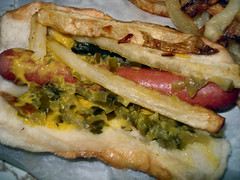
Yes, hot dogs. The Chicago dog. Is there anything more local? It is what this localvore family had for dinner last night. A happy return to the World's Greatest Hot Dog Stand after about six months of pescatarianism from older daughter (Yes MikeG it was the bacon). Gene and Judes, in the words written a few years back.

The greatest hot dog stand in the world serves neither hamburgers, nor polish sausage, nor grilled chicken sandwiches. There is no grill, no char-broiler, no spinning mound of gyros. At the greatest hot dog stand they only need buckets of simmering water for dogs, steamers for steaming buns and Supreme tamales and ever bubbling vats of oil for the fresh cut fries.

You can see the greatest hot dog from far up the street. Because the greatest hot dog stand is all glass and harsh florescent lights and stands as a beacon for all who are hungry. If you see a line, you know it will move fast.

The greatest hot dog stand follows few of the rules laid out by the experts. Their buns are poppy-seedless. They offer few condiments beyond mustard (no ketchup on site). They do not dust their dog with celery salt. Yes, it is a Vienna sausage, but a skinnyish one at that. You really need to eat more than one at the greatest hot dog stand in the world, and many of the customers do (Sample customer, "I'll take seven hot dogs and an [extra] order of fries”).

The cooks at the greatest hot dog stand in the world occupy their time in between orders by thrusting fresh Idaho potato through a machine that converts them into perfect sized french fries. These amazing sticks of pure potato get tossed on top of each offering so that if you want to eat them inside your hot dog bun, well you can and maybe should.

The greatest hot dog stand in the world is a throwback to a world when people ate hot dogs. A throwback to a time when a great stand could keep their buns steamed just right, and their red hots, hot but not limp. So a Gene and Jude hot dog snaps right back at you. Interactive eating. With a side of hot fries, you will know you are at the greatest hot dog stand in the world.

Gene and Judes
2720 River Road
River Grove, IL 60171-1325
708-452-7634
On the corner of River Road and Grand

Thursday, January 03, 2008

Local As I Wanna Be

On Beet


A simple dinner.

Three versions of house made bureks from City Fresh Market at Devon and Kedzie, Chicago*: cheese, spinach and sauerkraut. Plus, the salad pictured. About 25 keeper beets getting soft, boiled until tender (over an hour), then peeled; cubed and dressed with olive oil, lemon juice, harissa from Middle Eastern Bakery (Clark and Foster, Chicago); garnished with local cilantro that has somehow survived our fridge.

*Chicagoland seems awash in "Fresh" supermarkets. As far as I can tell, there is no relationship between City Fresh, Garden Fresh, Fresh Market, Fresh Farms, etc. Many of these places have a Russian orientation and are good sources for smoked fishes and garlicky "Korean" salads. City Fresh, on Devon has some Balkan in it, as especially marked by its homemade pies including the bureks. It also sells a few versions of Bosnian pita bread. No house roasted meats however. In general, I am inclined to like any grocery with Fresh in the store name, and I mean that literally.

Wednesday, January 02, 2008

I Visit My Food

Toys in the Attic

Wine geeks place furniture in their cellars to hang out with their wine. I poke around the attic to check on my fruit (and veg). As I have mentioned before, this is the first winter we have used the attic as a storage option. It is unheated and pretty (although not completely) dark. The attic seems appropriate for everything but alliums (which should be mixed with potatoes in the first place, and need a warmer locale in the second).

We have not dined in home in over a week, really since the lamb neck, Boston and all. Today I wanted to see how the food was holding out. Good. All of the attic apples are solid as are the squash. The white potatoes, including Yukon Gold and fingerling seem no worse for the wear, but some of the red potatoes are sprouting. Turnips too, a few turnips are growing proto-leaves. Still, the turnips seem firm and mold-free, all I want. Beets, however, are a bit looser. We will cook some tonight.

We did buy navel oranges, tangerines and grapefruit today.

Monday, December 24, 2007

Winter Break

The family and I are off to Boston tomorrow. I hope to indulge in as much local food there as possible (as well as partake in that sacred of customs, Chinatown on Christmas). I may or may not blog between now and January 2, 2008. Happy Holidays to all. Eat Local. Eat Well.

For those in need of something to read look at my meager blogroll. There's always activity on LTHForum.com and this may be the greatest blog ever!

Saturday, December 22, 2007

Between Nose and Tail Eating

The Neck

Fergus Henderson, through his books and TV appeaarances has (at least) raised the foodie awareness towards odder parts of the animal. He extols not only the liver (usually salted) or the marrow bone (now famous). He pleads for you to try the parts at the extremes, say frying up an ear and including it in a salad. In this spirit, there is the neck.

Our organic, local lamb from Wettstein's farm had a neck. It gamely lowered its jaws to the ground so he (or she) could nibble and nosh in his (or her) short but happy life. It is a cut less used in American cooking. Joy speaks silent of its joys. Yet, there is was. Taking up a great use of our upstairs freezer. It became the centerpiece of our Shabbat meal.

There really is no way of cooking a neck beyond braising. That said, there is, I imagine after one neck preparation, no hard way to ruin a neck. A pan, some flavored liquid, some aromatics and time, time, time. It is a hunk of product, mostly bone and fat--and long solid bone. We had expected we could cut the neck into something approaching osso buco style steaks, but that bone is long and big. You need a band saw. Our neck bubbled away for about 3 hours with stock and assorted middle eastern style spices like cumin. Local red potatoes and not local green olives went in twenty minutes before the finish. Local (frozen) peas and local parsley went in at the final five minutes. It took a certain amount of poking and digging to get morsels of meat to feed the crowd. For that you get very rich, to some a bit too fatty, rich, soft, lamb meat.

If you do not have a lamb neck in your freezer, I do see them at Middle Eastern butchers like Sahar, 4829 N. Kedzie, Chicago.

Friday, December 21, 2007

Winter Farmer's Markets

Don't Fret

Tomorrow is the last day of the Green City Farmer's Market for several months. Eat localers might think themselves stuck with their inventory on hand. Fret not, there are some markets open in the coming months. For the most part, I cannot vouch for these markets, or more importantly, tell you what will be there this winter. Still, it's a start. I DO hope to visit many of these--if anyone has any intel on these markets please pass them forward.

I've included a couple of Wisconsin markets. I'll post about options in Michigan and Indiana in another entry.

[Unless other indicated, the quoted material comes from the Illinois Department of Agriculture's web site, which has excellent eat local materials.]

Churchs' Center For Land & People

Via Bill Daley at the Trib's blog, I learned of this organization and the series of winter farmer's markets and market/brunch's being held in the Chicago area. Here's the schedule.

Twin City Farmers Market
"Indoor market. Historic building. Meat, permanent freezers of beef, pork, pastured chicken and pastured bison. Fresh eggs. Seasonal produce(much of it grown organically), baked goods, some locally made products (soaps, candles, baskets, rugs, woodwork, metalcraft, etc.)and gift baskets. 106 AVENUE A, STERLING, IL 61081
Heritage Farmer's Market
Located on Route 9 East of Pekin; 18837 STATE ROUTE 9 PEKIN, IL 61554

Geneva Winter Market
The Winter Market in Geneva, IL starts Thursday, November 1st and will run every Thursday (except Thanksgiving Day, and between Christmas and New Years) through the middle of May. You'll enjoy shopping for the finest local produce, cheese, meats, eggs, cheese, nuts and honey; as well as baked goods, and more! Farmers and Vendors who will be there are: Curds & Whey Cheese Company, Pine Row Farms, Unicorn Farms, Grandma's Eggs, Schramer's Meats, and Inglenook Pantry! Location: Winter Market at Inglenook Pantry 11 N 5th St, Geneva, IL 60134
Dane County Farmer's Market
One of the premier farmer's markets in the USA. So great that is makes me depressed--I can never fully hit all the stands, by the time I have shopped a part of the market, put some stuff away, taken a coffee break, the other part is packing up for the day! The market meets once a week during the winter at the Frank Lloyd Wright designed Monona Terrace. Here's what the Market web site sez about the winter fare:
Wondering what you can find at the DCFM Winter Market? Here's a listing to help guide you.

Fruit
Apples; Cider; Jams, jellies, and preserves; Pears; Pear and apple butters; Raspberry products

Stored Vegetables
Carrots, Garlic, Potatoes, Shallots, Turnips

Fresh Vegetables
Chard, Greens, Kale, Lettuce, Micro-greens, Radish, Spinach, Tomatoes

Meats
Beef, Bison, Brats and sausage, Chicken, Conventional and special cuts, Emu, Ground beef, Highland beef, Jerky, Ostrich, Pork, Roasts, Turkey, Steaks

Decorations
Bison products, Emu products, House plants, Orchids, Ostrich products, Potted flowers

Cheeses
Flavored cheeses, Goat cheese, World-class aged cheeses, Fresh cheese curds

Baked Goods
Flat breads, Biscotti, Cheesecake, Pastries, Cinnamon rolls, Sweet breads, Torts, Cookies, Muffins, Panettone, Sourdough bread

Specialty Items
Mushrooms, Maple syrup, Wool products, Candles, Honey, Pesto, Vinaigrettes, Eggs, Hot sauces, Flavored sea salt, Goat milk soap, Salsa, Yarn, Sheepskins, Hides and leather, Soups, Pasta sauce, Fresh-ground whole wheat flour, Herbal vinegar

Milwaukee Public Market
The sheen has faded slightly from this market, with the closing of some of the food stalls. It does not help that last year I got a chance to visit the even cooler Detroit and Cleveland Markets (to be discussed in a forthcoming post). Still, last year, the Milwaukee market sold a bit of local produce all winter, including some much need garlic. This is a stellar source for Wisconsin cheeses, and the C. Adams bake shop is worth the visit alone.

Thursday, December 20, 2007

The Inventory

On Hand

I vacillate over whether we are prepared for the winter. I think we have enough until we make a big meal (like Thanksgiving), and then I feel like we have used too much!

The following is a good list of produce. In addition to the produce, we have plenty of frozen local cow, local lamb and local pork (chicken we buy live from John's at Fullerton and Central). We have about five pounds of local walnuts, bags of local wheat (several types of flour plus bulger) and cornmeal. I'm not listing general kitchen staples, canned goods, beans, noodles, etc. Some of the staples are local, some are not. We get eggs weekly from Farmer Vicki's Genesis Growers. We buy milk and cheese (local) and bread (sometimes local) as we need it.

Cranberries - about twelve packages, in our basement fridge
Cabbage sprouts - 3 heads - basement fridge
One of Vicki's greens that I've never heard of - basement fridge
Bok choy - one head - basement fridge
Swiss chard - 1 bunch (this will be used tomorrow for dinner) - upstairs fridge
Broc - 3 or 4 good sized heads - basement fridge
Pie pumpkins - maybe 4 - Storage room, attic, living room and basement
Celery - 2 bunches - upstairs fridge
Herbs=parsley, cilantro, sage, thyme and mint - upstairs fridge (to the extent they are not spoiled)
Bacon - upstairs fridge (generously gifted by MikeG); downstairs fridge (not local)
Winter squash - plenty including acorn, delicata, turban and butternut - storage room, attic, living room and basement
Keeper onions - - about 30, at least - storage and kitchen
Sweet potatoes - a good amount, 20 or more - attic and storage
Garlic - about 25 heads - storage and kitchen
Cabbage 1 whole/1 half - basement fridge and upstairs fridge
Sunchokes - good amount, say two meals worth - basement fridge
Carrots - plenty, at least 20 lbs - basement fridge and upstairs fridge
Parsnips plenty, at least 20 lbs - basement fridge and upstairs fridge
Beets - red - plenty - basement fridge and attic
Turnips - good amount - basement fridge and attic
Potatoes small round red, yukon gold, russet, fingerling - we are especially long on the red and we have a 50 lb bag of russet (less those used for latkes) - attic and storage
Apples - rome, gala, sungold, yellow delicious, others - about 50 lbs - dining room and attic

I do not have an exact tally of what's frozen but it includes many bags of greens, green beans, peas, asparagus, corn, apple sauce, pesto, broccoli, red peppers, cherries, grapes, raspberries, blueberries.

How We Did Local Yesterday

Paul and Us

At the Green City Market, Chef Paul Virant of Vie demonstrated his signature dish, gnocchi. The Vie menu is an every changing guide to what can be done with gnocchi. Showing that winter cooking is not all root vegetables and stews, Chef Paul cooked up a gnocchi made with Illinois produced goat cheese from Prairie Fruit Farms. He garnished the gnocchi with oyster mushrooms from Wisconsin's River Valley (at the market) and escarole from an un-named Wisconsin farmer. He finished with a sauce made with butter and sorrel purchased from Growing Power (at the market). The goat cheese gave the gnocchi a pleasant tang, and the tang balanced well against the buttery-earthy oyster mushrooms. He sure made it look damn simple.

For us, first my wife thought about trying the gnocchi. Then we considered our leftovers, either Monday's pasta with Farmer Vicki's cauliflower or Tuesday night's stir-fry with Vicki's bok choy, carrots and broccoli. Instead, we were mesmerized by a gorgeous loaf of ciabatta bread we picked up at the Green City Market from Bennison's Bakery--outside of Fox & Obel's peasant sour dough, I would say Bennison's is my favorite bread in Chicago. A simple dinner, Whole Foods smoked salmon spread (not local, but it could have been their smoked trout spread from Rushing Waters in Wisconsin, so it feels less a cheat!), washed rind "petite frere" cheese from Wisconsin's Crave Brothers (one of the few local cheeses I have not adored, and I've liked other things from Crave Brothers, it was way too mild for a washed rind); Maytag Blue from Iowa, canned bread and butter pickles from some local farmer's market, and butter from the Amish in Indiana. Winter's been easy so far.

At the penultimate market, we were disappointed to not find Farmer Vicki's Genesis Growers. It turns out because of the heavy August rains, she has not enough crops for Wednesday and Saturday, so she is holding out until Saturday. So, there was not that much for us to buy. Grower Power had carrots and parsnips; we bought nearly 10 lbs or each (both last an incredibly long time). We skipped their red potatoes as we are pretty long on tubers, and we skipped their brussell sprouts because we will be out of town for a week. Hillside Orchids still had a good amount of apples. We purchased big bags of rome, gala and sungold.

Because this is when eating local gets fun, I promise to post a lot more regularly.

Tuesday, December 18, 2007

Vie - va

Vie and Me Eat Local

New Vie menu posted yesterday (here). See how they cope with the changes in weather.

Chef Paul Virant demonstrates at the last Wednesday Green City Market of 2007. 10:30 AM.

I will be at the market picking through the scraps tomorrow. I hope you show up as well. I will say that if you are planning on stocking up tomorrow, you may be hard pressed. As of a couple of weeks ago, the market was fairly bare. Still, Vicki should be there and she has a good selection of root crops and hoophouse greens. Likewise, Growing Power has their green houses working to good effect. There should be squash and potatoes (just not a lot of variety) and apples that can still be stored away. Don't forget to get enough onions and garlic to last. Next week it gets tough.
I am reasonably confident of our ability to hack it out the rest of the winter. We have plenty of carrots, parsnips, cabbage, beets and turnips that should last. We are very well stocked on potatoes--helped by a purchase of 50 lbs of Wisconsin potatoes at a wholesaler, and garlic and onions. I'm not even sure we can eat all the squash we have. We have our sources for hot house materials that should give us some stuff green. Yes, lettuce can be had! Finally, we have a freezer full of stuff: peas, green beans, asparagus, a lot of corn (we could not eat it fast enough). While we will be buying citrus and bananas and maybe an avocado or two, I otherwise expect to be local these cold months. I know Vie will be too.

Monday, November 12, 2007

The Two Faces of John Kass

In Defense of Coffee Snobbery

John Kass is the male Maureen Dowd (or something like that). You love him when he's tearing apart your villain, but when the poison pen turns to your side, ouch. There was good Kass last week, at least from a professional perspective. His column last Friday showed some of the things that can be done with a bit of public record research, the same type of research I do for my clients. Bad Kass showed up yesterday, maligning my friend Monica Eng (who he cannot actually name) and her work in drinking the city's coffee. [Registration required for the CTrib's web site.]

"Spiros, are there nutty, smoky traces of oak or salami in the coffee?"
First of all, this bothered the heck outta me. Kass using a trick from his old political reporting days, the quote without the context. In describing the awful coffee at White Hen, Monica stated there were salami flavors in the coffee. Sure, certain wines have been described as having bacony flavors, but I am pretty darn positive Monica was not talking about some inner porcine quality to the White Hen bean. Rather, it was a point that the coffee was not so fresh and picked up the odors of the store.

Then we get this:
"When I go for coffee, I want a cup of coffee. What I don't need is some kid wearing a sweater and his shirt tails sticking out because it's the style, pointing to a list of coffees, each of which are described sensually, in language that would have caused my mom to wash my mouth out with soap. It's coffee, dang it. Wake up, America."
As someone who's done his own research on the city's coffee (a really hard job), I appreciate the work Monica did. Why not determine where to spend one's coffee dollar. Still, Kass is mocking the idea that people should care about a drinking a nice cup of coffee. Why is that. Substitute beer or whisky, wine (of course) or even BBQ ribs, something Kass is seeking connoisseurship on, for coffee. Why subject ourselves to percolated coffee as Kass subjects. Really, there is a reason why percolators went out of fashion.

Well, I've about run out of things to say on this subject. I need a good cup of coffee.

Thursday, November 08, 2007

Green City Winter Market - November 7, 2007

Did We Bump Into Each Other?

OK, first of all, the name thing. It's the Green City Winter Market but aint it still fall? I'll call it the Winter Market though. Now, what'd I think? Well, I think it was a lot like I expected. Genesis Growers and Growing Power, farms that are geared up for 3(plus) season farming had plenty to offer. Green Acres seemed there out of a sense of commitment. Nicholl's and Kinnickinick said the heck with it. Which all means it was good enough.

Really good, really; Vicki at Genesis had anything an eater could need this time of year. This was not a surplus stand. She was still a growin' away outside and had gorgeous broccoli (artfully displayed) and cauliflower to prove it as well as rutabagas, turnips, five or so kinda radishes and the usual squash, potatoes, onions. She also had a good range of herbs including parsley, oregano, thyme and mint. Growing Power was more geared towards their greenhouse crops, but the pea sprouts and sunflower sprouts were still especially tasty. I appreciated the big bag of mixed lettuces. If that was not enough to last us, we got chestnuts from Hillside Orchards (after really liking them at Vie) and celery and Japanese sweet potatoes from Green Acres.

Right now we are hardly in keeper mode. Between our fall Genesis Growers CSA and this market we won't go hungry for several more weeks. I will say that we did a great job of taking care of one of our big needs from last year, garlic. One week, Tomato Mountain made a deal with us and we took their on-hand inventory. We've put away a fair amount of potatoes, but I do not see a huge need here as I believe I can find local potatoes year-round. Same with apples, we have plenty now in the attic, but I believe we will be able to buy for several more months. On the other hand, local onions are harder to find as the months progress. We surely need to put more away. Remember, late fall and early winter are not hard times to eat local. It's the times the keeper stuff have run dry and the earliest crops are weeks away.

Wednesday, November 07, 2007

Are You Shopping Today?

Yes, I Have a Blog and I Can Use It

I actually had draft post up for days last week before one of the kidz shut the computer down. I know I've let you all down during these key moments of eating local, but I'm still here; still eating local. I'll be doing some shopping at the Green City Winter Market today. Hopefully you will be too.

One of the real limitations on eating local around here is the lack of winter markets. There is no reason, climatically or ecologically that we cannot have winter markets. First of all, farmers can be growing right now and on and on, harvesting cool weather crops and using greenhouses. Second of all, there are plenty of things that can be sold after their growth: potatoes, cabbage, onions, apples, etc., etc., etc. It should be easier for farmers (or related) to store keepers than consumers. I'd rather buy as I need than store myself. It can happen.

Our limited winter markets, however, are not thriving. Sarah Stengner told us at her localvore lunch that few people were attending the mid-week fall Green City Markets (hence one of my reasons for going today). I heard from one of the vendors at the first indoor Green City Market that lookers way outnumbered buyers. To a good extent, the farmers are no so keen on the idea either. It's a long season, and they are ready for a break. Many manage their inventory so that they have nothing left by November, now. For instance, by last week already, Nicholl's Farm had little left beyond apples and potatoes. Hardin Farms said they were about out of apples. It's an uphill battle when people are not shopping and farmers have noting to sell.

Eating local does not end with a one week challenge, nor does it end when most markets pack up. As more people commit to eating local year-round, the more incentives there will be for year-round markets.

Wednesday, September 19, 2007

Local as I Wanna Be

Happy New Year Edition!

My wife (and I) make some pretty good briskets, but we were not really ready for something heavy this New Year. This was not your Bubbie's holiday meal. We designed a Rosh Hashanah meal awash in traditions though. Moreover, it was exceedingly local. In fact, our ample supplies of vegetables steered us more towards Sephardic type foods. I have pictures that I will post soon.

Apples dipped in honey - Start with a classic, from all branches of Jew. We used Macoun apples from Nicholl's farm, a firm apple with some, but not an overwhelming, tartness. The honey came from an Mennotite farm-store in Indiana.

Green olives, round challah w/raisins from Prairie Bread Kitchen in Oak Park - After coffee, my most excepted food is the olive, and at least a few times a week, olives grace our table as a nibble, a relish, sometimes even a contraband vegetable. Sephardic tradition is that no "black" foods are eaten on Rosh Hashanah including black olives and eggplants. Instead, it is traditional to eat green olives. Ours came from Italy via Caputo's (my wife likes the giant Italian kind, not the more bitter Middle-Eastern variety). Of course Askenazic Jews often end up with dark raisins in their challah, like we did.

A riff on Claudia Roden's black-eye pea salad with Sandhill Organic heirloom tomatoes (an Egyptian Jewish New Year special, echoed in Low Country traditions) - The closest thing I could find to black-eye peas at the Oak Park Farmer's Market before the holiday were Genesis Grower's crowder peas. Still, before I could nab, another person bought out her whole stock. Instead, we used Genesis Grower's fresh cranberry beans from our CSA box dressed in a garlic vinaigrette, augmented with those tomatoes.

Libyan spicy fish, using Whole Foods Great Lakes whitefish - This dish shows up in many Jewish cookbooks. It's more of a Shabbat dish than a Rosh Hashanah dish, where spicy foods are supposed to give sway to sweet. What the hey. Very good. Very simple. The fish is poached in lemon juice, garlic, hot peppers and tomato paste (guess the non-local). So good that my getting to be fish lovin' older daughter ate.

Wild rice with pomegranate - Originally we were going to make couscous, a traditional holiday meal for both Jews and non-Jews in Morocco. Instead, when we were in the couscous aisle, my wife saw some wild, Minnesota wild rice (as compared to cultivated). It made our meal that much more local and certainly more interesting (as the kidz would say). Pomegranates are highly traditional for any Jews that can get their hands on them, this time of year. First of all, one is supposed to eat a "new food" at Rosh Hashanah, and pomegranates are usually just coming into season. Second, the pomegranates are supposed to have 613 seeds, corresponding to the number of mitvah or commandments in the Torah. They do make an ideal garnish for the wild rice, the vivid magenta against the drab brown and the sweet against the bitter.

It was supposed to be seven vegetables steamed with the couscous. We switched to seven roasted vegetables (carrots, butternut squash, sweet potato, zuke, cauliflower, red pepper; and turnip; all local). Seven being a lucky number. Carrots, especially are associated with the Jewish New Year in European traditions, being one of the few available vegetables. There's something Yiddish there about it's name and coins too.

Beef-leek patties - Using more of our cow (at this point, we've made a very decent dent in the supply of burger). Leeks are yet another traditional vegetable associated with Rosh Hashanah. Like the Libyan fish, this recipe shows up in a lot of Sephardic Jewish cook books. It is a holiday item, also popular on Passover (when another crop of leeks has arisen). The recipes call for a dish 3/4th leek and 1/4th meat and binding. We made them a lot more meaty.

Swiss chard w/caramelized onion and raisins. Chard is one more traditional vegetable (there are seven in Sephardic Jewish tradition, and chard is also very much in season at this time). As I noted above, the Rosh Hashanah meal is supposed to be filled with sweets, for a sweet year. Typical, we made the onions sweet by long cooking, then we made the dish even sweeter by adding raisins (only golden!). I will say that the Sandhill chard needed all that help, it was a put hair on your chest kinda veg.

Finally, my wife made the Bee Sting cake from the Chicago Tribune Magazine. The recipe was not set out to satisfy the need for honey cakes, but it certainly did a good job at it. - The bee stinger cake came out quite nicely, even in a 10 inch spring form instead of the required 9. The recipe called for stuffing the cake with flavored whip cream. My wife asked if I wanted that. At first, I said no, why bother, let's just throw the cream on top. Then, I noticed how pretty the top was, so I said can you stuff. Stuffing did not work so hot, the cake, being so honey-infused, crumbled a bit. She used the whipped cream to hide the cracks. So, it was still very good but no longer as pretty.

L'Shana Tova. May your meals in the coming year be as local as you want them to be.

Wednesday, September 12, 2007

What's Local in Oak Park (soon!)

Answered Prayers

As probably a few people new to this eating local thing are finding out, it's not necessarily easy to find local food in Chicago. I mean it's abundant. At farmer's markets like Evanston, Oak Park and Green City. Easy. Nah. What if you do not live near a good farmer's market. What if you are busy the day it's around. What if you shopped there but forget something (or lost it, like I did with some parsley and thyme). And how are you gonna make dinner tonight if that piece of meat you got is rock solid frozen--worse, what about that local, organic chicken you bought, you have this narrow window between in being thawed and it being spoiled. You need a store to shop at all the time.

Minneapolis has something (God, I love Dara Moscowitz). Grafton Wisconsin has something (Slow Pokes) Soon Oak Park will have something at the expanded Marion Street Cheese Market. My wife and I stopped on at Marion today to pick up some Prairie Fruit Farm's goat cheese for our dinner tonight. My spirits were wonderfully lifted by talking to one of the new co-partners. He told me that as the cheese shop expands, taking space across South Boulevard, the existing place will turn into a butcher, They will be carrying an array of local meat, chicken and eggs. I really look forward to this. Am certainly glad I live in Oak Park.

More to come soon, I am sure.

Eat Local Grapes

Spit Away

The New York Times has an interesting story (reg. req.) today on the quest to create better tasting table grapes.
In the United States, convenience reigns, and in California, where 97 percent of American table grapes are grown, “neutral-flavored” grapes like Thompson and Flame, sweet but bland, dominate production, largely because they are seedless and hold up well to long-distance shipping.
The solution, it seems rests on finding new places to grow flowery Muscat grapes or try to cross-breed some flavor into the Cali grapes. Here's a third idea. Eat local grapes.

Today's article points out that our Concords have flavor, but notes it's not necessarily one worth remembering. It seems that Concords and similar grapes share a gene with certain glands from foxes and weasels, hence the term foxy to describe the grape's flavor. I do not believe it's the flavor the detracts from our grapes, nor the skins, which this article notes is thick and astringent and slips off the grape's soft flesh. What really inhibits a lot of eaters are the seeds. There's a lot of spitting going on when a local grape is eaten. Is that really so bad? No one needs a seedless cherry; I mean so-called seedless watermelon still have those white seeds. We can handle it, can't we.

I've read that certain Southern grapes like the Scuppernongs are more flavorful than our Concords. If that's true, I'm pretty happy with second place. Our local grapes exude character. Each grape acts Wonka-like, offering multiple flavors and textures (right down to those hard seeds). It's good eating. And we have them. At least in farmer's markets, they are easy to find. Caputo's, in Elmwood Park, also has some Concords, but theirs came from Canada of all places.

Local grape season will last for until early October. Buy a lot now. First of all, grapes stay long in the fridge. Second, they freeze wonderfully. Come winter you can have little grape sorbet balls for a snack.

Tuesday, September 11, 2007

How to Eat Local

Local Reporters Find it Not Easy

Hey!

Are you attempting the Chicago Eat Local Challenge? Faring better than some of our local food reporters and writers?


I wouldn't mind eating more local food if the selection and quality is there and it doesn't cost a fortune.
That's Kelly Mahoney of Kelly the Culinarian commenting at the Reader's food blog.

I'm not bragging when I say that two days before the challenge, I was at the Oak Park Farmer's Market purchasing a locally raised, organic pork shoulder from the Wettstein's, getting about four pounds of heirloom tomatoes, large red peppers and Swiss chard from Sandhill Organics, a few peppers and arugula from Farmer Vicki's Genesis Growers, sweet potatoes, two types of apples and radishes from Nicholl's Farm, red peaches, white peaches, nectarines and raspberries from Skibbes. Of course this supplemented my weekly CSA box that included spaghetti squash, kale, white potatoes, more apples, onions, I think beets. If I know anything about an Eat Local challenge, it's that you need food. That's something Martha Bayne at the Reader recognized. Her eat local was not going so good because she had no time to shop like me.

Not having shopped, Martha Bayne could not have commented on the cost. God yes, local food costs money. Five dollars can seem like a lot for a container of berries that can be gone in one sitting. My wife preferred it, did not press, when I told her she did not want to know the price of the Wettstein's pork. Time Out Chicago's, David Tamarkin found that $40 was not getting him the ingredients needed to bake a cake. I've justified my expenditures by calling it a hobby. Instead of going skiing, I eat rare breeds of melon. It's true that I am willing to accept the costs of local food, but I also do not believe the costs are as outrageous, what I really mean is as outlandish, as they seem. Like I said in response to Kelly in the Reader's comments, I often find farmer's market produce cheaper than Whole Food's produce. If you have made a decision to pay for quality, both intrinsic (organic/sustainable/food miles, etc.) and extrinsic (freshness, taste) than you can do no worse than eat local. It does cut back in other ways. My family used to eat out a lot, a lot. We don't. We do not eat out because we want to eat our local food. More important, we find so many restaurants now lacking compared with our farm food. Why waste the meals. Believe me, restaurant food, even cheap meals, are more expensive than eating at home.

David Tamarkin also reached local ennui (after less than a week!). He ate "prisoner lunches" of local tomatoes on local bread with local eggs, suffering because tomatoes need some salt, and he did not want to give in. Exemptions, he asked, you could have exemptions. He wondered if all us localvores were simply too soft for drizzling our fresh tomatoes with long traveled olive oil. How dare. The wet marinade that my local pork sat in contained nary a local ingredient. Should I have been eating it. I do not mind thousands of exemptions as long as I try to follow one simple rule: can I get it local. So, last week we wanted to try figs. Guess what, we got some. What I'm not gonna do is buy Washington apples or Colorado peaches or Idaho potatoes. Yet, I don't fill up on mangos, avocados, and the like. If my prime consideration is getting it local, my second consideration is that in general, I favor local.

Kelly the Culinarian wonders about quality. I suggest she try one of the figs (organic) I purchased. It was fun to eat. There's a certain pleasure in a fresh fig, the way the tiny-tiny seeds squish around your mouth. Yet, our figs had the barest wisp of fig flavor. It was a tease, poltergeist food, the memory of a flavor. I knew that if I lived in California or Israel or some other place, I could get a fig with real figginess. I eat local because I want quality in my food. So, I satisfy myself with tomatoes that taste the way they are supposed to taste, potatoes that taste like you would not know they taste.

Eating local spoils you, it's that good. Perhaps David and Kelly and Martha can stick it out and find out.

Friday, September 07, 2007

Eat Local Pie

Something Sweet for the Coming Eat Local Challenge

My wife got a chance this summer to bake pies for the Hoosier Mama Pie Company. When she started, I thought she'd be bringing home a pie each time. Boy was I wrong about that. Mostly, what I've got is lessons on how really (really) hard the pie business is.

Still, I've had a few pies along the way. Lucky me. Not every pie Hoosier Mama makes is purely local--the really local pies can be purchased Saturday at the Green City Farmer's Market. They make lemon chess and chocolate creams, but they also make great use of local fruit. I've tried the peach and the blueberry, and bias as I am now, it is really hard to find pies as good. There was just a clarity to the fruit that is missing from most other such things. The all butter crust is pretty special too, if those things matter (mais oui!). So, for people looking to eat as much possible local next week, and don't have time to fix a dessert, think about getting some pie.

Local as I wanna Be

Put It On the Menu

How many food bloggers have aspirations of opening a restaurant. Perhaps, someday, the VI clan will open its exceedingly local driven restaurant. Until then, we tinker with the menu, inspiring the above phase if a dish really works. This one did. I did not photo it, but pasta does not necessarily photo well anyways. Plus, the key ingredient of this dish would have been nearly invisible.

My wife's dinner creation: local Nicholl's Farm cauliflower ("what can I do with such a small thing") par-boiled; then added to a good does of Italian olive oil heated to near shimmer in a large saute pan, followed by local garlic (what a pleasure to begin using the new stuff as we finally tossed the remaining shriveled garlic of old), thin slice of Genesis Grower's red hot peppers that look like jalepenos (but are not, I forget what), and Wisconsin baby green and yellow summer squash and Genesis Growers pimientos. Cook over medium heat while pasta (non-local) gets ready. Just at the point of al dente she added the pasta to the pan with several chunks of Maytag blue cheese. Finished with an aggressive shake of pepper.

First of all, blue cheese really plays well against heat, the Motown rhythm section. In other words they made the dish sound right. The hooks, those wonderful Motown elements that differentiate the songs came from the assorted vegetables, mixing sweet and crunchy, suave and vegetal. I'd say a plate for young America, but I'm afraid my allusions run into the fact that many a youth detest the strength of blue cheese. On the other hand, my younger daughter liked it. Even she thought it ready for the place.

Thursday, September 06, 2007

How to Eat Local?

Does Fruit Have Recourse?

As typical, last Saturday I was up early. I went to hit the market before myself and the family would be volunteering at the Oak Park Food Pantry. I could not find much hard cash beyond a $50. At the market I did what any good localvore would do. Buy something big.

My wife had previously expressed a desire to can some peaches. I decide to fulfil this desire by buying a 1/2 barrel of peaches. Now, I won't name the vendor, which is a bit consumer unfriendly of me, I know, but these peaches really sucked. They seem dense and leather inside. I'm thinking of returning the bunch. Can I do that?

Tuesday, September 04, 2007

What's Local at Costco (Oak Brook), What's Local at Caputo's (Elmwood Park) + Offally Good at Caputo's

Costco

Carr Valley's award winning cheeses, from Wisconsin were well stocked at the Oak Brook Costco on 9/2/05, at prices about $5/lb below Whole Foods (in River Forest). Varieties available included Cocoa Cardona, Morbay and 4 year cheddar.

Costco also had Michigan apples.

Caputo's

The local selection at the Capututo's in Elmwood Park is high. In past weeks they have had Michigan peaches. No more, but they have a few types of Michigan apples including Paula Red. I forget to blog about the big bushels of Michigan plum tomatoes for canning, but they're still there, if starting to looking a bit picked over. There were local onions, cukes, zukes, green peppers, eggplants and 10 lb bags of Wisconsin russet potatoes.

On LTHForum, Cathy2 asked about various cuts of offal for a stew she is making for the LTH picnic on September 8 (on that date, Forest Glen Forest Preserve will be the best place to eat in Chicago, and unfortunately I cannot make). I expected Capututo's to meet her needs, and when I visited today, as Cathy2 said to me when I gave her the lowdown, "offaly good." Fergus Henderson would feel right at home at Caputo's, at least the Harlem branch in Elmwood Park. They had the elusive calves brains, they had liver (beef, veal and pork); kidneys both veal and pork, tripe, lotsa extremities like tails and feet. The only couple of things I did not see were tongue (I'm sure it's there, just did not look) and sweetbreads.

I mention the offal not so much to gross people out, but because I think that eating offal is part of the whole Eat Local thing, that is showing respect for the creatures we eat, eating mindfully, and not just supporting the worst in factory farms. Of course, the offal at Caputo's may not be local, but it's one of those things, like buying in bulk, that's local in spirit.

Thursday, August 30, 2007

How Not to Eat Local

The Thursday Morning Massacre

Sweet corn's half-way to ruin the minute it's picked, why bother with what's been sitting in my fridge for over a week. Those patty-pan squashes that looked so damn cute, even at $6/lb, are now just a squsihy-sqaushy science project. I so much designed a slaw recipe for kohlrabi that I got my mother to make it, mine just languished. There were turnips that I thought would last longer, and celery I think I'm just putting in the wrong spot in the downstair's fridge. My older daughter can easily gobble up a whole cucumber in a sitting, but her habits did not get to all we had. The window for certain greens is small. I meant to cook the beet greens, the kale, the what not. Instead, I cleared it all out before loading today's box. I buried a lot of formerly good produce in my green Waste Management coffin. After more than two years of dedication to eating local, I wonder, am I so good at it.

OK, I'm trying to make a point, not self-reflect. My point, a point that I have made before, that others probably hear better than I, is that eating local takes time. Past time, future time. I need more time to figure out my storage. Like I say, when will I learn the right spot in the fridge to place the celery. How long will things last. Some things, carrots, for instance, seem immortal, the horcruxed veg. Other times, as in those turnips, I am surprised. Beyond that, as we move into the storage phase of the year, what to do. Where to put it--I have some ideas on this, but that's for another post. I know whatever I do, I will ruin some food. There will be waste. It still takes time to understand what works best. I am not there.

It takes time I did not have. Or time I used up. I could have saved that corn by freezing it that day (and believe me, that's what I'm doing as soon as I finish this post). A lot of those greens could have been saved. There is surely a burden on eating local. Not only must us localvores process our food more than the supermarket customer, but we need to take the time to make do. As Farmer Vicki will often say, the summer CSA boxes are supposed to be too much food. We are supposed to have more food now than we need because we will not have enough food later. We can eat local in Chicago all year round. If we have time.

Wednesday, August 29, 2007

Eat Local Cheese

We're No. 1, We're No. 1!

Drive-thru reports that Wisconsin cheese maker Carr Valley scored big time at the recent American Cheese Society judging. Beyond Carr Valley, cheeses from the Big 10 killed at the competition. We cannot win the Rose Bowl, but topped the cheese championship. This year's Best of Show came from Black Star Farm's Leelanau Cheese (aged raclette) of Sutton's Bay Michigan. Roth Kase, from Wisconsin, was third runner up in the Best of Show championship.

I'm sorry, I'm horribly chauvinistic when it comes to local cheeses. I know Cyprus Grove, Cabot and Red Hawk put out good cheeses, but it just bugs me when I see them on local cheese lists, when they dominate the selection at the cheese counter (when you can find any domestic cheeses). This year's results (pdf) again show how good are our area cheeses. Up and down the list you will find Fair Oaks Dairy, Capriole, Crave Brothers, Widmer's Cheese, Prairie Fruit Farms (how their Huckleberry Blue did not get a prize I do not know); BlueMond Dairy, Hidden Springs, etc. etc. etc. and etc. If I anything, I find myself thinking, why did we not win here; where's my friends at Brunkow, we gotta do better a feta next year...I guess that what happens from 30+ years of rooting for the Cubs, you take an intense interest in your cheese team.

There is no place better to find Midwestern cheeses than at the Dane County Farmer's Market (the one farmer's market that makes me sad, but that's for another post). The Oak Park Farmer's Market has Brunkow and Prairie Fruit Farms, so it's a good to dabble. The cheese shop in the Milwaukee Public Market also has a great selection as does Zingerman's, which, unfortunately, is a little far for regular shopping for me. If you like cheese, you can do no better than to eat local.

Monday, August 27, 2007

Local As I Wanna Be

The Summer of the Greek (Village) Salad

Last year was the summer of zucchini. We seemed to eat summer squash every other day. This summer, we have been incredibly lazy in our cooking. More often than not, it seems like this is what we've eaten for a meal.


Local yellow tomatoes, local green tomatoes, local hot red pepper, imported Greek olives, local cucumbers, local baby lettuce, local feta, imported olive oil, imported vinegar, local dried oregano.

What's Local at the New Maxwell Street Market

Michigan Fruits and Vegetables

If you have even a passing interest in the Chicago food media buffet over the last five years, you know that the weekly (Sunday) street market up and down Canal Street called the New Maxwell Street Market (in deference to the original Chicago street scene) is one of the best places to eat in Chicago. If you have been snoozing all this time, start here and then get this documentary, a good peak of the video can be found at this link. Maxwell Street is a top foodie destination. At the bottom of this post, I'll tally of eating over the last two Sundays.

To eat. To shop, I'm less enamored. Granted, there is some shopping I like. My family can hardly ever resist a pound or so of candied Mexican plums (cirules) when they are available. I marvel at the secret herbs. The dried pepper stands impress me. On the other hand, I've never been much for the vegetables and I certainly bypass the big crates of ultra-ripe fruit for sale. After all, I am a localvore. I have better places to get this stuff.

Except maybe now. The market yesterday was awash in the kinda ugly ripe tomatoes that signify taste. There were imperfect zucchini and their accompanying imperfect blossoms. All around me there was horrible looking fruits and vegetables, and I was happy. Granted, I did not buy any, having a pretty full larder at home, but I would if I wanted.

Still, the ample showing of local food at the Maxwell Street Market underlies a key issue with eating local around here. For a few months, it is not hard to get good tomatoes, better peaches, musky muskmelons. Then it all disappears. These vendors return to selling their crappy Cal stuff. Yes, summer tomatoes sell. Why cannot we also see fall root crops and winter potatoes and greens grown in hoop houses. I wish the small part of the food industry that still exists around here could expand beyond August.

And not just beyond August, another problem, not just with Maxwell Street, but with the local food economy in the Chicago area, it consists of about five crops. Apples, eggplants, tomatoes, bell peppers, zucchini, corn and cucumbers. These things, plus maybe onions and peaches, and potatoes can be obtained locally in their season. Rich and varied diet? It is not that our soil does not support other crops. Visit a farmer's market. Even Whole Foods has gone beyond in their supply of local--although the demand for its local burdock root, I gotta imagine stays low. Maxwell Street should be awash in tiny shiny plums, purple cauliflower, fresh shelling beans, fragrant (if seeded) grapes, big beets, bigger hard squashes. While I can dream and pine for what's not there, I am still happy that Maxwell, about now, is a source for local food.

If you like eating, you should really get there. Here's what I ate over the last two weeks (last Sunday was rain delayed): four tacos de birria, two cups of consome, three grilled steak tacos, one fresh made churro, one empanda de rice pudding, one bean pupusa.