It's getting awfully hard, now that we've used the flower part, to tell the nasturtiums from the arugula or was that the watercress from the mescalun; spinach's pretty easy to pick, but between radish sprouts and oregano, it's not quite so, I use the cat to separate the nettles from the cat nip, my nose can do the trick with the mint yet it does not help that there are two kinds. It'd get easier, but tomorrow a new CSA box arrives.
Update: Oh, pea shoots, one of those bags of green things is pea shoots, which one?
Wednesday, May 23, 2007
To Put Pen to Paper
Lotta Things to Say, No Time to Say Them
The need for earlier farmers markets in Chicago, especially after seeing what Madison, WI could offer mid-May...Restaurant Show tackles sustainability, who's really ahead of the curve, home cooks or chefs (or another version of why cannot Paul Kahn find local potatoes in February)...Vital Books, who's take on eating local did I prefer, Farmer Kingsolver or 100 mile diet, and why eating local is not crazy and IS possible...Great Wisconsin cheeses like Fantome Farm goat cheese made shortly before I purchased...Local as I Wanna be meals like wedge salad with Green Goddess dressing, pasta dressed with local shitakes and greens...Mexican food in Monee...Really big burger in Marengo...Really, really big morels in Madison...Eat Local means more than fruit, what's available including grains, syrup, trout, etc...etc, etc., etc.
The need for earlier farmers markets in Chicago, especially after seeing what Madison, WI could offer mid-May...Restaurant Show tackles sustainability, who's really ahead of the curve, home cooks or chefs (or another version of why cannot Paul Kahn find local potatoes in February)...Vital Books, who's take on eating local did I prefer, Farmer Kingsolver or 100 mile diet, and why eating local is not crazy and IS possible...Great Wisconsin cheeses like Fantome Farm goat cheese made shortly before I purchased...Local as I Wanna be meals like wedge salad with Green Goddess dressing, pasta dressed with local shitakes and greens...Mexican food in Monee...Really big burger in Marengo...Really, really big morels in Madison...Eat Local means more than fruit, what's available including grains, syrup, trout, etc...etc, etc., etc.
Monday, May 21, 2007
The Iceberg Cometh
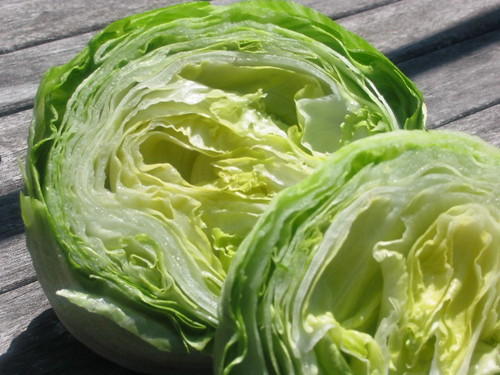 (pic courtesy of David Hammond)
You Should Subscribe to a CSA
Over at LTHForum.com, there's a discussion on CSA's, prompted by the once a year inclusion in the Genesis Grower Spring box of a head of iceberg. Besides wanting to re-post Hammond's great lettuce shot (I tried one myself, against Chez Panisse Vegetables, for irony sake, but it was not even close to as good), I wanted to re-post why I think it's a good idea to subscribe to a CSA.
To quote myself:
Why the CSA? Well, I do feel some conniption about actually supporting, nay "owning" a piece of the farm. Still, it is not just an act of charity. Ownership has its benefits. First of all, as with this week's iceberg, there will be things that go into the CSA that never make it to market. We have first crack. Second, and even more important, you build a relationship with a farmer. This cuts two ways. You can go to the farm, see how the stuff is grown, see what kinda practices they use, actually understand where you food comes from. Also, you get the inside track on things. As I have blogged about, there may be the opportunity to buy some of the heard, there are the off-season CSAs, these are less available and may be sold out to non-subscribers--and off-season is the time when you really need the stuff. And, and there is off-season. Farmer Vicki does not advertise or offer to many, but there is the chance to buy from her even in the dead of winter. Finally, as an owner, you also have access to other products of the farm. Vicki offers her home canned goods (and she's a fantastic canner).Now, I should have more on this today or soon, but with what's being reported these days about food imports and food inspections, it seems more important than ever to be a farmer (so to speak).
Friday, May 18, 2007
So You Wanna Eat Local
Think Ahead
It was a very good day at the first Green City Market of Chicago.

The Bennison Bakery girls had nothing to sell by 11:00.

And Hoosier Pie had not got around to changing their sign to reflect their lack of inventory.

I went crazy over all the fresh herbs at Growing Power; who's so local they're farming in downtown Chicago.

A day after the market, I got my weekly CSA box from Genesis Growers. More asparagus, more mint, broccoli, chard, lettuce, carrots, spring onions. What did I do. I blanched. I froze. All my broccoli from the last few weeks will be available for a long time. Broccoli, for instance, is pretty useless raw, so blanching/freezing does little to the final product. Defrosted, I can even make a salad from my handiwork. Next February.
One thing I plan on doing more this year is drying. It's easier to freeze fruit than veg, but we found limited use for frozen fruit. I cannot put it in the kidz lunch. Therefore, I'm gonna try more drying this year, peaches, apricots, grapes especially. Then, I'll have plenty of local fruit to fill their brown paper bags.
Eating local should not be a pastime that begins with the first outdoor markets in May and rolls up come fall. Buy now what you can eat later. Preserve. You will find it very worth it.
It was a very good day at the first Green City Market of Chicago.

The Bennison Bakery girls had nothing to sell by 11:00.

Green Acre Farms was equally sold out.
And Hoosier Pie had not got around to changing their sign to reflect their lack of inventory.

After our (usual) (typical) (dreadful) winter, Chicagoans are starting to revel in fresh, local food. Stories and reports on the farmers markets were all over the media last week, print and e. The hype seemed to work. A late start and the (usual) (typical) (dreadful) traffic on North Avenue got my wife and I to Green City on the late side. We still had plenty of asparagus

I went crazy over all the fresh herbs at Growing Power; who's so local they're farming in downtown Chicago.

A day after the market, I got my weekly CSA box from Genesis Growers. More asparagus, more mint, broccoli, chard, lettuce, carrots, spring onions. What did I do. I blanched. I froze. All my broccoli from the last few weeks will be available for a long time. Broccoli, for instance, is pretty useless raw, so blanching/freezing does little to the final product. Defrosted, I can even make a salad from my handiwork. Next February.
One thing I plan on doing more this year is drying. It's easier to freeze fruit than veg, but we found limited use for frozen fruit. I cannot put it in the kidz lunch. Therefore, I'm gonna try more drying this year, peaches, apricots, grapes especially. Then, I'll have plenty of local fruit to fill their brown paper bags.
Eating local should not be a pastime that begins with the first outdoor markets in May and rolls up come fall. Buy now what you can eat later. Preserve. You will find it very worth it.
Thursday, May 17, 2007
Why...Local Potatoes
Wondering why I tweaked John Bubula today about getting local potatoes
SDritz on LTHForum.com
SDritz on LTHForum.com
To go with the chicken meatloaf I whipped up last night, we had half of the asparagus and the fingerling potatoes from Nichols that I picked up during my lunch hour on Tuesday. The asparagus were terrific -- very sweet and tender. My husband kept saying, "Boy, these are the best potatoes EVER." I just threw them in the oven with a little olive oil, kosher salt and pepper in a separate dish while the meatloaf was cooking. They were really good. I'll have to get more next week.
In Season
The Chicago Tribune discovers today that some restaurants around town like to present seasonal menus.
Hugh Fearnley-Whittingstall is one of my new gurus, provides some needed context. He says exactly what I've been saying for a while, just substitute Chicago for Britain.
While I'm a half-full kinda guy when it comes to farmers markets--I loved the nearly sold out Green City Market yesterday, I'm a half-empty kinda guy when it comes to seasonality. I appreciate, I really do, what many local restaurants are doing with seasonal menus. I'd just love to see some crazy purists out there.
PS
My wife happened to finish reading the quoted article as I was wrapping up this blog post. Her take was even stronger than mind, finding the author a bit too arch, almost mocking, that seasonality was just another trend, not a legitimate aspiration.
PPS
And in discussing with my wife, I was reminded of something else in the article that bugged me (a bit). Now, I hate to say anything bad about John Bubula, his heart is in many right places (see here for instance). But the article notes about him:
North Pond serves up "exceptional ingredients at the height of their season," according to its Web site, which includes a list of 19 mostly local farms that supply the restaurant with just-harvested food, including one in a Grayslake subdivision. Add to that list dozens more -- mk, Blackbird, Green Zebra, Spring, Volo, Seasons, Va Pensiero, Sola, Everest, Timo and on and on....That means ramps in March and morel mushrooms, spring onions, spring garlic and radishes right now. This is why you're seeing asparagus on the menu these days, and soon you'll see corn.My problem with the notion of seasonality is that while I'm seeing morels now, I'm also seeing ramps (big time) and corn will not be so soon, surely not how most people consider soon.
(link)
Hugh Fearnley-Whittingstall is one of my new gurus, provides some needed context. He says exactly what I've been saying for a while, just substitute Chicago for Britain.
This is a big and important question. And I am aware that not all supposed food lovers agree with me about the answer. Much of the way cookery is presented in Britain – in books, colour supplements and on television – works against our understanding and appreciation of the seasons. It does so by fostering a ‘grass is greener’ mentality, making us aspire to someone else’s seasonality (or, ironically, their relative lack of it). It implies that the food and produce of sunnier climes (the Mediterranean in particular) are more worthwhile than our own. In short, it idolises the exotic. To those who perpetrate this idea, it may be a genuine source of regret that we do not have an endless summer in this country. I feel no such pangs. On the contrary, I think we have one of the richest experiences of the seasons of any country on earth. And we have a range of produce and a culinary heritage that reflect that experience and help to make us who we are. Our weather may be the butt of longstanding jokes among our Continental neighbours, and consequently, in that self-effacing British way, among ourselves. But don’t we love it really? Isn’t our summer so special precisely because, just like our autumn, our winter and our spring, it doesn’t last forever? (His full take on seasonality here.)
While I'm a half-full kinda guy when it comes to farmers markets--I loved the nearly sold out Green City Market yesterday, I'm a half-empty kinda guy when it comes to seasonality. I appreciate, I really do, what many local restaurants are doing with seasonal menus. I'd just love to see some crazy purists out there.
PS
My wife happened to finish reading the quoted article as I was wrapping up this blog post. Her take was even stronger than mind, finding the author a bit too arch, almost mocking, that seasonality was just another trend, not a legitimate aspiration.
PPS
And in discussing with my wife, I was reminded of something else in the article that bugged me (a bit). Now, I hate to say anything bad about John Bubula, his heart is in many right places (see here for instance). But the article notes about him:
If Bubala can get potatoes locally in season, he will. Otherwise, he orders some from Idaho.I gotta say, from my long stash of Genesis Grower keeper potatoes to a 50 lb bag of Wisconsin potatoes purchased at the wholesaler, Restaurant Depot to Igi Farms stuff that's at Trader Joes and other places to even what was just at Whole Foods, is it that hard to find local potatoes year round, round here?
Wednesday, May 16, 2007
What's Local at Whole Foods (Hell's Gate Edition*)
*North/Sheffield in Chicago
 Not much really.
There were these potatoes from Minnesota, on the far cusp of my local boundary. And the ramps that Whole Food's still pushing at sales prices. (I guess I'm not very typical of the clientele.) Yeah-yeah, there was the Organic Valley cultured butter and the Trader's Point yogurt, and even some Lynfred Winery cranberry wine, but overall, not too much local. I will say that the merchandising at this Whole Foods is worlds better than the one in River Forest, Illinois.
PS
I should also report that the morels at this Whole Foods came from California, and were even more expensive to boot!
 Not much really.
There were these potatoes from Minnesota, on the far cusp of my local boundary. And the ramps that Whole Food's still pushing at sales prices. (I guess I'm not very typical of the clientele.) Yeah-yeah, there was the Organic Valley cultured butter and the Trader's Point yogurt, and even some Lynfred Winery cranberry wine, but overall, not too much local. I will say that the merchandising at this Whole Foods is worlds better than the one in River Forest, Illinois.
PS
I should also report that the morels at this Whole Foods came from California, and were even more expensive to boot!
198 Pounds of Ground Beef to Go
In Which I Make Meatloaf

OK, no one's gonna accuse me of conspiracy to distribute food porn, certainly not with this beaut. Still, I may not be proud of my pic, but I'm proud of my original concoction. Our first use of of our local cow. Before getting into my recipe, let me, again, plug the use of local meat. It's easy to think local, buying a bit of lettuce here, an apple there, yet unless you are a vegetarian, your localness is limited without meat. Luckily farmers markets around Chicago are starting to offer meat with their veg. You may not want to do what we did, buy directly from a farmer, but you can still get your fill of local burger.
What I decided. I decided that we had a window, with the forthcoming cool front, to use the oven. A meatloaf takes over an hour, and in our air conditioning-less kitchen would not be a great idea soon. I've never made meatloaf before. The plan, the method seemed straightforward and easy. I could whip up my own creation on the first go-around.
I only made one boo-boo. With ramps still present, I knew they would be the key feature. I separated bulb from leaf. Chopped and sauteed the former. The leaves, I placed on the loaf after it went in the pan, my intention that it would provide a wrapper. Look French if you can picture. Unfortunately, the leaves just kind of pooled up on the top after an hour or so of cooking. I tried to crisp them up with the broiler and nearly burnt. They became an accent. Everything else worked if it made for an ugly product. Besides the ramp bottoms, I added a bit of cooked diced carrot to the meat, two slices of soaked, Whole Foods country wheat bread, a Farmer Vicki egg, a splash of cheap French cognac (purchased at a Russian style fish market), salt and pepper. The meat went into a clay loaf pan. A wrap of aluminium foil, a pre-heated 350 degree oven, and about an hour got us to dinner.
Although we have fresh vegetables, broccoli and kale, the dish seemed to demand certain classics. We still have a good amount of Michigan potatoes. I could use the already burning oven to roast those (Italian olive oil). To the chagrin of my wife, I took a package of last year's peas from the freezer ("I could use those in soup...stew..."). We ate a salad of Illinois lettuce, Illinois radishes, Illinois carrots and French cheese while the meat finished. Dressing, as mostly, was not local. Neither was the wine. When I sampled this, "soon to be next designated Beaujolais village" at House Red in Forest Park it had the fruitiness of the breed with a good deal of backbone/acid. A great buy at $14. The bottle we took home seemed to lack all the Beaujolais characteristics, reminding me instead of a mediocre California pinot.

OK, no one's gonna accuse me of conspiracy to distribute food porn, certainly not with this beaut. Still, I may not be proud of my pic, but I'm proud of my original concoction. Our first use of of our local cow. Before getting into my recipe, let me, again, plug the use of local meat. It's easy to think local, buying a bit of lettuce here, an apple there, yet unless you are a vegetarian, your localness is limited without meat. Luckily farmers markets around Chicago are starting to offer meat with their veg. You may not want to do what we did, buy directly from a farmer, but you can still get your fill of local burger.
What I decided. I decided that we had a window, with the forthcoming cool front, to use the oven. A meatloaf takes over an hour, and in our air conditioning-less kitchen would not be a great idea soon. I've never made meatloaf before. The plan, the method seemed straightforward and easy. I could whip up my own creation on the first go-around.
I only made one boo-boo. With ramps still present, I knew they would be the key feature. I separated bulb from leaf. Chopped and sauteed the former. The leaves, I placed on the loaf after it went in the pan, my intention that it would provide a wrapper. Look French if you can picture. Unfortunately, the leaves just kind of pooled up on the top after an hour or so of cooking. I tried to crisp them up with the broiler and nearly burnt. They became an accent. Everything else worked if it made for an ugly product. Besides the ramp bottoms, I added a bit of cooked diced carrot to the meat, two slices of soaked, Whole Foods country wheat bread, a Farmer Vicki egg, a splash of cheap French cognac (purchased at a Russian style fish market), salt and pepper. The meat went into a clay loaf pan. A wrap of aluminium foil, a pre-heated 350 degree oven, and about an hour got us to dinner.
Although we have fresh vegetables, broccoli and kale, the dish seemed to demand certain classics. We still have a good amount of Michigan potatoes. I could use the already burning oven to roast those (Italian olive oil). To the chagrin of my wife, I took a package of last year's peas from the freezer ("I could use those in soup...stew..."). We ate a salad of Illinois lettuce, Illinois radishes, Illinois carrots and French cheese while the meat finished. Dressing, as mostly, was not local. Neither was the wine.
 When I sampled this, "soon to be next designated Beaujolais village" at House Red in Forest Park it had the fruitiness of the breed with a good deal of backbone/acid. A great buy at $14. The bottle we took home seemed to lack all the Beaujolais characteristics, reminding me instead of a mediocre California pinot.
Tuesday, May 15, 2007
What Half a Cow Looks Like


It was a trip that began like so many trips of ours, with a delay, a detour, as now brace-less daughter once again forgot a permission slip. From Hatch Elementary School, our trip also proceeded as many of our trips proceed. Slowly. The long way. Faced with highway congestion and side streets, why be stuck where it's boring. At least stuck south on Cicero, with camera, I could find things like this.
Actually, for all its traffic lights, Cicero, through Oak Lawn, Alsip, Crestwood, etc. is a chowhound's delight. Wife and I were filled with, we gotta go there, we gotta go there, places. First, soon, definitely, has to be House of Hughes, a classic suburban roadhouse (in the nicer division, from the outside at least, it reminded me wholly of Melrose Park's lamented Homestead, yet oddly enough, in 2000 the Reader noted its BBQ). And surely, as we turned East on Lincoln Highway, there were some old time Italian places in the Heights to explore. We soldered on as it was between breakfast and lunch. Soon into Indiana. At US 41, stood the House of Hughes looking Teibels (scroll down), a place that has been on my short-list for eons. Still not quite lunch time. Suburbia changed like/that, to Indiana countryside. Just as we got darn hungry and in need of facilities, dining options became less. Of course, my wife, who happened to be driving, needed know assent to pull into this place.

It provided about what we expected in a countryside lunch, although we always wish for better.

Our method, about 180 minutes after leaving Oak Park, Illinois, we pulled off of Main Street, Brook, Indiana, into the parking lot of the Brook Locker.

 We waited as two families loaded their cars (one car, one pick-up truck). They roll out your meat in the mesh trays, and you put it into large clear plastic bags. It easily fit into the way-back of the Volvo. We took the highway home (yet stopping at the Fair Oaks Dairy for cheese, duh), contemplating what we would do with so much ground beef.
Monday, May 14, 2007
What's Local at Whole Foods (River Forest)
Morels!

And I spent $7 on the mushrooms pictured just so Whole Foods will sell local to you next time. First thing I did when I saw the mushrooms today was ask how much. I winced. Then, I asked where. It took a bit of digging from the pit boss, but when he finally said Antigo Wisconsin, I bought.
Ramps, sunchokes and burdock root all remain as they were from last week.

And I spent $7 on the mushrooms pictured just so Whole Foods will sell local to you next time. First thing I did when I saw the mushrooms today was ask how much. I winced. Then, I asked where. It took a bit of digging from the pit boss, but when he finally said Antigo Wisconsin, I bought.
Ramps, sunchokes and burdock root all remain as they were from last week.
Addendums
In which I add to other posts.
The Reader's Farmer's Market Calender
My additions:
- May - Morels
- July - Cherries, sweet and tart, apricots, sweet onions
- August - Peaches, nectarines, dry onions
- September - Grapes, plums, root vegetables, various wild 'shrooms
- October - Asian pears (papples), black walnuts, pumpkins
Time Out Chicago's Featured Farmers
My additions:
Genesis Growers - Obviously, I'm gonna name my friend Farmer Vicki (and name her first). Vicki grows a bunch of vegetables and a few fruit organically, yet because she is not certified, her prices are much less than others. Her vegetables exude intensity, borne out by the deep Illinois prairie soil and hot summer sun. Especially special are her hot peppers, her lettuces and her melons. Vicki is one of the few farmers around here to grow sweet potatoes. You can find her Wednesdays at Green City Market and Saturdays at Kankakee and Oak Park.
Green Acres Farms - Rivals Nichols on variety and is the strongest in the area, by far on Asian vegetables. Many types of potatoes, radishes, eggplants, onions. Green City and Evanston.
Hardin Farms - Oak Park's finest purveyor of stone fruit, especially the short season of apricots.
Oriana's Oriental Orchard - The Papple Lady. Asian pears and black walnuts. Green City Market.
LTHForum Forest Park French Market Report
This is more of an addition to my post from last week. Ann Fisher adds to the database of this market.
The Reader's Farmer's Market Calender
My additions:
- May - Morels
- July - Cherries, sweet and tart, apricots, sweet onions
- August - Peaches, nectarines, dry onions
- September - Grapes, plums, root vegetables, various wild 'shrooms
- October - Asian pears (papples), black walnuts, pumpkins
Time Out Chicago's Featured Farmers
My additions:
Genesis Growers - Obviously, I'm gonna name my friend Farmer Vicki (and name her first). Vicki grows a bunch of vegetables and a few fruit organically, yet because she is not certified, her prices are much less than others. Her vegetables exude intensity, borne out by the deep Illinois prairie soil and hot summer sun. Especially special are her hot peppers, her lettuces and her melons. Vicki is one of the few farmers around here to grow sweet potatoes. You can find her Wednesdays at Green City Market and Saturdays at Kankakee and Oak Park.
Green Acres Farms - Rivals Nichols on variety and is the strongest in the area, by far on Asian vegetables. Many types of potatoes, radishes, eggplants, onions. Green City and Evanston.
Hardin Farms - Oak Park's finest purveyor of stone fruit, especially the short season of apricots.
Oriana's Oriental Orchard - The Papple Lady. Asian pears and black walnuts. Green City Market.
LTHForum Forest Park French Market Report
This is more of an addition to my post from last week. Ann Fisher adds to the database of this market.
Local as I Wanna Be
Another Ramp Dinner

Bruschettas, two: Illinois garlic, Illinois arugula, Italian white anchovies, Indian pepper, Italian olive oil; Illinois garlic, Illinois chard, Italian white beans, Italian olive oil, Indian pepper. Then, frittata from Illinois eggs, Wisconsin cheese, Italian olive oil, Illinois asparagus, Wisconsin ramps. In my Vie like inspiration, I garnished with Michigan pickled asparagus.
Beer brewed in DuPage County. Polish water.


Bruschettas, two: Illinois garlic, Illinois arugula, Italian white anchovies, Indian pepper, Italian olive oil; Illinois garlic, Illinois chard, Italian white beans, Italian olive oil, Indian pepper. Then, frittata from Illinois eggs, Wisconsin cheese, Italian olive oil, Illinois asparagus, Wisconsin ramps. In my Vie like inspiration, I garnished with Michigan pickled asparagus.

Beer brewed in DuPage County. Polish water.

Sunday, May 13, 2007
Thursday, May 10, 2007
Why Eat Local
Janet Rausa Fuller finds an more interesting topic than me!
In most cases, the red-tinged flesh draped across the small mound of rice was tilapia -- a cheap substitute. Nine of the 14 samples were tilapia. Four were red sea bream -- nearly as pricey but still not red snapper.You know just today I happened to be looking on the Land Connection web site, and I re-read their reasons to eat local. Confidence in what you buy was not one of the reasons. Yet as today's fish fraud article in the Sun Times and the revelation the other day that Wal-Mart was passing off fraudulent organic food show, it really pays to know exactly where comes your food.
Local As I Wanna Be

Dinner
Wisconsin ramps, sauteed (with one dried Illinois pepper for accent); Great Lakes trout, sauteed; over puree made of Wisconsin turnips, Illinois carrots and Illinois turnips. Local parsley. California and Turkish olive oil, Morton kosher salt (local company!), Indian pepper, Michigan milk, Wisconsin butter, nutmeg from ??. Illinois lettuce salad (mesculun mix), dressing of California olive oil, indeterminate pasteurized egg, Italian red wine vinegar, salt/pepper as above. French wine. Polish water.

I hate to brag, but this was one hell of a dinner, the flavors going from the exact onionish-garlic of the ramp to the near candy sweet of the puree (excellent job with those turnips Vicki!); soft on the bottom, firm and meaty in between and bright and crunchy on top.
The techniques, were, well if I could do..As preparing local veg goes, peeling parsnips, carrots and turnips is one of the easier tasks. It took about 20 minuites in boiling water to make them soft enough. You might notice my puree is a bit on the, shall we say rustic side. I used a ricer, which worked fine if made a bit of a mess. I could have run it through a strainer to smooth, give it a restaurant quality, but I was afraid we would then not have enough for a meal. The rest was done with a big stainless steel pan, some butter and some olive oil.
Wednesday, May 09, 2007
Martha Bayne Ruined My Week
So, it WAS a good week
Until I read this on the Chicago Reader's food blog. Gosh, I love Washington Island (although sadly, and predictably, I never got around to posting on our meals at the Washington Island Hotel).
Martha's post hits all of my "things". Love Madison, love Washington Island Coffee Shop. Love the Madison neighborhood where its located--although I have twin bad experiences around there. First, my kids decided to partake in the small beach even though they were not wearing swim suits. Second, one daughter, who will go nameless, cough-no more more brace-cough dropped our car keys (about) in the sewer, it was not so much the sewer per se but finding them in the first place...Yet, I still love the place. Love the wheat grown on Washington Island. Love the bread baked from the wheat, love the beer made from the wheat, and certainly look forward to drinking the vodka made from the island wheat.
I hate Martha Bayne of the Chicago Reader.
Until I read this on the Chicago Reader's food blog. Gosh, I love Washington Island (although sadly, and predictably, I never got around to posting on our meals at the Washington Island Hotel).
Martha's post hits all of my "things". Love Madison, love Washington Island Coffee Shop. Love the Madison neighborhood where its located--although I have twin bad experiences around there. First, my kids decided to partake in the small beach even though they were not wearing swim suits. Second, one daughter, who will go nameless, cough-no more more brace-cough dropped our car keys (about) in the sewer, it was not so much the sewer per se but finding them in the first place...Yet, I still love the place. Love the wheat grown on Washington Island. Love the bread baked from the wheat, love the beer made from the wheat, and certainly look forward to drinking the vodka made from the island wheat.
I hate Martha Bayne of the Chicago Reader.
Eat Local - Beef
Our Cow Has Been Killed!
Actually, the slaughter (sounds better, right?) was a few weeks ago. We let it hang, farmers say hang, I guess us yuppies would have said "dry age", before butchering. Today, the big hunk of cow becomes eatable cuts of meat.
Let me digress a sec. Not that I've collected data on this, but I think most people proceed towards eating local in this vein. First, they buy some fruit, say supplementing their regular marketing with a nice box of strawberries ("honey they're all red!"). Fruties migrate to veggies, but selective veg, like sugar snaps that are not at Jewel. Finally, the budding localvore will shop for most of his or her produce at farmers markets or via a CSA. And stop there. Few take the logical step to local meat.
Several factors limit local meat consumption (at least around Chicagoland). It's expensive. That to me was a big barrier. Pricey and less delicious; well not really less delicious but it's an artisan flavor not classic steakhouse flavor. It's hard to find. Only a few farmers markets carry meat. Even if meat is available, there are usually limited cuts. It's frozen. When you do chase it down, it is nearly always frozen. This cuts down on spur of the moment meals, and many people will claim the freezing detracts. Related, if you buy meat at a farmers market you have to get it home or into a very good cooler. So for many, the local eating stops where Dr. Atkins starts.
In a lot of ways, that's a shame. Green, there may be no aspect of local eating that affects the environment more than local meat. Not to get into a lot of details, but think about all of the impacts, that's 'pacts, of industrial meat production. A lot of carbon emissions involved and other wacky-bad stuff in that production. Taste, while it just won't taste like the fanciest steakhouse, it will taste special and highly delicious. I'm really glad (and fortunate) to have this source of local meat.
Over the phone today, I dissected my cow. I had studied a fair amount, and my Executive Chef Friend Evil Ronnie supplied me with the NAMP Meat Buyers Guide. My butcher, however, knew nothing of NAMP standard cuts/numbers. We worked it out. Three bigger chuck roasts, two smaller chuck roasts, one large rib roast, the rest of the rib cut into bone-in steaks; a tenderloin, a flank steak, a brisket, inch thick NY loin steaks, one sirloin roast, several sirloin steaks, 3 round roasts, 3 round steaks, beef shanks, a skirt steak, the rest of the meat ground, heart, tongue, kidneys, tail, bones (split) and kidney fat--turns out we are the first people (at least modern people) to request the suet, in fact it actually costs the locker $$ to have the fat removed, so our suet saves them money. It will all be flash frozen.
We shall pick it up, probably on Friday.
Actually, the slaughter (sounds better, right?) was a few weeks ago. We let it hang, farmers say hang, I guess us yuppies would have said "dry age", before butchering. Today, the big hunk of cow becomes eatable cuts of meat.
Let me digress a sec. Not that I've collected data on this, but I think most people proceed towards eating local in this vein. First, they buy some fruit, say supplementing their regular marketing with a nice box of strawberries ("honey they're all red!"). Fruties migrate to veggies, but selective veg, like sugar snaps that are not at Jewel. Finally, the budding localvore will shop for most of his or her produce at farmers markets or via a CSA. And stop there. Few take the logical step to local meat.
Several factors limit local meat consumption (at least around Chicagoland). It's expensive. That to me was a big barrier. Pricey and less delicious; well not really less delicious but it's an artisan flavor not classic steakhouse flavor. It's hard to find. Only a few farmers markets carry meat. Even if meat is available, there are usually limited cuts. It's frozen. When you do chase it down, it is nearly always frozen. This cuts down on spur of the moment meals, and many people will claim the freezing detracts. Related, if you buy meat at a farmers market you have to get it home or into a very good cooler. So for many, the local eating stops where Dr. Atkins starts.
In a lot of ways, that's a shame. Green, there may be no aspect of local eating that affects the environment more than local meat. Not to get into a lot of details, but think about all of the impacts, that's 'pacts, of industrial meat production. A lot of carbon emissions involved and other wacky-bad stuff in that production. Taste, while it just won't taste like the fanciest steakhouse, it will taste special and highly delicious. I'm really glad (and fortunate) to have this source of local meat.
Over the phone today, I dissected my cow. I had studied a fair amount, and my Executive Chef Friend Evil Ronnie supplied me with the NAMP Meat Buyers Guide. My butcher, however, knew nothing of NAMP standard cuts/numbers. We worked it out. Three bigger chuck roasts, two smaller chuck roasts, one large rib roast, the rest of the rib cut into bone-in steaks; a tenderloin, a flank steak, a brisket, inch thick NY loin steaks, one sirloin roast, several sirloin steaks, 3 round roasts, 3 round steaks, beef shanks, a skirt steak, the rest of the meat ground, heart, tongue, kidneys, tail, bones (split) and kidney fat--turns out we are the first people (at least modern people) to request the suet, in fact it actually costs the locker $$ to have the fat removed, so our suet saves them money. It will all be flash frozen.
We shall pick it up, probably on Friday.
What's Local - Whole Foods (River Forest)
It's getting better all the time...
Well, not really, especially when they have oranges from South Africa. South Africa, Michael Pollin, are you still in touch? Still, the produce department now has, instead of one local item, four local items.
Well, not really, especially when they have oranges from South Africa. South Africa, Michael Pollin, are you still in touch? Still, the produce department now has, instead of one local item, four local items.
ramps (still!)I passed on the root-y things until so I can check some books. I'm confident they'll be there next time.
burdock root
sunchokes
parsnips
Cheesemakers of Wisconsin
SLBunge at Mouthfulsfood.com provides a nice list of Wisconsin cheesemakers for touring purposes:
If you come the northern route, there are a number of interesting cheesemakers in Wisconsin.
Within about a 45 miles radius of Madison you've got the following cheesemakers that I can vouch for having very good product:
Fantome Farm (Ridgeway) for goat cheeses
Uplands Cheese Company (Dodgeville) for Pleasant Ridge Reserve
Bleu Mont Dairy (Blue Mounds) for cave-aged Swiss styles and artisinal versions of New World styles of cheese.
Hook's Cheese Company (Mineral Point) for very good aged cheddars and decent blues.
Chalet Cheese Coop (Monroe) is notable for being the last US producer of fresh Limburger.
If you get to all of these places is that you will be driving through some of the upper-Midwest's prettiest countryside with lush, rolling hills and great twisted country roads.
Farther afield but maybe worth a drive there are these:
Carr Valley (LaValle) makes award willing European-style cheeses.
Widmer's Cheese Cellars (Theresa) in a tiny little downtown dairy makes the classic American Brick cheese although it is probably too large to be considered artisinal.
Lovetree Farmstead Cheeses (Grantsburg) makes fantastic sheep's milk cheeses but is fairly far north.
BelGioioso (Denmark) makes fine versions of Italian cheeses including a Burrata. Again, the company may be a bit large for your taste.
Chicago Area Farmers Markets
From the Trib:
List
"Buying locally grown food supports our independent farmers, preserves open land from development--and fresher food is better for you," said Veronica Resa, media relations specialist and community relations liaison for the Mayor's Office of Special Events.
List
Tuesday, May 08, 2007
A Good Week, A Great Week

- Sophia ditches brace
Intransigeant catering problem resolved
Invitations out
Camera found
Ramps
Vie Update Update
Just because I posted on Vie yesterday, did not mean I had any plan to go there. Yet as it turned out, we had something big (HUGE) to celebrate last night. My scoliosis stricken daughter got the good, nay, huge, nay near-improbable news that her s-curved spine was no more. In the words of the Doc, "don't know why, but don't really care." Sophia has worn a brace for nearly two years (not days as I orignally wrote!), thick or thin, 23 or so hours a day, ever present dry-fit shirt trying to stave off heat. It was expected that she wear this form-fitting plastic master until at least her 16th year. Today she won't. Tomorrow she won't. She has been freed. Vie just happened to be nearby. What better place to celebreate.
I'm a big believer that context is key in dining, and often food tastes so good because of the circumstances. Vie certainly tasted better than ever last night. Not only the brace-off, but there was the pre-teens partaking in one of their fancier dining experiences ever and taking it for all its worth--Sophia insisted she wanted the kobe steak. The kids, at least, put the amuse in the amuse, guzzled with glee their complimentary kiddie cocktails, and wiped their plates entirely clean from their initial morel to their final mini-cheesecake.
It helps, I guess, that a fresh season is great season to hit Vie. Vie gets the best just arrived produce. Nearly all of it is local, but they have outstanding connections for the few non-local items like their fresh hearts of palm. Asparagus hit at least a third of his dishes, rhubarb and ramps made multiple appearances, and other spring things like radishes and dandelion were rampant (haha). Chef Virant applies the proper application to these prime ingredients. Most of his prepartions are classic: asparagus with hollandaise, seared foie gras. In fact when I think about it, I would say that Virant's ouevre is Joy of Cooking, especially the pentultimate fancier-food edition. His recipes are very, well, ordinary is not the right word, probably classic. Yet what sets the food apart, by far, are the accents, an unusual vegetable here, a strong mustard dressing there and, as widely reported, ample use of picked and preserved things. It was all wrapped up in that amusing amuse: morel (not local) battered fried on top of a ramp vinaigrette, accented by some shavings of asparagus.
My older daughter and I shared bacony meal. We had a salad with wood grilled dandelions and a strip of house made bacon (gray from no nitrates) and the bacon wrapped Guntrhop Farm chicken ballotine, served with peas and chard. I also ordered the foie gras with poached rhubarb that reminded me a bit (in a good way) of bacon. This was Tinkers to Evers to Chance. Exact. Special. Outstanding.
As I said, my other daughter had the steak, and in a testament to times-a-changin', she ate a hell of a lot more of the steak than the side order of house made naan. The waiter talked my wife into the turbot en papillote. It came with a herb vinaigrette, but I liked it's natural, birthed from the paper state better.
To celebrate, Chef Virant sent us out coolers of rhubarb juice with rhubarb shreds before we dug into three desserts: rhubarb cobbler, molten chocolate cake and peanut butter gooey butter cake. They were all good, but the chocolate cake did not quite rise to the specialness that is Vie's stuff.
Monday's happen to be 1/2 price wine night at Vie. To celebrate we had a 1/2 bottle of Billecart-Salmon, one of my favorites (about my favorite) NV champagnes; then we had a bottle of Régis Minet, Vieilles Vignes, Pouilly Fumé that I found a little too subtle. I've become too hooked on New Zealand SBs.
I'm a big believer that context is key in dining, and often food tastes so good because of the circumstances. Vie certainly tasted better than ever last night. Not only the brace-off, but there was the pre-teens partaking in one of their fancier dining experiences ever and taking it for all its worth--Sophia insisted she wanted the kobe steak. The kids, at least, put the amuse in the amuse, guzzled with glee their complimentary kiddie cocktails, and wiped their plates entirely clean from their initial morel to their final mini-cheesecake.
It helps, I guess, that a fresh season is great season to hit Vie. Vie gets the best just arrived produce. Nearly all of it is local, but they have outstanding connections for the few non-local items like their fresh hearts of palm. Asparagus hit at least a third of his dishes, rhubarb and ramps made multiple appearances, and other spring things like radishes and dandelion were rampant (haha). Chef Virant applies the proper application to these prime ingredients. Most of his prepartions are classic: asparagus with hollandaise, seared foie gras. In fact when I think about it, I would say that Virant's ouevre is Joy of Cooking, especially the pentultimate fancier-food edition. His recipes are very, well, ordinary is not the right word, probably classic. Yet what sets the food apart, by far, are the accents, an unusual vegetable here, a strong mustard dressing there and, as widely reported, ample use of picked and preserved things. It was all wrapped up in that amusing amuse: morel (not local) battered fried on top of a ramp vinaigrette, accented by some shavings of asparagus.
My older daughter and I shared bacony meal. We had a salad with wood grilled dandelions and a strip of house made bacon (gray from no nitrates) and the bacon wrapped Guntrhop Farm chicken ballotine, served with peas and chard. I also ordered the foie gras with poached rhubarb that reminded me a bit (in a good way) of bacon. This was Tinkers to Evers to Chance. Exact. Special. Outstanding.
As I said, my other daughter had the steak, and in a testament to times-a-changin', she ate a hell of a lot more of the steak than the side order of house made naan. The waiter talked my wife into the turbot en papillote. It came with a herb vinaigrette, but I liked it's natural, birthed from the paper state better.
To celebrate, Chef Virant sent us out coolers of rhubarb juice with rhubarb shreds before we dug into three desserts: rhubarb cobbler, molten chocolate cake and peanut butter gooey butter cake. They were all good, but the chocolate cake did not quite rise to the specialness that is Vie's stuff.
Monday's happen to be 1/2 price wine night at Vie. To celebrate we had a 1/2 bottle of Billecart-Salmon, one of my favorites (about my favorite) NV champagnes; then we had a bottle of Régis Minet, Vieilles Vignes, Pouilly Fumé that I found a little too subtle. I've become too hooked on New Zealand SBs.
What Was Local in Forest Park, What Is Local in River Forest, What Will Be Local in Oak Park
I got the near Western suburbs covered.
Last Saturday, the Forest Park French Market began its seasonal run. It's funny with farmer's markets. It's like the opposite of wine, with farmer's markets, it's like the the more you know and appreciate, the more you like bad markets. I mean my wife likes to tell the story about how disappointed we were on our first visit to the, first of the year, Oak Park Farmer's Market; we were like that's all. We soon learned about how things grew around here. Now, of course, it does not take much in a market to make me happy. More dry flowers, painted furniture and earrings than food, well so what.
Forest Park French last week had two produce merchants. One, Hardin Farms, from Michigan, is one of my favorites (they also sell in Oak Park). They were selling black walnuts, cracked black walnuts (!) and dried fruit. The other produce people was an operation with farms in Northern and Southern Illinois. They had the first local asparagus I've seen as well as radishes. Also, and to my happiness they had some stored garlic (also stored onions and potatoes but I did not need those). Instead of ruminating on this small holding, we took pleasure in buying what was there. Beside these guys, there was an Amish outfit selling the usual Amish stuff: pies (made with lard), noodles, rolls, and eggs. The French Nun sold pastries that only looked like what the French could make.
The local offerings at the Whole Foods in River Forest are not vast. Yet, in the vein of appreciating the small, let's appreciate what they have. Firstly, there are ramps, fresh, local ramps from Harmony Farms in Wisconsin. We purchased four bunches. Secondly, the fish counter featured three lake fish including gorgeous orange-tan lake trout. Thirdly, the cases across from the fish featured such local products as Rushing Waters rainbow trout spread and Organic Prairie bacon (for purists note that while based in Wisconsin, there is no guarantee that the Organic Valley/Prairie stuff comes from local farmers). Finally, as always, there's local milk and butter.
And to come, in Oak Park, I got a little preview of what will be there when the market opens on June 2, there will be a few additions. Bread and meat, continuing to move beyond just things grown in the ground, the Oak Park Farmer's Market this year will have two bread bakers and another meat vendor (chicken and lamb). I look forward fer sure.
Last Saturday, the Forest Park French Market began its seasonal run. It's funny with farmer's markets. It's like the opposite of wine, with farmer's markets, it's like the the more you know and appreciate, the more you like bad markets. I mean my wife likes to tell the story about how disappointed we were on our first visit to the, first of the year, Oak Park Farmer's Market; we were like that's all. We soon learned about how things grew around here. Now, of course, it does not take much in a market to make me happy. More dry flowers, painted furniture and earrings than food, well so what.
Forest Park French last week had two produce merchants. One, Hardin Farms, from Michigan, is one of my favorites (they also sell in Oak Park). They were selling black walnuts, cracked black walnuts (!) and dried fruit. The other produce people was an operation with farms in Northern and Southern Illinois. They had the first local asparagus I've seen as well as radishes. Also, and to my happiness they had some stored garlic (also stored onions and potatoes but I did not need those). Instead of ruminating on this small holding, we took pleasure in buying what was there. Beside these guys, there was an Amish outfit selling the usual Amish stuff: pies (made with lard), noodles, rolls, and eggs. The French Nun sold pastries that only looked like what the French could make.
The local offerings at the Whole Foods in River Forest are not vast. Yet, in the vein of appreciating the small, let's appreciate what they have. Firstly, there are ramps, fresh, local ramps from Harmony Farms in Wisconsin. We purchased four bunches. Secondly, the fish counter featured three lake fish including gorgeous orange-tan lake trout. Thirdly, the cases across from the fish featured such local products as Rushing Waters rainbow trout spread and Organic Prairie bacon (for purists note that while based in Wisconsin, there is no guarantee that the Organic Valley/Prairie stuff comes from local farmers). Finally, as always, there's local milk and butter.
And to come, in Oak Park, I got a little preview of what will be there when the market opens on June 2, there will be a few additions. Bread and meat, continuing to move beyond just things grown in the ground, the Oak Park Farmer's Market this year will have two bread bakers and another meat vendor (chicken and lamb). I look forward fer sure.
Monday, May 07, 2007
New Menu up for Vie
Chef Paul Virant changes his menu more than weekly, to reflect his moods, whims and what's in season. Unfortunately, he does not change his online menu that often. I always take pleasure when a new Vie menu has been posted. I do have to say, in my fantasy world, Vie would ditch the octupus and everything else not local, but has I have noted, he does tend to cook this stuff very well.
Localvores.org
This site just sprang up (Localvores.org). I do not know if it's just a web based resouce or a club. Regarldess, I'm happy for the resource and look forward to seeing what they are up to.
Sunday, May 06, 2007
Local as I Wanna Be
Dinner
Local herbs, (mixed into) Wisconsin butter, Wisconsin ramps, olive oil from California, sea salt from some sea, pepper from who knows (India, I believe); grapeseed oil also from who knows; Great Lakes trout, Michigan potatoes, Illinois lettuce, Wisconsin blue cheese, California lemon, French wine, Italian water.
Local herbs, (mixed into) Wisconsin butter, Wisconsin ramps, olive oil from California, sea salt from some sea, pepper from who knows (India, I believe); grapeseed oil also from who knows; Great Lakes trout, Michigan potatoes, Illinois lettuce, Wisconsin blue cheese, California lemon, French wine, Italian water.
Friday, May 04, 2007
Slow Food Nation
Via the Purple Asparagus listserv:
Carlo Petrini, founder of the international Slow Food Movement, will be in Chicago on May 19th, to discuss his new book, Slow Food Nation: Why our Food Should be Good, Clean, and Fair.
Date: Saturday, May 19th, 2:00 pmLocation: Thorne Auditorium, Northwestern University School of Law. The auditorium is located at the corner of Chicago Ave. and N. Lake Shore Drive in downtown Chicago .
Admission cost: $5, with advance reservations strongly advised.Students and faculty with valid ID, admitted for free.To Reserve: On-line or call the Chicago Humanities Festival, 312.661.1028, ext 40.
His talk will focus on three strategies outlined in his new book:
- Defending biodiversity;
- promoting taste education;
- building of local food communities
Traveling the world in order to write Slow Food Nation, Petrini witnessed first-hand the many ways that local and native peoples feed themselves without making use of the methods employed by agribusiness and the food industrial complex described in such recent books as Fast Food Nation by Eric Schlosser and The Omnivore's Dilemma by Michael Pollan.
Petrini relates real-life anecdotes about the behaviors of peoples in places as varied as Chiapas, Mongolia, Puglia, Bangladesh, and Sweden.He concludes that the food we eat should be healthful and delicious (good); sustainably produced using environmentally sensitive methods (clean); by producers who are justly compensated and treated with dignity (fair).
Co-sponsors of this event are Slow Food Chicago, the Chicago Humanities Festival, L'Istituto Italiano di Cultura, the Alice Kaplan Institute for the Humanities, Chicago's Green City Market, and Rizzoli International.
Petrini will present his lecture in Italian with an onstage translator. Afterwards he will be available to sign books, with on-site sales provided by The Book Stall of Winnetka.
Thursday, May 03, 2007
And Now for Something Completely Different
But still green!
With the lettuce (head), lettuce (mescalun), cooking greens (chard), green onions (two bunches!), and radishes (well, the tops are green); this week's box also included broccoli.
Ah, spring.
With the lettuce (head), lettuce (mescalun), cooking greens (chard), green onions (two bunches!), and radishes (well, the tops are green); this week's box also included broccoli.
Ah, spring.
Plenty - Something I Did Not Know
I Don't Need Much Convincing.
I'm not reading Plenty for ecological footprints and animal cruelty and salad recipes. They got my respect from page one. I'm convinced. Still, I was hoping to pick some things up from this couple who ate everything from 100 miles or less, and 3 or so months into the adventure, I got my first good factoid.
I pine for a year round market in the Chicago area. It is May, however, and markets around here are (at least) soon: Green City (May 17) and Evanston (May 19) are about the first to roll out. But also, the "French Market" in Forest Park (which actually features French nuns, or even more accurately, actual French, French nuns) will run this Saturday from 9-1 PM on Madison in Forest Park. Here's a report on last years early Forest Park French Market.
I'm not reading Plenty for ecological footprints and animal cruelty and salad recipes. They got my respect from page one. I'm convinced. Still, I was hoping to pick some things up from this couple who ate everything from 100 miles or less, and 3 or so months into the adventure, I got my first good factoid.
It took an Act of Congress in 1976 that allowed for farmer's markets, a law that essentially allowed states to allow farmer's markets. Before this, there were fewer than 300 farmer's markets in the USA. Now, there are more than 3,000.
I pine for a year round market in the Chicago area. It is May, however, and markets around here are (at least) soon: Green City (May 17) and Evanston (May 19) are about the first to roll out. But also, the "French Market" in Forest Park (which actually features French nuns, or even more accurately, actual French, French nuns) will run this Saturday from 9-1 PM on Madison in Forest Park. Here's a report on last years early Forest Park French Market.
Tuesday, May 01, 2007
What's Local at Caputo's...What's Local at Whole Foods...What's Local...
I'm only a bit into Plenty, the tale of two people who only eat local. In the beginning we learn much of what they cannot have, because it is beyond their 100 mile limit. One of the hardest things for them is no local grain, forcing them to make sandwiches from sliced turnips. On the other hand, their stores in Vancouver supply an array of local seafood. Me, if I was a bread baker, could use my Wisconsin wheat or my Minnesota oats or my cornmeal from two states, yet in my stores, I find, well, whitefish.
While Caputo's today had Michigan apples on sale, 59 cents/lb, whitefish is probably the one local item that can always be found around here. I heavily interrogated the fishmonger at Whole Foods about their fillets, making him let me smell them, before a recent purchase. As I am wont, their localness made dinner extra delicious. My wife used a preparation that highlighted their freshness.
She thawed some asparagus (how's that for an off riff on Cali-corporate seasonality, eating last year's asparagus this time of year) and made a bed on a sheet of foil. Sliced lemon and herbs (local of course) made a layer before the fish. She rubbed a bit of mustard (mustard, there's another thing that would keep me from being 100 mile pure), splashed some white wine and folded. 20 or so minutes in a pre-heated oven, and we were local-licously eating our second course of dinner. First, last week's chard, which turned its accompanying pasta pink.
Sadly, my joy over dinner is lessened (a lot), by the fact that I cannot seem to find my camera--I had wanted to document the whitefish. I hope that mere words suffice.
While Caputo's today had Michigan apples on sale, 59 cents/lb, whitefish is probably the one local item that can always be found around here. I heavily interrogated the fishmonger at Whole Foods about their fillets, making him let me smell them, before a recent purchase. As I am wont, their localness made dinner extra delicious. My wife used a preparation that highlighted their freshness.
She thawed some asparagus (how's that for an off riff on Cali-corporate seasonality, eating last year's asparagus this time of year) and made a bed on a sheet of foil. Sliced lemon and herbs (local of course) made a layer before the fish. She rubbed a bit of mustard (mustard, there's another thing that would keep me from being 100 mile pure), splashed some white wine and folded. 20 or so minutes in a pre-heated oven, and we were local-licously eating our second course of dinner. First, last week's chard, which turned its accompanying pasta pink.
Sadly, my joy over dinner is lessened (a lot), by the fact that I cannot seem to find my camera--I had wanted to document the whitefish. I hope that mere words suffice.
Reason to Eat Local
NYT:
Last year, inspectors sampled just 20,662 shipments out of more than 8.9 million that arrived at American ports. China, which in one decade has become the third-largest exporter of food, by value, to the United States, sent 199,000 shipments, of which less than 2 percent were sampled, former officials with the agency said.
Now, as F.D.A. inspectors travel to China to investigate the source of contaminated pet food that has killed at least 16 dogs and cats and sickened thousands of others, critics in Washington are warning that the agency is woefully understaffed and underfinanced to keep America’s food supply safe.
Monday, April 30, 2007
Drink Local
Via the Trib's food blog, South Water Kitchen is offering an array of Midwestern wines. I'll have to try this soon.
South Water Kitchen is located at 225 N. Wabash Ave. 312-236-9300 .
South Water Kitchen is located at 225 N. Wabash Ave. 312-236-9300 .
How to Store Vegetables
Farmer Vicki provides some useful tips this week on storing veg. As the author of the Time Magazine piece on Eat Local noted, CSA/farmer's market stuff lasts a lot longer than expected, a huge benefit of you getting it so soon after harvest. In our house, we find vegetables lasting much longer than standard advice given in books. Here's Vicki's advice:
How to store veggies
First, veggies like humidity but not wetness. With a few exceptions, like tomatoes, they are best stored in the refrigerator.
Leafy greens - If they look a little tired, immerse in a bowl or sink of cold water for five minutes. Remove, drain or spin and place in a plastic bag or container with a paper towel to absorb moisture and to later provide humidity. If you lack time, moisten a paper towel. Place it in the bottom of a plastic container, place the green on top of it and seal and store in the frige. One of our members treats them like fresh flowers. She cuts the bottom of the stem and sets them in a bowl of water for a half hour or so.
Lettuce - Lettuce should be treated the same as greens. It is even more sensitive to excess water so be careful not to get your towel too wet. Storage of lettuce can be two weeks, if kept humid, not wet, sealed and cold.
Root crops - Beets, turnips, carrots, radishes, etc. These crops are best stored long term without greens. The greens may be left attached if they will be used within a few days to a week. Otherwise cut off the tops to use as a green. Most of the greens are more nutritious than the root. Even carrot tops are edible and highly nutritious. Use them for juicing, smoothies or as a salad ingredient. Store roots with humidity. A paper towel, dampened in a sealed plastic container works well. They can be stored for a long time - even months this way. Traditionally these crops were stored in a root cellar in damp saw dust and held up for 5 or 6 months. The only caution is not too much water. Water causes rotting.
Vital Book
Like Martha at the Reader, I've started reading Plenty, the tale of a couple who take eating local VERY seriously. And Like Martha, I'll withold judgment until I finish (or at least until I can spout my mouth off).
Friday, April 27, 2007
With Eggs
Farmer Vicki told us (see below) that Spring is the time for things green (although Hat Hammond notes that there was a bit of purple this week as well.) A way my family enjoys these omnipresent spring greens is with eggs. A great natural partner, and many cuisines do the egg-greens combo thing. The eggs (good farm fresh like we get from Genesis Growers*) tap down some of the green's edge, and the greens boost the mildness of the eggs. Moreover, when you make the eggs strapazzatti, gently scrambled in large curds, you get wonderfully contrasting bites of egg and green.
This recipe started with Swiss chard, dropping the stems in boiling water a few minutes before the leaves. Some where in between, I added kale to the boiling water. You cannot have too much or too little greens for this dish. I lightly beat eight eggs with salt, pepper, and a good splash of heaven forbid non-local olive oil. Then, I sauteed the whites from three of this week's green onions in some olive oil--I used to bemoan all the spring onions Vicki gave, then I realized we needed to cook with the onion in season; green from spring through early summer, then the soft skin sweet onions (until they ran out) and finally, the rest of the year, the dry ones. The greens go into the pan to get introduced to the onions followed soon by the eggs. It's done over low heat. I don't use a classic French twenty-five minute scramble, but I do try to take my time. It's a recipe that will work with any green around, and like yesterday, especially good with something (my chard) that was on the tired side.
Of course, we were stayed as local as possible with a side of Michigan potatoes (boiled). Mesculun from last week (strong!) set us up for two local cheese from Marion Street Cheese Market in Oak Park: Prairie Fruit Farms moldorific ordorrific goat's blue called Huckleberry Blue and a slightly milder (anything would be milder) Amish edamish type of cheese whose name I cannot now locate. Had to stay local for the beverage, drinking hoppy (but too simple) beer from Two Brothers (nice post on them here.)
The box this week: the used kale, romaine lettuce, green leaf lettuce (a variety called Waldmans), Napa cabbage, radishes, beets, spring onions and a jar of Vicki's home canned apple jam (although I would have preferred the spiced apples I spied in her kitchen the other day!).
*The eggs are a hoot. Because the chickens are different breeds and ages, it's a dozen "mixed", ranging in size and color. Not eggs to bake with, per se, but as delcious as anything.
This recipe started with Swiss chard, dropping the stems in boiling water a few minutes before the leaves. Some where in between, I added kale to the boiling water. You cannot have too much or too little greens for this dish. I lightly beat eight eggs with salt, pepper, and a good splash of heaven forbid non-local olive oil. Then, I sauteed the whites from three of this week's green onions in some olive oil--I used to bemoan all the spring onions Vicki gave, then I realized we needed to cook with the onion in season; green from spring through early summer, then the soft skin sweet onions (until they ran out) and finally, the rest of the year, the dry ones. The greens go into the pan to get introduced to the onions followed soon by the eggs. It's done over low heat. I don't use a classic French twenty-five minute scramble, but I do try to take my time. It's a recipe that will work with any green around, and like yesterday, especially good with something (my chard) that was on the tired side.
Of course, we were stayed as local as possible with a side of Michigan potatoes (boiled). Mesculun from last week (strong!) set us up for two local cheese from Marion Street Cheese Market in Oak Park: Prairie Fruit Farms moldorific ordorrific goat's blue called Huckleberry Blue and a slightly milder (anything would be milder) Amish edamish type of cheese whose name I cannot now locate. Had to stay local for the beverage, drinking hoppy (but too simple) beer from Two Brothers (nice post on them here.)
The box this week: the used kale, romaine lettuce, green leaf lettuce (a variety called Waldmans), Napa cabbage, radishes, beets, spring onions and a jar of Vicki's home canned apple jam (although I would have preferred the spiced apples I spied in her kitchen the other day!).
*The eggs are a hoot. Because the chickens are different breeds and ages, it's a dozen "mixed", ranging in size and color. Not eggs to bake with, per se, but as delcious as anything.
Thursday, April 26, 2007
Eat Local - In Spirt
A long time ago, I touched on the notion that it was possible to Eat Local without actually eating local. That given the various constraints (see post below), it was not always possible to Eat Local (or as local as you wanted), yet one could always try to eat "as if". Was it made like local; artisanal; family (or small) farm, fair trade, organic, shade grown, free range, grass-fed, hormone free, without antibiotics, tuna safe--buzz words for sure, but pay attention, research. I have no hierarchy or scale (although I do tend to disdain corporganic like Horizon Milk). Just look for the products that seem best. Seek the products that would be like what you would get if you could find it local. Moreover, could it mimic the environmental impact of local; how many layers of packaging, could it be bought in bulk, how far did it travel.
A good read today, from the Chicago Tribune discusses the issue of plastic bags. In short: plastic bags bad (!). So, compare the amount of plastic bags needed to buy produce at the grocery store to my CSA box from Genesis Growers. Who gets more plastic? If you are not getting a CSA, however, you can still try, as if, by reducing your use of plastic bags. As they say in the article:
Things do add up.
A good read today, from the Chicago Tribune discusses the issue of plastic bags. In short: plastic bags bad (!). So, compare the amount of plastic bags needed to buy produce at the grocery store to my CSA box from Genesis Growers. Who gets more plastic? If you are not getting a CSA, however, you can still try, as if, by reducing your use of plastic bags. As they say in the article:
Avoiding the use of plastic bags is very difficult. My daily newspaper is usually delivered in a plastic bag. Most department stores, convenience stores and drugstores offer nothing but plastic bags. When I make a small purchase and say "I don't need a bag," I am usually greeted with disbelief. At a grocery store that customarily offers paper bags, I have to emphasize, "No plastic, please." At some establishments, for tiny purchases, many shopkeepers ask, "Would you like a little bag?" as if it were a courtesy.
Things do add up.
Wednesday, April 25, 2007
Honey We're In the New York Times!
Well not us per se (we were in the Sun Times), but today's New York Times notes [registration req.] the movement towards eating local. It's an OK article. It hits upon key elements on why; carbon footprint, tastes better, supports farmers, but especially as it focuses on purists, makes it seem quite hard to eat local.
First of all, if you peruse the Eat Local Challenge blog you find few (if any) absolutists. We wrestle with issues like spices yet accept many far away products. Some of it is craven addiction--see me without morning coffee, a lot of it (at least for me) is a sense of which items are meant to travel or have historically traveled. Spices have always been caravaned; apples have not. Second, as I keep on saying, it's not that hard (or maybe, it gets easier). Yes, it can require diligence and effort. Find farmer. Buy freezer. Enjoy turnip. Take what you can get. Help if the kidz love apples.
Granted, the article brought up some serious limitations. For one thing, the article talks about people forced to make odd sandwiches because there were no local grains. I mean coffee-shmoffee, if your area does have bread things, it can get tricky. For another thing, the article mentions the increased cost of local chicken. It does take some work and expense at being local. I mean if I wanted really local bread, I could bake it from Wisconsin wheat. If I wanted. To bake. On the other hand, I'm laying out some big coin for my 1/2 cow; it's not that expensive for beef, per se, but on the other hand as one purchase, it seems a lot.
Figure out what works because it can be done.
First of all, if you peruse the Eat Local Challenge blog you find few (if any) absolutists. We wrestle with issues like spices yet accept many far away products. Some of it is craven addiction--see me without morning coffee, a lot of it (at least for me) is a sense of which items are meant to travel or have historically traveled. Spices have always been caravaned; apples have not. Second, as I keep on saying, it's not that hard (or maybe, it gets easier). Yes, it can require diligence and effort. Find farmer. Buy freezer. Enjoy turnip. Take what you can get. Help if the kidz love apples.
Granted, the article brought up some serious limitations. For one thing, the article talks about people forced to make odd sandwiches because there were no local grains. I mean coffee-shmoffee, if your area does have bread things, it can get tricky. For another thing, the article mentions the increased cost of local chicken. It does take some work and expense at being local. I mean if I wanted really local bread, I could bake it from Wisconsin wheat. If I wanted. To bake. On the other hand, I'm laying out some big coin for my 1/2 cow; it's not that expensive for beef, per se, but on the other hand as one purchase, it seems a lot.
Figure out what works because it can be done.
Tuesday, April 24, 2007
What's Local at My Local Whole Foods
Nothing!*
It's fun to repeat blog posts, no? On Sunday, the sign advertised Harmony Valley turnips; the box said Cal-Organic.
*Actually, without a sign or any sign or other advertisement, Whole Foods was selling red potatoes from IGI Farms in Wisconsin.
It's fun to repeat blog posts, no? On Sunday, the sign advertised Harmony Valley turnips; the box said Cal-Organic.
*Actually, without a sign or any sign or other advertisement, Whole Foods was selling red potatoes from IGI Farms in Wisconsin.
Links
I've culled some Eat Local links from LTHForum.com
Fresh Eggs Near Wauconda
Wettstein's Meat in Oak Park
Grass Fed Beef in Chicago (granted not all of it is local)
Best CSA
Excess Radishes in Box, Now What
2007 Wisconsin Artisan and Farmstead Directory
Unexpected Delight at Green City Market
Local Produce in the Off-Season
Winter Green City Market
Beer and Cheese Tour of Wisconsin
Fresh Eggs Near Wauconda
Wettstein's Meat in Oak Park
Grass Fed Beef in Chicago (granted not all of it is local)
Best CSA
Excess Radishes in Box, Now What
2007 Wisconsin Artisan and Farmstead Directory
Unexpected Delight at Green City Market
Local Produce in the Off-Season
Winter Green City Market
Beer and Cheese Tour of Wisconsin
Monday, April 23, 2007
Will('s) Special
Well, I was Mr. Proud Papa last week (thank's again Janet), but, as it turns out, compared to Our friend and Pal, former Chowhounder, current LTHer, YourPalWill, well, as those neighbors in Aurora would say, "we're not worthy, we're not worthy".
Let me explain:
Or digress, you see most foodies of a certain age, before we had the Internets to inspire and amuse us had books and magazines and stuff like that. We had, namely, Calvin Trillin and the Stern's. Mr. T writes some food stuff still, but without his beloved, he seems a bit less interested in that. The Sterns, even as one took a career change, go on, cranking out new editions of RoadFood every few years. Occasionally, they mix it up, as in their latest version, which focuses on the sandwich.
So, I see new book yesterday at Book Table in Oak Park. My wife and I start thumbing through the book, noticing all the places and sandwiches we've tried over the years: Casamento's oyster loaf, Katz's, Hoover's in Austin, when we get to the third (or so) page of contents. I (first) see Rivieria. Cool. Been there done that. Then, I notice the sammy listed for da'Riv.
Not just an Italian sub, but the Will freakin' special. The Will special. Granted, for those who know Will, take his girl scout cookie orders or otherwise hang with him, they know he's pretty darn special, but now all the nation also knows about the Will Special at Riviera. And (and!) Lthforum gets a plug too!
Check it out in bookstores everywhere! And get thee to Riviera for a Will Special.
Riviera Italian Imported Foods
3220 N Harlem Ave Chicago, IL 60634
773-637-4252
Let me explain:
Or digress, you see most foodies of a certain age, before we had the Internets to inspire and amuse us had books and magazines and stuff like that. We had, namely, Calvin Trillin and the Stern's. Mr. T writes some food stuff still, but without his beloved, he seems a bit less interested in that. The Sterns, even as one took a career change, go on, cranking out new editions of RoadFood every few years. Occasionally, they mix it up, as in their latest version, which focuses on the sandwich.
So, I see new book yesterday at Book Table in Oak Park. My wife and I start thumbing through the book, noticing all the places and sandwiches we've tried over the years: Casamento's oyster loaf, Katz's, Hoover's in Austin, when we get to the third (or so) page of contents. I (first) see Rivieria. Cool. Been there done that. Then, I notice the sammy listed for da'Riv.
Not just an Italian sub, but the Will freakin' special. The Will special. Granted, for those who know Will, take his girl scout cookie orders or otherwise hang with him, they know he's pretty darn special, but now all the nation also knows about the Will Special at Riviera. And (and!) Lthforum gets a plug too!
Check it out in bookstores everywhere! And get thee to Riviera for a Will Special.
Riviera Italian Imported Foods
3220 N Harlem Ave Chicago, IL 60634
773-637-4252
Friday, April 20, 2007
Eat Local - Fish
Bill Daley in (the link free!) Chicago Tribune blog asks about local fish, namely local smelts. Sadly, as far as I know, there is no commercial fishing in Illinois, or much commercial fishing of any kind in Illinois. Perhaps there are people who know, but when I look at the regs, there seems nothing against fishing per se. Forces do conspire.
It's fishy. It's bony. It's toxic. (OK, there may be a point there.) Muddy, mushy, not so meaty, no tartare, no sashimi, hell no ceviche, who wants freshwater fish. And remember that cookbook culture that tells us we should be gorging away at artichokes and peas about now, well these books are filled with tuna and salmon and recipes just for the halibut (hahahaha). I can see why no one wants to dip their nets in our waters.
Maybe teeming is not the word, but the Great Lakes contain many delicious fish: whitefish, perch, the un-sellable coho, trout, Bill Daley's smelts, even (I'm sure) some remaining herrings. This is how I suggest demand gets re-built. Go to Washington Island, Wisconsin. Granted, it's like a $45 ferry ride but still less than half a tasting menu at Alinea. Commercial fishing thrives on Washington Island, meaning a boat can go out, catch 25 whitefish, 25 lawyer (burbot) and a mess of perch and have them all eaten by the next day. The fish can be done up fancy at the Washington Island Hotel , boiled at KK Fiskes or say a Friday fish fry at Findlay's Holiday Inn. No flash frozen, packed on ice, color added, farm raised fish tastes like it. Try!
After that, you'll not just pine for some smelts, you'll god damn demand we get fishin' in Illinois.
It's fishy. It's bony. It's toxic. (OK, there may be a point there.) Muddy, mushy, not so meaty, no tartare, no sashimi, hell no ceviche, who wants freshwater fish. And remember that cookbook culture that tells us we should be gorging away at artichokes and peas about now, well these books are filled with tuna and salmon and recipes just for the halibut (hahahaha). I can see why no one wants to dip their nets in our waters.
Maybe teeming is not the word, but the Great Lakes contain many delicious fish: whitefish, perch, the un-sellable coho, trout, Bill Daley's smelts, even (I'm sure) some remaining herrings. This is how I suggest demand gets re-built. Go to Washington Island, Wisconsin. Granted, it's like a $45 ferry ride but still less than half a tasting menu at Alinea. Commercial fishing thrives on Washington Island, meaning a boat can go out, catch 25 whitefish, 25 lawyer (burbot) and a mess of perch and have them all eaten by the next day. The fish can be done up fancy at the Washington Island Hotel , boiled at KK Fiskes or say a Friday fish fry at Findlay's Holiday Inn. No flash frozen, packed on ice, color added, farm raised fish tastes like it. Try!
After that, you'll not just pine for some smelts, you'll god damn demand we get fishin' in Illinois.
Thursday, April 19, 2007
Welcome Sun Times Readers
(Thanks also for the plugs from Paul at Kiplog and Gapers Block.)
In Janet Fuller's other article today, she mentions hoop houses, the PVC(ish) tents that magically transform and extend the growing seasons for Northern farmers. Besides keeping things warm generally, the hoop houses keep the ground from freezing. Farmers like Vicki, can (and do) harvest year-round. (Listening, Whole Foods?). The hoop houses make Vicki's spring CSA more meaningful and robust.
My box this week:
In Janet Fuller's other article today, she mentions hoop houses, the PVC(ish) tents that magically transform and extend the growing seasons for Northern farmers. Besides keeping things warm generally, the hoop houses keep the ground from freezing. Farmers like Vicki, can (and do) harvest year-round. (Listening, Whole Foods?). The hoop houses make Vicki's spring CSA more meaningful and robust.
My box this week:
- Head lettuce
- Mescalin mix
- Radish bunch
- Chard
- Kale
- Bok choy
- Carrots
- Mint
Spring is the time for greens. The cooler temperatures are perfect for growing greens. I don't know about you, but my body is craving greens right now. They are super nutritious - about as good as a multi-vitamin. I really believe we should eat according to the cycles of earth. Things are set up in nature according to what we need, when we need them. After a long winter of storage veggies, low light, cold weather and a lower activity level we need super foods to clean out the toxins and rev our systems back up. Nature helps us with this by providing greens. I will continue to provide green things every week - along with ideas on how to use them.
Welcom Sun Times Readers
Like Monica Eng before here, Janet Fuller managed to make me look saner than I thought.
So you wanna eat local.
Good.
It's hard. Not what you think. You do not need to live in California or work for Google [ed. which means you are already living in California, right?]. Winter is not your problem. Listen, don't let anyone from California tell you they have better strawberries. Don't worry that there is no year round public market. You live in the middle of the best farmland, probably, in the world. Shop at a farmer's market when it's there. Subscribe to a CSA. Freeze, can, dry, cold-store; You can live (fer sure) year round on the fruits, vegetables, milk, nuts, butter, eggs, beef, lamb, pork, turkey, duck, pheasant, ham(s), cheeses (many) available within 100 (or so) miles of your house. Getting the stuff is easy.
Using the stuff, that's hard. I was reminded again the other day while dripping purple juice everywhere. Beets are a pain. Like mashing rutabagas and peeling squash (oy, what a pain) and triple washing the aphids off your spinach. Eating local, of course, requires you to eat what's in season, or if you don't eat in then in season, it must be processed for when you will eat it. This means your stuck eating what's around.
Often (typically?) what's around is beets or turnips or celery root. It aint all perfect, ideal, heirloom tomatoes. It takes work. Roast about a dozen beets. See how long it takes. Make a root vegetable mash. See why Rachel Ray is not a localvore. But then, see what she misses in flavor. Not the least enjoy the benefits of eating local...even if can be hard (at times).
You want to eat local. Here's some help:
So you wanna eat local.
Good.
It's hard. Not what you think. You do not need to live in California or work for Google [ed. which means you are already living in California, right?]. Winter is not your problem. Listen, don't let anyone from California tell you they have better strawberries. Don't worry that there is no year round public market. You live in the middle of the best farmland, probably, in the world. Shop at a farmer's market when it's there. Subscribe to a CSA. Freeze, can, dry, cold-store; You can live (fer sure) year round on the fruits, vegetables, milk, nuts, butter, eggs, beef, lamb, pork, turkey, duck, pheasant, ham(s), cheeses (many) available within 100 (or so) miles of your house. Getting the stuff is easy.
Using the stuff, that's hard. I was reminded again the other day while dripping purple juice everywhere. Beets are a pain. Like mashing rutabagas and peeling squash (oy, what a pain) and triple washing the aphids off your spinach. Eating local, of course, requires you to eat what's in season, or if you don't eat in then in season, it must be processed for when you will eat it. This means your stuck eating what's around.
Often (typically?) what's around is beets or turnips or celery root. It aint all perfect, ideal, heirloom tomatoes. It takes work. Roast about a dozen beets. See how long it takes. Make a root vegetable mash. See why Rachel Ray is not a localvore. But then, see what she misses in flavor. Not the least enjoy the benefits of eating local...even if can be hard (at times).
You want to eat local. Here's some help:
Read often, the Eatlocalchallenge.com blog. Get inspiration and help from the several posters there. There, you can also find Jamie S.'s, tips for eating local.
Read often (also) the best Internet food forum, (luckily based in Chicago) where you'll find notices of local meat sales and threads about where to find local eggs (one of many).
Make friends with a local farmer. Our family was extremely lucky. A local farmer made friends with us, actually made friends with a daughter. "Farmer Vicki" Vicki Westerhoff took time from vigorous farm life to introduce and inspire the kidz at Hatch Elementary School in Oak Park. Three or so years later we are buying one of her cows. Through our relationship we gain access to products beyond what's at the market. More importantly, we learn about farming and even get to help. Unless (or until) you are a farmer, you cannot full understand and appreciate eating local without the guidance of a local farmer.
More anon.
Tuesday, April 17, 2007
What's Local This Week at (My) Whole Foods
Nothing!
It's a truism of local eating, eat what's available not necessarily what you want. For instance, my local CSA provided me this week with a Napa cabbage. I use that for slaw even if I'm more in the mood for a red cabbage slaw. Obviously, things are a bit more complicated. A bit of attention to eating local, and you realize that whole categories of foods are seasonal. Take soup, I mean stock or related, braises. Good braises or stocks require aromatics like carrots, leeks, onions, and celery.
From the Eastern Market in Detroit, we had a sackful of Michigan winter carrots. Lying around our basement fridge from a late Winter Farmer Vicki delivery was "cutting celery" or German celery or leaf celery (i.e., stemless celery), which is good for nothing but seasoning. My thrifty wife preserved some leek tops in the freezer. There are enough onions in storage. We were ready for a red wine braised beef. We bought six pounds of chuck. Then, Bugs Bunny of a daughter number 1 ate all the carrots.
Even a dedicated localvore finds himself in the Whole Foods produce aisle once in a while. We needed carrots or the beef would be spoiled (heaven forbid we do the braise sans carrots). Now, localvores have been sneering at Whole Foods, and mostly for good reason. It is the epitome of global-cororganic food, with as much food from New Zealand, Mexico and Chile (it seems) than even evil California. Whole Foods has tried, realizing the Time Magazine spotted trend that is Eat Local. For instance, here I reported on some local food exposure at Whole Foods last September. Here in River Forest, through the fall they sold produce from Driftless Organic in Wisconsin.
And yesterday when I saw a sign, one sign amidst all the grown in California, for kale grown in Wisconsin, I went to buy it. I did not even need kale, having other greens from last week's CSA, but I wanted to help show Whole Foods that people would buy local. There were two different kales in front of me. Both had "cal-organic" labels. I asked. It seems that there was no local kale, only a sign for local kale..."it's our only sign for dinosaur kale." Perhaps, Whole Foods was capitalizing on the eat local trend without supplying local food. Maybe (!)
Typically, the produce guy sneered when I asked where was the local kale. The presumption remains that it is not possible to have anything local yet in this part of the world. Yet, my farmer filled (kinda) a box this week. There is no reason Whole Foods cannot develop better relationships with farmer's like Vicki that use hoop houses to jump start the growing season. There should be more than nothing local each week at Whole Foods
It's a truism of local eating, eat what's available not necessarily what you want. For instance, my local CSA provided me this week with a Napa cabbage. I use that for slaw even if I'm more in the mood for a red cabbage slaw. Obviously, things are a bit more complicated. A bit of attention to eating local, and you realize that whole categories of foods are seasonal. Take soup, I mean stock or related, braises. Good braises or stocks require aromatics like carrots, leeks, onions, and celery.
From the Eastern Market in Detroit, we had a sackful of Michigan winter carrots. Lying around our basement fridge from a late Winter Farmer Vicki delivery was "cutting celery" or German celery or leaf celery (i.e., stemless celery), which is good for nothing but seasoning. My thrifty wife preserved some leek tops in the freezer. There are enough onions in storage. We were ready for a red wine braised beef. We bought six pounds of chuck. Then, Bugs Bunny of a daughter number 1 ate all the carrots.
Even a dedicated localvore finds himself in the Whole Foods produce aisle once in a while. We needed carrots or the beef would be spoiled (heaven forbid we do the braise sans carrots). Now, localvores have been sneering at Whole Foods, and mostly for good reason. It is the epitome of global-cororganic food, with as much food from New Zealand, Mexico and Chile (it seems) than even evil California. Whole Foods has tried, realizing the Time Magazine spotted trend that is Eat Local. For instance, here I reported on some local food exposure at Whole Foods last September. Here in River Forest, through the fall they sold produce from Driftless Organic in Wisconsin.
And yesterday when I saw a sign, one sign amidst all the grown in California, for kale grown in Wisconsin, I went to buy it. I did not even need kale, having other greens from last week's CSA, but I wanted to help show Whole Foods that people would buy local. There were two different kales in front of me. Both had "cal-organic" labels. I asked. It seems that there was no local kale, only a sign for local kale..."it's our only sign for dinosaur kale." Perhaps, Whole Foods was capitalizing on the eat local trend without supplying local food. Maybe (!)
Typically, the produce guy sneered when I asked where was the local kale. The presumption remains that it is not possible to have anything local yet in this part of the world. Yet, my farmer filled (kinda) a box this week. There is no reason Whole Foods cannot develop better relationships with farmer's like Vicki that use hoop houses to jump start the growing season. There should be more than nothing local each week at Whole Foods
Friday, April 13, 2007
Double Duty
As if from Harry Potter, Fergus Henderson's books have magical properties [ed. cannot resist those Potter analogies, huh?]. You find yourself wondering if you should salt some liver to see what Dried Salted Pig's Liver, Radishes and Boiled Eggs tastes like. Salted. Pigs. Liver. The spell wears off and you are at least enchanted with his fascination with radishes. He devotes two pages on how to eat them, and you eat not just the bulbs. Last night I doused the radish greens with balsamic vinegar to cut the bite, and we had a fine salad to finish a meal.
One of the great things about getting produce from farmers is that you get the whole thing. This week's box may have included only about five radishes, but the radish greens provided another dish (so to speak). All the time, us CSAers get double duty: turnips and turnip greens, beets and beet greens, parsley and parsley root; hell I've even made use of carrot leaves (tastes a lot like parsley). Double duty helps a lot at this time of year because a spring box is not vast.
The idea of spring vegetables springs from two related sources (I think). First, in California (evil California), things are growing away. The supermarkets have artichokes, asparagus, strawberries. Second, there's (I believe) a kinda idealized, what I would call, cookbook culture of spring because so many cookbooks base their words on French and Italian climates and cuisines where peas do come in April. In Chicagoland, peas come in late June. Those eating local know otherwise. We can, however, make due.
So, our Spring CSA from Farmer Vicki's Genesis Growers is a rump offering. Stuff that happens to be thriving now in her hoop houses, mostly odd(ish) greens like boc choy and napa cabbage. Lettuce makes it. We also got this week a few big turnips and beets that I think came from storage. The message is, while we can stretch some of the box, radish and salad, we cannot expect a box this week to be sufficient. It still takes storage, freezer, and as we do (often) a bit of eating out to stay local.
One of the great things about getting produce from farmers is that you get the whole thing. This week's box may have included only about five radishes, but the radish greens provided another dish (so to speak). All the time, us CSAers get double duty: turnips and turnip greens, beets and beet greens, parsley and parsley root; hell I've even made use of carrot leaves (tastes a lot like parsley). Double duty helps a lot at this time of year because a spring box is not vast.
The idea of spring vegetables springs from two related sources (I think). First, in California (evil California), things are growing away. The supermarkets have artichokes, asparagus, strawberries. Second, there's (I believe) a kinda idealized, what I would call, cookbook culture of spring because so many cookbooks base their words on French and Italian climates and cuisines where peas do come in April. In Chicagoland, peas come in late June. Those eating local know otherwise. We can, however, make due.
So, our Spring CSA from Farmer Vicki's Genesis Growers is a rump offering. Stuff that happens to be thriving now in her hoop houses, mostly odd(ish) greens like boc choy and napa cabbage. Lettuce makes it. We also got this week a few big turnips and beets that I think came from storage. The message is, while we can stretch some of the box, radish and salad, we cannot expect a box this week to be sufficient. It still takes storage, freezer, and as we do (often) a bit of eating out to stay local.
Thursday, April 12, 2007
Eat Local...Ham!
A while back I wrote a post for the Eat Local Challenge blog on how my effort to eat local had skewed my palate. Like an observant Jew who would actually not like the taste of bacon, I found that all things local tasted that much better to me. One of the things I cited was locally made Iowa prosciutto from La Querica. So, it turns out it's not just me. Mike Sula's piece in the Reader mentions he got some of the ham at Whole Foods in Chicago; I've always purchased mine at Fox & Obel. Unfortunately, the demand (until now) appears a bit low, and sometimes the Querica ham at F&O is a bit dried up.
Tuesday, April 10, 2007
Vie
Seems like I'm not the only one waiting to write about a February meal at Vie. Eat Chicago covers all the main points about Vie: the tinker-tinker-tinker they do in the kitchen ("hey let's make some sausage guys"); the effort to source local instead of talking about sourcing local, and the kind of cooking you cannot do at home (even if you tinkered and sourced). There is no more restaurant (or restaurateur) that I like around here than Vie (and Chef Virant).
But do I love it? I kinda do. I will go endlessly back to see what's around, what they are doing. I want pickled grapes and house made tasso. Vie appeals to all my sensibilities. It does not always appeal to my senses. On our February visit we had the same scallop and black rice dish mentioned by Eat Chicago. Like EC, my wife and I found the dish cooked well but tasting eh. For ages (I love reading the Vie menu) I was salivating over a brisket and bean dish. When I finally tried it, last winter, it was another eh, especially compared with brisket I had recently had in Central Texas (score one for cheap eats). I still remember one of the first things I had at Vie, a salsa made with fresh oregano and other herbs. How do we say...oh yea, eh. Maybe it's refinement when I'm looking for a bit more oomph. Why I prefer the Rolling Stones to the Beatles.
I will say this. There are things that are always (seem) delicious at Vie. Seek anything fried. They are mastering of the fry. Although I did not favor the brisket, I tend to like things coming off the wood-burning grill. And fish, I hate the fact that the restaurant I love most for its local-ness does best, things that are not local. So, make sense, I love them for being local but love best what's not local. Right?
But do I love it? I kinda do. I will go endlessly back to see what's around, what they are doing. I want pickled grapes and house made tasso. Vie appeals to all my sensibilities. It does not always appeal to my senses. On our February visit we had the same scallop and black rice dish mentioned by Eat Chicago. Like EC, my wife and I found the dish cooked well but tasting eh. For ages (I love reading the Vie menu) I was salivating over a brisket and bean dish. When I finally tried it, last winter, it was another eh, especially compared with brisket I had recently had in Central Texas (score one for cheap eats). I still remember one of the first things I had at Vie, a salsa made with fresh oregano and other herbs. How do we say...oh yea, eh. Maybe it's refinement when I'm looking for a bit more oomph. Why I prefer the Rolling Stones to the Beatles.
I will say this. There are things that are always (seem) delicious at Vie. Seek anything fried. They are mastering of the fry. Although I did not favor the brisket, I tend to like things coming off the wood-burning grill. And fish, I hate the fact that the restaurant I love most for its local-ness does best, things that are not local. So, make sense, I love them for being local but love best what's not local. Right?
Buy Local - April 14 Buzz Cafe - Oak Park
Ann Fisher, of LTHForum posts to let people know they can buy local beef, pork, chicken, lamb and eggs from the Wettstein's this Saturday at the Buzz Cafe in Oak Park. See here for details.
I cannot resist an opportunity to support this farm. Taste the way food used to taste--last summer Slow Food Chicago organized a BBQ taste-off, having Honey 1 do batches with conventional pork and the Wettstein's pork; Robert Adams of Honey 1 commented that day how the Wettstein's pork reminded him of his grandfather's piggies. More importantly, support a true local farm, that is doing it all right.
I cannot resist an opportunity to support this farm. Taste the way food used to taste--last summer Slow Food Chicago organized a BBQ taste-off, having Honey 1 do batches with conventional pork and the Wettstein's pork; Robert Adams of Honey 1 commented that day how the Wettstein's pork reminded him of his grandfather's piggies. More importantly, support a true local farm, that is doing it all right.
Links
Blog 3.0 needs some links. I've added two (with more to come). Jen Maiser monitored and marshaled various localvores into one place, Eatlocalchallenge.com, which has become an outstanding resource. Read how people many people attempt to eat local, including many who are showing it's possible to be penny-wise and still eat local. More importantly, behind the scenes, Jen has served as a real hub for the whole Eat Local movement, answering e-mails, schmoozing the press, spreading new challenges. Her blog barely scratches the surface of all she does, but it is a great read anyways, with outstanding pictures to boot.
Monday, April 09, 2007
What Me Blog
Well, yeah, there's so much I shoulda coulda woulda blogged about; not the least, from November 2006 until April 2007, we bought not a single "baby" carrot. And cow, soon there will be a whole half cow in the freezer. We are buying 1/4 of Farmer Vicki's current heard.
So because I was eating local all this time, because it's time to encourage others to eat local, because the first box from Farmer Vicki came last week, because I need a place to post a couple of pics I like of the Sonoran desert, because I cannot continue to spend so much time playing computer poker; it's time to blog again.
To help spread the vital information, I've re-introduced a bit of classic blog (design). Enjoy the ease of reading. Also, as you may note, the links and resources are gone. A lot of that stuff was dated or useless anyways. I'll update with the rest of the renewed blogging.
So because I was eating local all this time, because it's time to encourage others to eat local, because the first box from Farmer Vicki came last week, because I need a place to post a couple of pics I like of the Sonoran desert, because I cannot continue to spend so much time playing computer poker; it's time to blog again.
To help spread the vital information, I've re-introduced a bit of classic blog (design). Enjoy the ease of reading. Also, as you may note, the links and resources are gone. A lot of that stuff was dated or useless anyways. I'll update with the rest of the renewed blogging.
Tuesday, January 16, 2007
Eat Local Quandry Solved
I checked in on the Eat Local Challenge--the quest to eat as much as possible in our house from food grown with the states that roughly comprise the Big Ten Conference (and I mean in our house, we fail miserably to stick to the Challenge when eating out)--last week. As it turns out, after ridding ourselves of the mess, as well as some key buys from insider Eat Local sources, we are pretty well stocked. We are not digging into the freezer. Instead, we have fresh carrots, turnips, kohlrabi, lettuce, and tons of potatoes. Yet there was one big problem.
Garlic, we were about out of our stash of locally grown garlic. Spices are an Eat Local problem, fer sure. Garlic is not an Eat Local problem. Many growers around here have garlic. We bought a lot through October, but it turns out not enough. In our house, we really need garlic to cook. So much so that we had to give in and buy a head at a supermarket, probably from China, geez. Luckily, we spent Saturday in Milwaukee, visiting our beloved Public Market. The Milwaukee Public Market is a real treasure for Eat Local fans. Lakeside Meats sells "Yuppie Hill" chickens; the cheese people have all manner of (local) artisinal cheeses. And produce; frankly in the past, I have thought the produce vendors did not sell enough local produce. There's still too much foreign produce for me, but I'm a 1/2 full kinda guy. I loved the fact that they were selling local garlic. I bought all they had out, enough for a good time.
Other local produce for sale on Saturday were apples, potatoes, spinach (very expensive!), and beets. The Challenge gets easier this year.
Garlic, we were about out of our stash of locally grown garlic. Spices are an Eat Local problem, fer sure. Garlic is not an Eat Local problem. Many growers around here have garlic. We bought a lot through October, but it turns out not enough. In our house, we really need garlic to cook. So much so that we had to give in and buy a head at a supermarket, probably from China, geez. Luckily, we spent Saturday in Milwaukee, visiting our beloved Public Market. The Milwaukee Public Market is a real treasure for Eat Local fans. Lakeside Meats sells "Yuppie Hill" chickens; the cheese people have all manner of (local) artisinal cheeses. And produce; frankly in the past, I have thought the produce vendors did not sell enough local produce. There's still too much foreign produce for me, but I'm a 1/2 full kinda guy. I loved the fact that they were selling local garlic. I bought all they had out, enough for a good time.
Other local produce for sale on Saturday were apples, potatoes, spinach (very expensive!), and beets. The Challenge gets easier this year.
Tuesday, January 09, 2007
Food and Wine Hearts Local
From Jen (via the Eat Local grapevine), here's links to two bits in the current issue of Food and Wine about eating local.
Localvore Inspirations - A few links to help Eat Local
How to Eat Like a Localvore - Like it sounds
Localvore Inspirations - A few links to help Eat Local
How to Eat Like a Localvore - Like it sounds
Monday, January 08, 2007
Winter Mess
Much apologies for the lack of Eat Local Posts. There was that Thanksgiving road trip, holiday shopping, kidz vacation, the passing of good ol' dog (I know, enough, let's not make the blog morbid), and then with the kidz off the week after New Years, a seemingly extra week off. It's time to get back to things.
Like Eat Local. From the end of the Oak Park Farmer's Market in October to mid-November, we got a Fall CSA box from Farmer Vicki's Genesis Growers. Vicki farmed a second Fall CSA. With a bit of experience and the milder weather, she succeeded brilliantly. Of course one has to like turnips...but also cabbage, brussel sprouts, fat carrots, beets, greens, fall fields supplied (and this on top of plenty of storage apples, potatoes, onions and squash). A typical box looked like:

So, what happens come January? The challenge to the Eat Local challenge remains, how. Or what. What stays. What lasts. What to eat in the leaner periods. During the summer, we froze produce, especially peas, red peppers, asparagus, corn. We have not dipped into that stash. We put about 20 squash into our cold "canning" room where they joined potatoes and onions. Last year we learned that this room was not cold enough for root vegetables like beets and turnips. This year all of that went into our downstairs extra fridge.
Our garbageman comes on Monday. Time to assess. Beets horrible, shriveled and quite moldy. Turnips with some shrivel but salvagable. Big giant rhutabaga from October (!) holding on. Carrots too, show little wear. Cabbage in the fridge looks passable, just shed the outer leaves. In the cold room, most of the squash failed--Vicki warned us that her squash were too soft--we did not take heed. The oldest, summer potatoes sprout, star shaped neo-potatoe. They need to go. Bigger ones are fine, as are the sweets. We keep plenty of onions. And apples, we only stored a bit because Michigan apples are easy to get. Some of the apples mooshed; most survived. Two went into the kidz lunch today.
The challenge continues.
Like Eat Local. From the end of the Oak Park Farmer's Market in October to mid-November, we got a Fall CSA box from Farmer Vicki's Genesis Growers. Vicki farmed a second Fall CSA. With a bit of experience and the milder weather, she succeeded brilliantly. Of course one has to like turnips...but also cabbage, brussel sprouts, fat carrots, beets, greens, fall fields supplied (and this on top of plenty of storage apples, potatoes, onions and squash). A typical box looked like:

So, what happens come January? The challenge to the Eat Local challenge remains, how. Or what. What stays. What lasts. What to eat in the leaner periods. During the summer, we froze produce, especially peas, red peppers, asparagus, corn. We have not dipped into that stash. We put about 20 squash into our cold "canning" room where they joined potatoes and onions. Last year we learned that this room was not cold enough for root vegetables like beets and turnips. This year all of that went into our downstairs extra fridge.
Our garbageman comes on Monday. Time to assess. Beets horrible, shriveled and quite moldy. Turnips with some shrivel but salvagable. Big giant rhutabaga from October (!) holding on. Carrots too, show little wear. Cabbage in the fridge looks passable, just shed the outer leaves. In the cold room, most of the squash failed--Vicki warned us that her squash were too soft--we did not take heed. The oldest, summer potatoes sprout, star shaped neo-potatoe. They need to go. Bigger ones are fine, as are the sweets. We keep plenty of onions. And apples, we only stored a bit because Michigan apples are easy to get. Some of the apples mooshed; most survived. Two went into the kidz lunch today.
The challenge continues.
Subscribe to:
Posts (Atom)

